
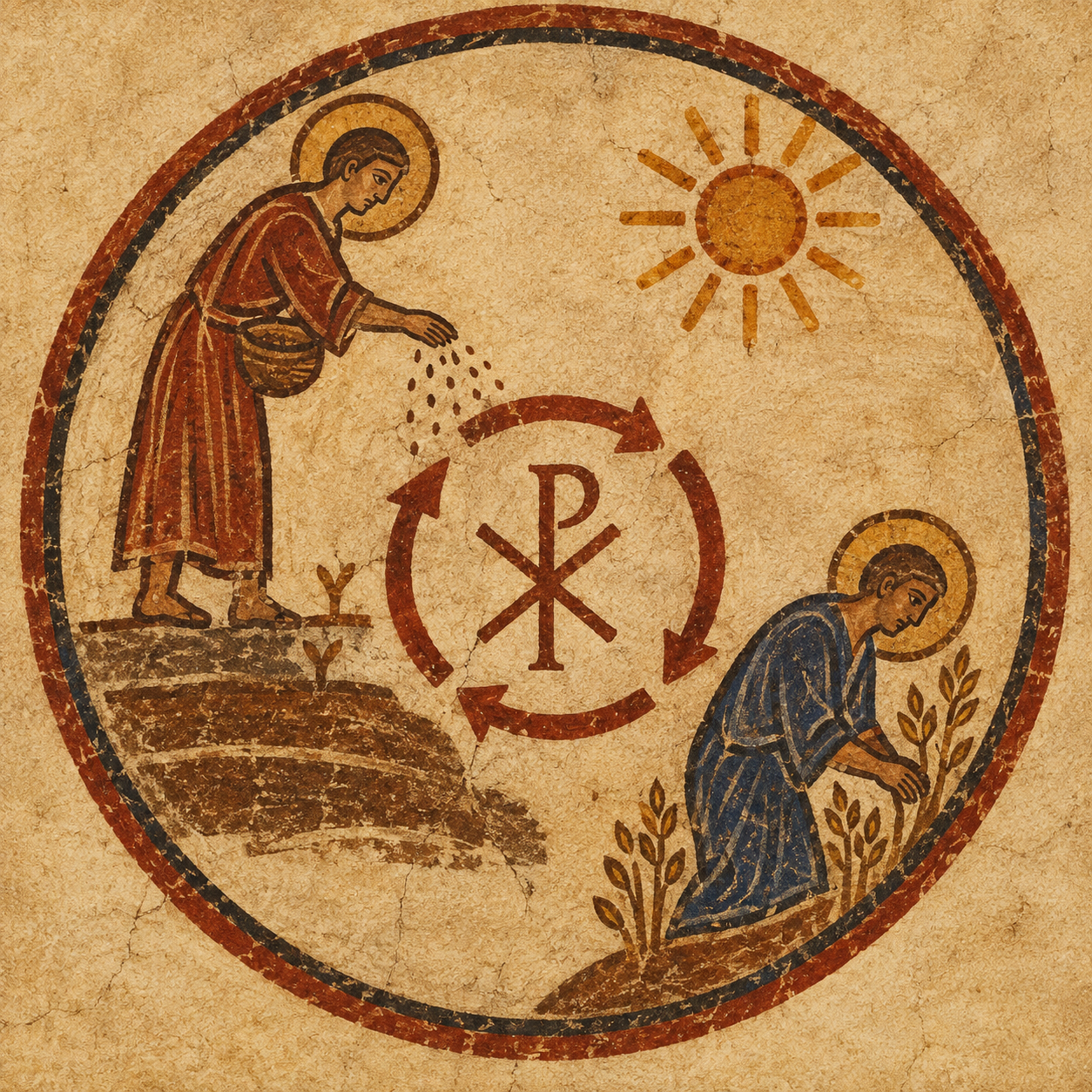
Unsurprisingly, the Sanskrit word “karma” – literally meaning “action,” “deed,” or “work” – does not appear anywhere in either the Old or New Testaments of the Bible. It would be very surprising if it did, seeing as the authors of both Testaments did not write in Sanskrit but rather in Hebrew and Greek. But the basic fundamental principle and idea of what Indians – and nowadays many Westerners too – call “karma,” is indeed in the Bible. The following quotations are from the New Testament but numerous verses expressing the same thing can also be found in the Old Testament, or what to Judaism is simply the Testament: the Tanakh or Hebrew Bible.
It can be seen from what follows that this principle of action and reaction, or sowing and reaping, is dealt with in Christian scripture from a purely ethical perspective, not touching upon the metaphysics or ontology of the principle. While the latter is interesting to know about and to endeavour to comprehend, it is its ethical aspect which is by far the most important. One can know all the metaphysical and esoteric theory provided by Theosophy but unless one puts it into practice in the circumstances and situations of one’s daily life, it is virtually worthless. These clear and simple expressions of the Law can provide us with just the reminders we need for practical application.
Unfortunately, many Christians largely overlook, ignore, or neglect such passages as these, due to the belief that simply asking God’s forgiveness will automatically undo any negative effects of one’s sins or misdeeds – no matter how wicked they might be – and will erase the cosmic record of the action in question, and absolve one of any responsibility for it, because of it being covered by the atonement wrought by Jesus when he suffered and shed his blood upon the cross. This belief and attitude is for the most part a Protestant thing and is not found in the older forms of Christianity (i.e. Roman Catholicism and Eastern Orthodoxy) nor in the Bible. These verses given below are part of the proof that the Protestants, or at least the majority of them, are not following the scripture which they claim to be their sole theological authority as closely as they might think.
Catholics come closest to the idea of karma, in saying that Jesus’ sacrifice on the cross provides forgiveness from eternal punishment for one’s sins (provided one sincerely repents of them) but does not do away with what is termed temporal punishment. There will still be unavoidable material consequences flowing back to oneself from one’s actions, they say, and these will have to be faced and – if the actions were bad – suffered and atoned for by oneself. It is further claimed that by deliberately doing good, selfless, and charitable deeds, one can more swiftly atone and can also to some degree preempt the temporal punishments thereby. Since they do not believe in reincarnation, the intermediate afterlife state of purgatory fills the role of where the unexpended temporal punishments still outstanding at the time of one’s death are suffered and expiated.
Although there are differences with the Theosophical teachings, there are also many profound similarities in this. But these quotes – which are by no means all of those which express such ideas – are not about the process or mechanisms of “temporal punishment” but about the simple principle that whatever you sow, you will reap, and that whatever you do to your neighbour will be done back to you. Who is your neighbour? Anyone and everyone you encounter.
~ * ~
“Bear one another’s burdens, and so fulfil the law of Christ. . . . let each one test his own work, . . . For each man will have to bear his own load. . . . Do not be deceived; God is not mocked, for whatever a man sows, that he will also reap. For he who sows to his own flesh will from the flesh reap corruption; but he who sows to the Spirit will from the Spirit reap eternal life. And let us not grow weary in well-doing, for in due season we shall reap, if we do not lose heart.” (The Apostle Paul, Galatians 6:2, 4-5, 7-9)
“Then Jesus said to him, “Put your sword back into its place; for all who take the sword will perish by the sword.”” (Matthew 26:52)
“If any one slays with the sword, with the sword must he be slain.” (The Apostle John, Revelation 13:10)
“And the harvest of righteousness is sown in peace by those who make peace.” (James 3:18)
“And I saw the dead, great and small, standing before the throne, and books were opened. Also another book was opened, which is the book of life. And the dead were judged by what was written in the books, by what they had done. And the sea gave up the dead in it, Death and Hades gave up the dead in them, and all were judged by what they had done.” (The Apostle John, Revelation 20:12-13)
“”Behold, I am coming soon, bringing my recompense, to repay every one for what he has done. I am the Alpha and the Omega, the first and the last, the beginning and the end.”” (Jesus Christ, Revelation 22:12-13)
“Blessed are the merciful, for they shall obtain mercy.”
“Make friends quickly with your accuser . . . lest your accuser hand you over to the judge, . . . and you be put in prison; truly, I say to you, you will never get out till you have paid the last penny.”
“For if you forgive men their trespasses, your heavenly Father also will forgive you; but if you do not forgive men their trespasses, neither will your Father forgive your trespasses.”
“Judge not, that you be not judged. For with the judgment you pronounce you will be judged, and the measure you give will be the measure you get.”
“So whatever you wish that men would do to you, do so to them; for this is the law and the prophets.” (Jesus Christ, from the Sermon on the Mount: Matthew 5:7, 25-26, 6:14-15, 7:1-2, 12)
“And as you wish that men would do to you, do so to them. . . . Judge not, and you will not be judged; condemn not, and you will not be condemned; forgive, and you will be forgiven; give, and it will be given to you; . . . For the measure you give will be the measure you get back.” (Jesus Christ, from the Sermon on the Mount: Luke 6:31, 37-38)
“Therefore you have no excuse, O man, whoever you are, when you judge another; for in passing judgment upon him you condemn yourself, . . . But by your hard and impenitent heart you are storing up wrath for yourself . . . For he [God] will render to every man according to his works . . . There will be tribulation and distress for every human being who does evil, the Jew first and also the Greek [or Gentile, i.e. non-Jews], but glory and honour and peace for every one who does good, the Jew first and also the Greek. For God shows no partiality.” (The Apostle Paul, Romans 2:1, 5-6, 9-11)
“If possible, so far as it depends upon you, live peaceably with all. Beloved, never avenge yourselves, but leave it to the wrath of God; for it is written, “Vengeance is mine, I will repay, says the Lord.” . . . Do not be overcome by evil, but overcome evil with good.” (The Apostle Paul, Romans 12:18-19, 21)
“Above all hold unfailing your love for one another, since love covers a multitude of sins.” (1 Peter 4:8)
“If any one thinks he is religious, and does not bridle his tongue but deceives his heart, this man’s religion is vain. Religion that is pure and undefiled before God and the Father is this: to visit orphans and widows in their affliction, and to keep oneself unstained from the world. . . . If you really fulfil the royal law, according to the Scripture, “You shall love your neighbour as yourself,” you do well. But if you show partiality, you commit sin, and are convicted by the law as transgressors. . . . The tongue is an unrighteous world among our members, staining the whole body, setting on fire the wheel of birth, and set on fire by hell.” (James 1:26-27, 2:8-9, 3:6)
~ * ~
This article may have raised more questions about various things. Please make use of the site search function (the magnifying glass symbol at the top of the page) and visit the Articles page to see the complete list of over 400 articles covering all aspects of Theosophy and the Theosophical Movement. You may be interested to read the other articles listed on that page under the heading “CHRISTIANITY, JUDAISM, ISLAM” and those listed under “THE LAW OF KARMA.”
The article The Truths and Untruths of Vicarious Atonement closely relates to this one.
~ BlavatskyTheosophy.com ~

