
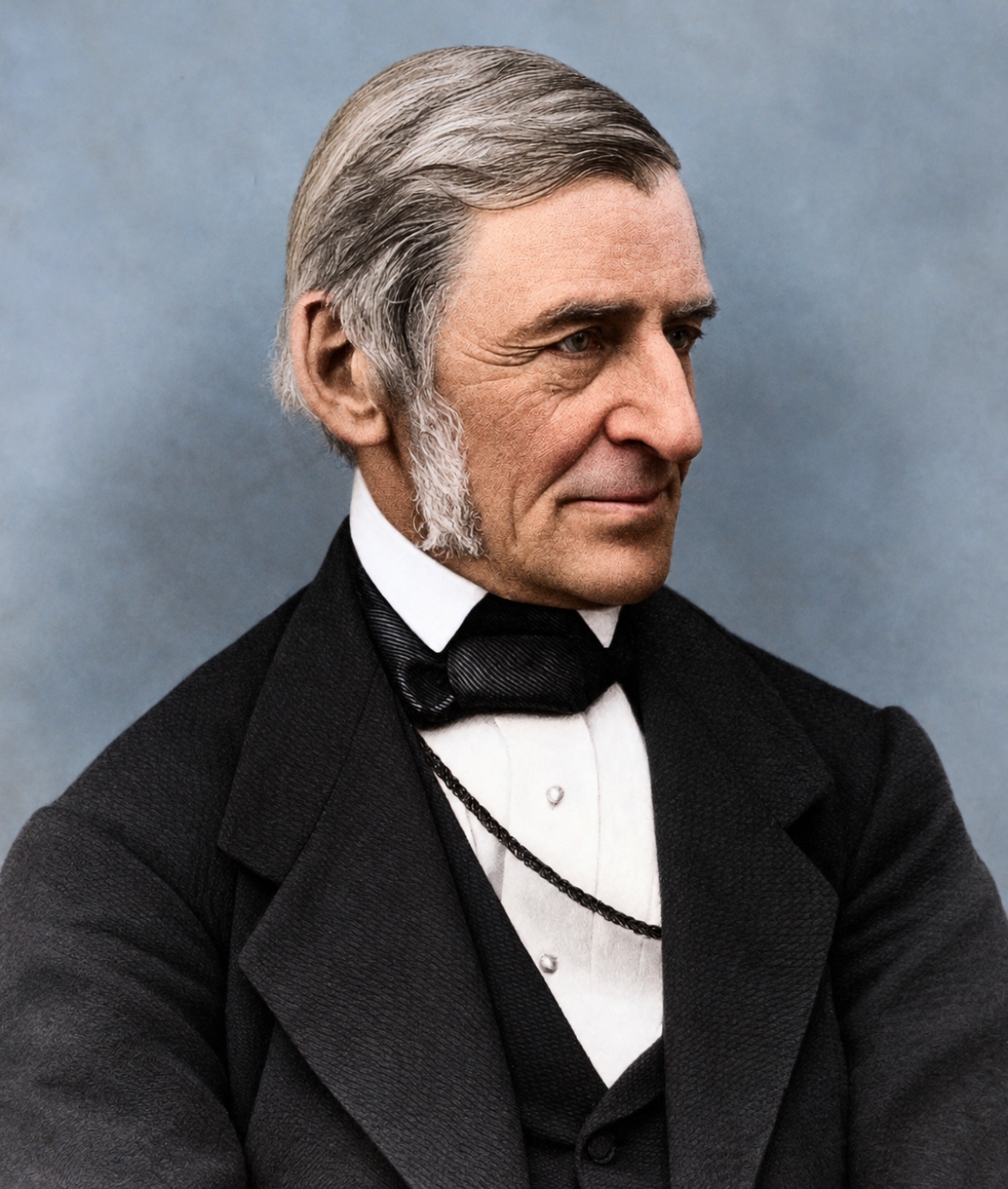
AN ARTICLE TITLED “PRECURSORS OF H. P. B. – RALPH WALDO EMERSON” FROM “THEOSOPHY” MAGAZINE, NOVEMBER 1935, PUBLISHED BY THE UNITED LODGE OF THEOSOPHISTS IN LOS ANGELES, CALIFORNIA, USA
In the Library at Concord, Massachusetts, there stands a bust of the American philosopher, Ralph Waldo Emerson. The face of this bust is asymmetrical. That is to say, if the face is viewed from two different angles, it presents the appearance of two different men.
This physical characteristic seems to permeate the whole of Emerson’s nature. If we look at his mind from two different angles it, too, seems to belong to two different men. On the one side we see the shrewdness and analytical quality of the West; on the other side the calmness and meditative quality of the East. At one moment the poet, the dreamer is present; at the next moment the shrewd Yankee who sold his apples in the Concord market and saw to it that they brought the highest price. His religious views present the same characteristic. Today he seems to be a devout Christian; tomorrow an equally devout Buddhist or Brahmin. He is, in other words, a living example of that law which he so consistently taught throughout his life — the law of opposites. Everything in the Universe, he says, is dual; everything has its opposite.
And it requires the union of these two opposites to make the perfect whole.
And so, taking him at his word, we must unite the two seeming opposites in Emerson’s nature if we would understand the man as a whole. When we have done this, we will see that his description of Plato is in reality an excellent description of himself :
“The unity of Asia and the detail of Europe are in his brain. Metaphysics and natural philosophy expressed the genius of Europe; he substructs the religion of Asia as the base. In short, a balanced soul was born, perceptive of the two elements.” — Plato: the Philosopher.
But even to regard Emerson as a whole is not enough. In order to really understand him, we must look at him as a part of a still larger whole. His philosophy must be considered in its relation to that complete system of thought known as Theosophy; his life-work must be considered in its relation to the Theosophical Movement.
Considering the fact that Emerson never called himself a Theosophist, and that his life was well-nigh spent before the Theosophical Movement of the last century was publicly launched, what right have we to presume that his work was in any way connected with Theosophy? H. P. Blavatsky herself answers the question.
In an article [“The Cycle Moveth”] written in 1890 she says:
“Thousands of men and women who belong to no church, sect or society, who are neither Theosophists nor Spiritualists, are yet virtually members of that Silent Brotherhood the units of which often do not know each other, belonging as they do to nations far and wide apart, yet each of whom carries on his brow the mark of the mysterious Karmic seal — the seal that makes of him or her a member of the Brotherhood of the Elect of Thought. Having failed to satisfy their aspirations in their respective orthodox faiths, they have severed themselves from their Churches in soul when not in body, and are devoting the rest of their lives to the worship of loftier and purer ideals than any intellectual speculation can give them. . . . Carrying in the silent shrine of their soul the same grand ideals as all mystics do, they are in truth Theosophists de facto if not de jure.”
And so, taking H. P. B.’s own words as our standard of judgment, we can easily see that Emerson, as well as many others not calling themselves Theosophists, were in reality forging some of those invisible links that connected the Theosophical Movements of the 18th and 19th centuries. Let us remember that the Messengers sent out periodically in the last quarter of every century westward had appeared that time in vain. St. Germain and Cagliostro went down into history as clever charlatans. The only man whose powers and knowledge could have been easily tested by exact science — Friedrich Anton Mesmer — had been hooted from the scientific arena by the greatest “scholars” of Europe. Therefore it was left to men other than professed Theosophists to carry on the work of the Theosophical Movement of the 18th century and to plough the ground for the Messenger of the 19th.
Emerson must have had an intuitive perception that his work was to plough the field for one greater than himself, for as early as 1838 he addressed the Senior Class of Divinity College in Cambridge with these pregnant words.
“I look to that supreme Beauty, which ravished the souls of those Eastern men, to speak in the West also. I look for the new Teacher, who shall follow so far those shining laws, that he shall see them come full circle; shall see their rounding complete grace; shall see the world to be the mirror of the soul; shall see the identity of the law of gravitation with purity of heart; and shall show that Duty is one thing with science, with Beauty and with Joy.”
The bond that unites Emerson with Theosophy and the Theosophical Movement is the same bond that unites Theosophists, wherever and however situated. It is the bond of similarity of aim, purpose and teaching. Emerson’s aim and purpose were the same as the three Objects of the Theosophical Society. He constantly reiterated the Brotherhood of man and nature. He always encouraged the study of comparative religions, sciences and philosophies, and followed himself the advice he gave to others along this line. He continually pointed to the spiritual powers latent in man and urged their development.
The method used by Emerson in expounding his own philosophy and that used by H. P. B. in writing her Secret Doctrine were curiously similar. Both disclaimed any authority for statements made. Both tried to arouse the intuitive perception of their readers. Both used the method of analogy, correspondence and symbols.
The three Fundamental Propositions which form the basis of Theosophy were also the basis of Emerson’s philosophy. His doctrine was that of Unity in diversity and he proclaimed the presence of the One Life in the whole of Nature. He considered Polarity, or the Law of action and reaction as the fundamental Law of the Universe. He pointed to the presence of the God within man himself, and urged ‘‘self-induced and self-devised efforts” as the only means by which man’s evolution can proceed.
The net of destiny, woven from the threads of heredity, environment and family traditions, was tightly drawn around Ralph Waldo Emerson from the day of his birth. His family Karma was interwoven with the Church, for most of his forefathers, from the very first one who landed on American shores, were clergymen, of one denomination or another. He was born in the Parish House of the First Unitarian Church in Boston, where his father was minister. His formative years were filled with a struggle between the call of the Church and his family expectations on the one hand, and his own inner convictions on the other. The dictates of family duty led him finally into a luke-warm adoption of the ministerial profession, where he hoped to achieve the substance by practicing the form. His inner conviction finally triumphed, and he severed his connection with the Church. His rebellion against Christianity as it was taught and practised in the Churches was openly and fearlessly expressed to the Senior Class of Divinity College:
“Historical Christianity has fallen into the error that corrupts all attempts to communicate religion. As it appears to us, it is not the doctrine of the soul, but the exaggeration of the personal, the ritual. It dwells with noxious exaggeration about the person of Jesus. The soul knows no persons. By this monarchy of a Christianity, which indolence and fear have built, the friend of man is made the injurer of man.”
As the worship of the personality of Jesus was decried by Emerson, it is not surprising to find him opposed to the idea of a personal God. He revolted against the dual concept of God as presented by Paley and Calvin, and recorded in his Journals his reverence of the Oriental conception of the impersonality of Brahman. To Emerson, God was “. . . not a relation, or a part, but the whole. Being is the vast Affirmative, swallowing up all relations, parts and times within Itself.”
Emerson’s concept of God is thus seen to be identical with the Theosophical concept, which denies a personality to the Universal Principle, the Root of all, from which all proceeds, and into which all will finally be re-absorbed. The Theosophist finds God in every atom of the Cosmos, visible and invisible. It is Law itself, and consequently admits of no miracle. As Emerson says:
“The word Miracle, as pronounced by Christian Churches, gives a false impression. It is Monster!”
As Emerson’s God was no Person outside of man, the futility of prayer was apparent to him. He says:
“Men’s prayers are a disease of the will. Prayer that craves a particular commodity is vicious. Prayer is the contemplation of the facts of life from the highest point of view. It is the soliloquy of a beholding and jubilant soul. But prayer as a means to effect a private end is theft and meanness. It supposes dualism and not Unity in nature and consciousness. As soon as the man is one with God, he will not beg. He will then see all prayer in action.”
Every Theosophist recognizes the absurdity of addressing a verbal prayer to an Absolute Principle. But every Theosophist knows the efficacy of what might be called Will-Prayer, addressed not to an outside God, but to the ‘‘Father” within himself. “Pray not — but act” is the Theosophist’s prayer. And where is the Theosophist who would not applaud Emerson’s advice to the Divinity students on that afternoon in July when he told them to “dare to love God without a mediator or veil” and to “acquaint themselves first-hand with Deity?”
Creeds and sects were viewed in their true light by Emerson — as separative and destructive to the true purpose of religion. A creed was to him a “disease of the intellect,” a sect “an inelegant incognito devised to save a man from the vexation of thinking.” He said that a really wise man would refuse to belong to any creed or sect, as these were only “Unthinking Corporations.”
Emerson’s religious revolt was always against the narrowness and bigotry of churches and creeds, his aim to present the Unity of all religions and the Brotherhood of man, irrespective of race, creed, color or religious affiliations. He felt that behind all religions there must be a common source from which all had sprung, a common basis in which all could be united. He says:
“The accepted Christianity of the mob of churches is now, as always, a caricature of the real. The heart of Christianity is the heart of all philosophies. Can any one doubt that if the noblest saint among the Buddhists, the noblest Mahometan, the highest Stoic of Athens, the purest and wisest Christian, Confucius in China, Spinoza in Holland, could somewhere meet and converse together, they would all find themselves of one religion? And all would find themselves denounced by their sects, and sustained by those believed adversaries of their sects?”
He believed that there was an “obscure and slender thread” that ran through all religions, philosophies and mythologies, tying them together. If he had lived a few years longer he would have found that “obscure and slender thread” in the string that H. P. B. used to tie together the ‘‘nosegay of culled flowers” which she brought to the Western world.
But that “thread’’ had not yet become visible during Emerson’s years of search. Therefore, having failed to find it in the West, he turned to the ancient East for inspiration and guidance. As he says in “The American Scholar”:
“When the intervals of darkness come, as come they must, when the sun is hid, and the stars withdraw their shining, — we repair to the lamps that were kindled by their ray, to guide our steps to the East again, where the dawn is. We hear, that we may speak.”
Having kindled his own torch at the flame of Eastern lamps, he held it aloft so that his own people might see the dangerous waters into which the bark of Western civilization was slowly but surely drifting, and turn their prow toward the East. He boldly rebuked the men of his time for wasting their strength and energy in riding, hunting and brandy-drinking, as well as for the solemn gravity with which they viewed the absurd follies they called life. He pointed to “Orientalism” as the only remedy for their ‘‘musty, self-conceited lives.’’
He feared that his advice might shock some of them, but assured them that in the doctrines of the ancient East they would find ‘‘a thunder never heard before, a light never seen before, a power that trifles with time and space.”
Emerson’s interest in the East appears very early in his life. He began jotting down his thoughts in his Journals at the age of sixteen, and one soon comes upon references to India. By the time he was nineteen he was already reading translations of Indian texts and writing poetry of a decidedly Eastern character. In his twenty-seventh year the central idea of his poem Brahma appeared in his Journal, and that same year he wrote:
“There is nothing for me but to read the Vedas. It contains every religious sentiment, all the grand ethics which visit each noble poetic mind.”
Emerson possessed one of the first copies of the Bhagavad-Gita sent to this country. In regard to this book he says:
“It was the first of books; it was as if an empire spoke to us, nothing small or unworthy, but large, serene, consistent, the voice of an old intelligence which in another age and another climate had pondered and thus disposed of the same questions which exercise us.”
He called the Zoroastrian, Indian and Persian Scriptures ‘‘majestic, and more to our daily purpose than this year’s almanac or this day’s paper.” His admiration of Buddhism is seen in his comparison of it with Transcendentalism. Buddhism, he says,
“. . . is the necessary or structural action of the human mind. Buddhism read literally, the Tenet of Fate, Worship of Morals, or the Tenet of Freedom, are the unalterable originals in all the wide varieties of geography, language and intelligence of the human tribes.”
The inspiration of Emerson’s philosophy has often been traced to Plato, and Emerson’s own statement that “out of Plato come all things that are still written and debated among men” has been taken to mean that Emerson considered Plato as the original and central sun of philosophical thought. On the contrary, Plato was to him only the focal point in which the spiritual and intellectual rays of the East met and converged. As every Theosophist knows, Plato’s teachings were merely reiterations of truths uttered centuries before by such sages as Vyasa, Kapila and Patanjali, and the Platonic philosophy was merely a compendium of ancient systems. Emerson says in his Essay on Plato:
“Plato, in Egypt and in Eastern pilgrimages, imbibed the idea of one Deity in which all things are absorbed. Having paid his homage to the Illimitable, he then stood erect, and for the human race affirmed: “All things are knowable!” That is, the Asia in his mind was first heartily honored. . . . The unity of Asia and the detail of Europe Plato came to join, and, by contrast, to enhance the energy of each.”
As the teachings of Plato were closely associated in the mind of Emerson with those of the ancient East, so also was the relationship between the purely Platonic teachings and those of the later Neo-Platonists clearly recognized. Augustine, the Bishop of Hippo, admitted that the doctrines taught in the Alexandrian School were the original esoteric doctrines of Plato, and Porphyry has shown the philosophy of Plato as having been taught and illustrated in the Mysteries. When we stop to consider the fact that one of the most important missions of the present Theosophical Movement is to revive the work commenced by Ammonius Saccas, the efforts of Emerson along this line assume a deeper significance. For it was largely due to his efforts that the mind of the American people was led to a reconsideration of the teachings of Neo-Platonism and Platonism, and through them back to the doctrines of the ancient East.
And so, in considering Emerson’s life-work in its relation to the Theosophical Movement, we can see that he forged three important cyclical links in preparation of the fourth.
He helped to re-establish the five thousand year cycle by bringing back the words of Krishna in the Bhagavad-Gita. He linked that cycle with the twenty-five hundred year cycle by turning the mind of the West back to Plato and the Buddha, and showing the connection of their teachings with the more ancient ones of Krishna. Through calling attention to the work of the Alexandrian School, he strengthened the fifteen hundred year cycle — the cycle of reincarnation. Uniting these three links into a chain of perfect continuity, he paved the way for the Teacher in whom all three cycles converged — H. P. Blavatsky, the Messenger of 1875.
~ * ~
“It may seem ludicrous to suggest that Emerson was the chief forerunner of Madame Blavatsky, her John the Baptist. Yet seriously, without Emerson, Madame Blavatsky could hardly have launched her gospel when she did with equal hope of success. There is every justification for the assertion that Emerson’s Orientalistic contribution to the general Transcendental trend of thought was preparatory to Theosophy. It must not be forgotten that his advocacy of Brahmanic ideas and doctrines came at a time when the expression of a laudatory opinion of the Asiatic religions called forth an opprobrium from evangelistic quarters hardly less than vicious in its bitterness. Theosophy could not hope to make headway until the virulent edge of that orthodox prejudice had been considerably blunted. It was Emerson’s magnanimous eclecticism which administered the first and severest rebuke to that prejudice, and inaugurated that gradual mollification of sentiment toward the Orientals which made possible the welcome which Hindu Yogis and Swamis received toward the end of the century.” (Alvin Boyd Kuhn, “Theosophy: A Modern Revival of Ancient Wisdom”)
“To obtain a glimpse of the first Theosophists, we will have to retrace the footsteps of hundreds of generations. To return for a moment to the dim traditions of “our abysmal past” as Mr. Tyndall would eloquently say — and name the four primitive Rishis — Agni, Vâyu, Aditya and Angiras, who, under the inspiration of the Omnipresent Spirit (Sarva Vipayas) gave utterance [to] the four Vedas. It is such men as these who knew of no other Deity but that which dwelt in them as they felt themselves inseparable from It, that Emerson must have had in his mind when writing his Essay on the Oversoul.
“Alone Emerson, one of the most transcendental idealists of our century, in his Essay on the Oversoul gives in a few words the most superb definition of the psychological states above referred to. Speaking of the commingling of the individual with the Universal Soul, he describes it by saying: “I, the imperfect, adore my own Perfect.” Among those who come right under Vaughan’s definition of Theosophists, Emerson stands conspicuous.” (H. P. Blavatsky, “Theosophy: The Essence of Philosophy and Science”)
Regarding “Vaughan’s definition of Theosophists,” HPB explains in her article “What is Theosophy?” – “[Robert] Vaughan offers a far better, more philosophical definition. “A Theosophist,” he says — “is one who gives you a theory of God or the works of God, which has not revelation, but an inspiration of his own for its basis.” In this view every great thinker and philosopher, especially every founder of a new religion, school of philosophy, or sect, is necessarily a Theosophist. Hence, Theosophy and Theosophists have existed ever since the first glimmering of nascent thought made man seek instinctively for the means of expressing his own independent opinions.” Please see What is Theosophy and Who is a Theosophist? for elaboration on this.
~ * ~
EMERSON ON THE OVER-SOUL
Emerson’s term “Over-Soul” or “Oversoul” is the one that surfaces most often in the writings and phraseology of H. P. Blavatsky. As just seen, she was particularly keen on his famous essay of that title. In Theosophical literature, the Over-Soul is most frequently spoken of as the Universal Over-Soul, by which is meant the Logos. It is thus generally given a macrocosmic rather than microcosmic application. Emerson’s essay, however, is clearly referring almost solely to the microcosmic. But HPB does in fact occasionally use the term in a microcosmic sense:
“As a general law, the Highest God, the Over-soul of the human being (Atma-Buddhi), only over-shadows the individual during his life, for purposes of instruction and revelation; or as Roman Catholics – who erroneously call that Over-soul the “Guardian Angel” – would say, “It stands outside and watches.” But in the case of the theophanic mystery, it incarnates itself in the Theurgist for purposes of revelation.” (“Some Reasons for Secrecy”)
“A natural-born mystic, he followed, as did his master Plotinus, the pure Indian Râj-Yoga training, which leads to the union of the Soul with the Over-Soul or Higher Self (Buddhi-Manas).” (“The Theosophical Glossary” p. 257, Entry for “Porphyry”)
Putting these quotes together, we can see that the Over-Soul in man is one’s Monad-Ego or Spiritual Triad: the conjunction and integral unity of Atman, Buddhi, and the Higher Manas; in short, our own Inner God. But this Lord within, this immaculate “beam of Light,” is an individualised ray belonging to the immeasurably vast collective aggregate of all such “Light-Beings” in the Universe. Hence the term “Over-Soul” can apply at either the macrocosmic or microcosmic levels, for the distinction between the two is rather illusory. Yet one does not need to have a firm grasp on such metaphysics in order to appreciate Emerson’s inspiring and beautiful “Over-Soul” text, which, like his work in general, is predominantly mystical rather than occult. (See Occultism and Mysticism for an explanation of the distinction and interrelation between the two.)
Excerpts from “The Over-Soul” by Ralph Waldo Emerson
Man is a stream whose source is hidden. Our being is descending into us from we know not whence.
The Supreme Critic on the errors of the past and the present, and the only prophet of that which must be, is that great nature in which we rest, as the earth lies in the soft arms of the atmosphere; that Unity, that Over-soul, within which every man’s particular being is contained and made one with all other; that common heart, of which all sincere conversation is the worship, to which all right action is submission; . . . and which evermore tends to pass into our thought and hand, and become wisdom, and virtue, and power, and beauty.
We live in succession, in division, in parts, in particles. Meantime within man is the soul of the whole; the wise silence; the universal beauty, to which every part and particle is equally related; the eternal ONE.
And this deep power in which we exist, and whose beatitude is all accessible to us, is not only self-sufficing and perfect in every hour, but the act of seeing and the thing seen, the seer and the spectacle, the subject and the object, are one.
We see the world piece by piece, as the sun, the moon, the animal, the tree; but the whole, of which these are the shining parts, is the soul. Only by the vision of that Wisdom can the horoscope of the ages be read, and by falling back on our better thoughts, by yielding to the spirit of prophecy which is innate in every man, we can know what it saith.
My words do not carry its august sense; they fall short and cold. Only itself can inspire whom it will, and behold! their speech shall be lyrical, and sweet, and universal as the rising of the wind. Yet I desire, even by profane words, if I may not use sacred, to indicate the heaven of this deity, and to report what hints I have collected of the transcendent simplicity and energy of the Highest Law.
All goes to show that the soul in man is not an organ, but animates and exercises all the organs; is not a function, like the power of memory, of calculation, of comparison, but uses these as hands and feet; is not a faculty, but a light; is not the intellect or the will, but the master of the intellect and the will; is the background of our being, in which they lie, — an immensity not possessed and that cannot be possessed.
From within or from behind, a light shines through us upon things, and makes us aware that we are nothing, but the light is all. A man is the facade of a temple wherein all wisdom and all good abide. What we commonly call man, — the eating, drinking, planting, counting man, — does not, as we know him, represent himself, but misrepresents himself. Him we do not respect, but the soul, whose organ he is, would he let it appear through his action, would make our knees bend. When it breathes through his intellect, it is genius; when it breathes through his will, it is virtue; when it flows through his affection, it is love.
And the blindness of the intellect begins, when it would be something of itself. The weakness of the will begins, when the individual would be something of himself. All reform aims, in some one particular, to let the soul have its way through us; in other words, to engage us to obey.
As there is no screen or ceiling between our heads and the infinite heavens, so is there no bar or wall in the soul where man, the effect, ceases, and God, the cause, begins. The walls are taken away. We lie open on one side to the deeps of spiritual nature, to the attributes of God.
The soul . . . She has no dates, nor rites, nor persons, nor specialties, nor men. The soul knows only the soul; the web of events is the flowing robe in which she is clothed.
The heart which abandons itself to the Supreme Mind finds itself related to all its works, and will travel a royal road to particular knowledges and powers.
Persons themselves acquaint us with the impersonal. In all conversation between two persons, tacit reference is made, as to a third party, to a common nature. That third party or common nature is not social; it is impersonal, is God.
As it is present in all persons, so it is in every period of life. It is adult already in the infant man. The soul is the perceiver and revealer of truth. We are wiser than we know.
We distinguish the announcements of the soul, its manifestations of its own nature, by the term Revelation. These are always attended by the emotion of the sublime. For this communication is an influx of the Divine mind into our mind.
A certain tendency to insanity has always attended the opening of the religious sense in men, as if they had been “blasted with excess of light.” The trances of Socrates, the “union” of Plotinus, the vision of Porphyry, the conversion of Paul, the aurora of Behmen, the convulsions of George Fox and his Quakers, the illumination of Swedenborg, are of this kind. What was in the case of these remarkable persons a ravishment has, in innumerable instances in common life, been exhibited in less striking manner. Everywhere the history of religion betrays a tendency to enthusiasm. The rapture of the Moravian and Quietist; the opening of the internal sense of the Word, in the language of the New Jerusalem Church; the revival of the Calvinistic churches; the experiences of the Methodists, — are varying forms of that shudder of awe and delight with which the individual soul always mingles with the universal soul.
The nature of these revelations is the same; they are perceptions of the absolute law. Revelation is the disclosure of the soul.
It is not in an arbitrary “decree of God,” but in the nature of man, that a veil shuts down on the facts of to-morrow; for the soul will not have us read any other cipher than that of cause and effect.
Thus is the soul the perceiver and revealer of truth. By the same fire, serene, impersonal, perfect, which burns until it shall dissolve all things into the waves and surges of an ocean of light, — we see and know each other, and what spirit each is of.
Your genius will speak from you, and mine from me. That which we are, we shall teach, not voluntarily, but involuntarily. The infallible index of true progress is found in the tone the man takes. If he have not found his home in God, his manners, his forms of speech, the turn of his sentences, the build, shall I say, of all his opinions, will involuntarily confess it, let him brave it out how he will. If he have found his centre, the Deity will shine through him, through all the disguises of ignorance, of ungenial temperament, of unfavourable circumstance.
The same Omniscience flows into the intellect, and makes what we call genius. Much of the wisdom of the world is not wisdom, and the most illuminated class of men are no doubt superior to literary fame, and are not writers. Among the multitude of scholars and authors, we feel no hallowing presence; we are sensible of a knack and skill rather than of inspiration; they have a light, and know not whence it comes, and call it their own; their talent is some exaggerated faculty, some overgrown member, so that their strength is a disease. In these instances the intellectual gifts do not make the impression of virtue, but almost of vice; and we feel that a man’s talents stand in the way of his advancement in truth.
But genius is religious. It is a larger imbibing of the common heart. It is not anomalous, but more like, and not less like other men.
This energy does not descend into individual life on any other condition than entire possession. It comes to the lowly and simple; it comes to whomsoever will put off what is foreign and proud; it comes as insight; it comes as serenity and grandeur. When we see those whom it inhabits, we are apprised of new degrees of greatness. From that inspiration the man comes back with a changed tone.
The soul that ascends to worship the great God is plain and true; has no rose-colour; no fine friends; no chivalry; no adventures; does not want admiration; dwells in the hour that now is, in the earnest experience of the common day, — by reason of the present moment and the mere trifle having become porous to thought, and bibulous of the sea of light.
Ineffable is the union of man and God in every act of the soul. The simplest person, who in his integrity worships God, becomes God; yet forever and ever the influx of this better and universal self is new and unsearchable; ever it inspires awe and astonishment.
When we have broken our god of tradition, and ceased from our god of rhetoric, then may God fire the heart with his presence.
It is the doubling of the heart itself, nay, the infinite enlargement of the heart with a power of growth to a new infinity on every side. It inspires in man an infallible trust. He has not the conviction, but the sight, that the best is the true, and may in that thought easily dismiss all particular uncertainties and fears, and adjourn to the sure revelation of time, the solution of his private riddles. He is sure that his welfare is dear to the heart of being. In the presence of law to his mind, he is overflowed with a reliance so universal, that it sweeps away all cherished hopes and the most stable projects of mortal condition in its flood. He believes that he cannot escape from his good. The things that are really for you gravitate to you.
The heart in you is the heart of all.
Let man, then, learn the revelation of all nature, and all thought to his heart; this, namely; that the Highest dwells with him; that the sources of nature are in his own mind, if the sentiment of duty is there. But if he would know what the great God speaketh, he must “go into his closet and shut the door,” as Jesus said. God will not make himself manifest to cowards. He must greatly listen to himself, withdrawing himself from all the accents of other men’s devotion. When I sit in that presence, who shall dare to come in? When I rest in perfect humility, when I burn with pure love, what can Calvin or Swedenborg say?
Great is the soul, and plain. It is no flatterer, it is no follower; it never appeals from itself. It always believes in itself.
The soul gives itself, alone, original, and pure, to the Lonely, Original, and Pure, who, on that condition, gladly inhabits, leads, and speaks through it. Then is it glad, young, and nimble. It is not wise, but it sees through all things. It is not called religious, but it is innocent.
Behold, it saith, I am born into the great, the universal mind. I, the imperfect, adore my own Perfect. I am somehow receptive of the great soul, . . . More and more the surges of everlasting nature enter into me, and I become public and human in my regards and actions. So come I to live in thoughts, and act with energies, which are immortal.
Thus revering the soul, and learning, as the ancient said, that “its beauty is immense,” man will come to see that the world is the perennial miracle which the soul works, and be less astonished at particular wonders; he will learn that there is no profane history; that all history is sacred; that the universe is represented in an atom, in a moment of time. He will weave no longer a spotted life of shreds and patches, but he will live with a divine unity.
He will cease from what is base and frivolous in his own life, and be content with all places and with any service he can render. He will calmly front the morrow in the negligency of that trust which carries God with it, and so has already the whole future in the bottom of the heart.
~ * ~
This article may have raised more questions about various things. Please make use of the site search function (the magnifying glass symbol at the top of the page) and visit the Articles page to see the complete list of over 400 articles covering all aspects of Theosophy and the Theosophical Movement.
~ BlavatskyTheosophy.com ~

