
The term “permanent astral” is quite commonly used by students of Theosophy associated with the United Lodge of Theosophists. The phrase is not used in any other Theosophical groups or organisations, for it appears to originate within the writings of Robert Crosbie, the founder of the ULT.
Neither H. P. Blavatsky nor William Q. Judge used the specific expression “permanent astral” or “permanent astral body.” Nonetheless, the idea underlying this expression is indeed taught by them as being a truth, a sacred reality of the occult life. But although every living human being has an astral body, we do not automatically have a permanent astral. In fact, the vast majority of human beings do not.
In “The Secret Doctrine” by HPB, we find this passage:
“Enoch [referred to in the Bible, in Genesis, as having been “taken up by God” rather than undergoing ordinary death] . . . Enoichion means in Greek the “inner eye,” or the Seer; in Hebrew, and with the help of Masoretic points it means the initiator and instructor, הֲנוֹךְ. It is a generic title; besides which his legend is that of several other prophets, Jewish and heathen, with changes of made-up details, the root-form being the same. Elijah is also taken up into Heaven alive; and the astrologer, at the court of Isdubar, the Chaldean Hea-bani, is likewise raised to heaven by the god Hea, who was his patron, as Jehovah was of Elijah (whose name means in Hebrew “God-Jah,” Jehovah, אֶלְיהׇ), and again of Elihu, which has the same meaning. This kind of easy death, or euthanasia [Note: HPB is not using the term here in its modern medical meaning but in its simple, literal, etymological meaning of an “easy death” or “painless death”], has an esoteric meaning. It symbolises the death of any adept who has reached the power and degree, as also the purification, which enable him to die only in the physical body and still live and lead a conscious life in his astral body. The variations on this theme are endless, but the secret meaning is ever the same. The Pauline expression (Hebrews xi. 5) “that he should not see death” — ut non videret mortem — has thus an esoteric meaning, but nothing supernatural in it.” (Vol. 2, p. 530-531)
In the original Theosophical literature, there are two types of “permanent astral body” (we may as well use this term, as the most convenient currently available) referred to:
(1) The attainment by an Initiate of a permanent, though physically invisible, subtle body, in which the individual can continue to consciously live and function on other planes after the death of their physical body, as well as during the sleep or trance state of the physical body. Such a body is necessary for one to be able to practically help humanity – and aid the Masters of Wisdom in so doing – in a deep and potent way, beyond a purely material, surface level assistance. This is what almost all Theosophists who speak of the “permanent astral” have exclusively in mind, often because they have not noticed or read attentively the descriptions of the other type, as follows.
(2) The deliberate refining of one’s whole being in such a way – through intensive and prolonged training, self-discipline, and self-mastery: mentally, morally, and materially – that as the cells of one’s dense physical body wear out and dissipate (as they do routinely in a periodical and cyclical manner, for everyone) no new matter of the same grade of physical density is attracted or generated to replace them, and they are instead replaced by a densifying of one’s astral body, so that eventually, even before one’s karmically appointed date of death, one has in fact already “died” – albeit imperceptibly to and unsuspected by anyone else – so far as one’s original outer shell or impermanent material casing is concerned. Instead, one now lives – here in this physical world – in a body which is not by nature physical but which has been “physicalised” by certain occult methods. The inhabitant of such a body – who inevitably can only be an Adept – can thus continue to live and labour in this world under the same appearance and as the same personality for an extremely long time, without ever having to be interrupted or hindered by ageing, decay, sickness, or death. This extremely long time far surpasses the roughly 200-300 years that an Adept may be able to live in an ordinary physical body of dense matter, the latter longevity largely being achieved by almost entirely suspending the heartbeat and all bodily functions (through the will) when putting the body to sleep at night, so that it wears out about half as slowly as it otherwise would.
Although we cannot know for sure what the interrelation is between these two types of “permanent astral,” it seems safe to say that although many Adepts may not choose to develop the second type of form (which we prefer to call the “densified astral,” so as to lessen confusion), those who do develop that second type could only do so if they have already attained – whether previously or in parallel – the first type, i.e. that permanent subtle body that belongs to another plane than the physical.
The “densified astral” is the subject of a lengthy article titled “The Elixir of Life,” written in 1882 by Godolphin Mitford (who had spent time personally with Masters of the Trans-Himalayan Brotherhood but later became a failed chela and died an ignominious and premature death) and published in the book “Five Years of Theosophy.” It is also spoken of, in slightly more veiled and more esoteric language, in the book “The Dream of Ravan,” which was viewed highly by H. P. Blavatsky. And HPB herself once wrote:
“When an Adept reaches during his lifetime that state of holiness and purity that makes him “equal to the Angels,” then at death his apparitional or astral body becomes as solid and tangible as was the late body, and is transformed into the real man. . . . See the explanations given on the subject in “The Elixir of Life,” by G. M. (From a Chela’s Diary), Five Years of Theosophy. . . . The old physical body, falling off like the cast-off serpent’s skin, the body of the “new” man remains either visible or, at the option of the Adept, disappears from view, surrounded as it is by the Akashic shell that screens it. . . . The Adept has the option of renouncing conscious Nirvana and rest, to work on earth for the good of mankind. This he can do in a two-fold way: either, as above said, by consolidating his astral body into physical appearance, he can reassume the self-same personality; or he can avail himself of an entirely new physical body, whether that of a newly-born infant or – as Shankaracharya is reported to have done with the body of a dead Rajah – by “entering a deserted sheath,” and living in it as long as he chooses. This is what is called “continuous existence.” . . . Such is the doctrine taught, everyone having the choice of either fathoming it still deeper, or of leaving it unnoticed.” (“Some Reasons for Secrecy”)
As was recounted in Guru Nanak and Sikhism in The Light of Theosophy, there are numerous attestations throughout religious history to the attainment of such a body, including the post-mortem testimonies regarding Guru Nanak, Adi Shankaracharya, Jnaneshvar (author of the Dnyaneshwari), the 19th century Hindu sage Ramalingam Pillai, and, most famously of all, Jesus Christ, his resurrection, empty tomb, and mysterious resurrection-body. It also has partial similarities – at least with regard to the spiritually self-induced gradual dissolution of one’s material form while still alive – with the much-lauded attainment in Tibetan Buddhism of the “Rainbow Body” or Jalü.
But in both of these cases, which astral body is it that is so transformed?
Most students of Original Theosophy would respond that the human constitution contains only one astral body, namely the Linga Sharira, also called the astral double, ethereal double, vital double, the design-body or model-body, etc. and that it must therefore be this which the Initiate transforms into a condition of permanence.
It is understandable why many think this, seeing as that is indeed the way things are usually presented and spoken about by H. P. Blavatsky and her closest colleague William Judge. But as we showed in The Question of The Etheric Body, Astral Body, and Other Bodies, their writings do occasionally distinctly show that that is not the whole picture.
In particular, it is in HPB’s article “Dialogues between The Two Editors: On Astral Bodies, or Doppelgangers” that she explains that we each have three main astral bodies: the “double” just spoken of, the “thought body” or “dream body,” and the “causal body.” As the term “astral” is one of extremely generic and loose usage in the original Theosophical literature, it is often found to be applied to almost anything non-physical and invisible. The causal body, for example, is termed “the spiritual body” and treated as the innermost, highermost vesture of the soul, yet it is also called “astral.”
In the article just linked to, we commented:
“The fact that [according to HPB] the Linga Sharira (a) cannot be separated or projected very far from the physical body during life, (b) is inactive and intermeshed with the physical body during sleep, and (c) after death stays close by the physical body and “disintegrates, pari passu, with the corpse,” “dies or fades out, with the disappearance of the last atom of the body” (“The Theosophical Glossary” p. 190, Entry for “Linga Sharira”), “finally dissipates when the last particles of the body disintegrate” (“Tibetan Teachings”), seems to indicate that this is a body with a strong magnetic attraction towards Earth, or the physical plane.”
In “The Elixir of Life,” although “G.M.” at first makes it sound like it is the Linga Sharira which is specially densified into material objectivity, he does provide a brief clarification:
“Our astral, vital body — the fourth of the seven [principles] (having attracted and assimilated to itself the second) and which is so much more ethereal than the physical one — may be made to harden its particles to the atmospheric changes. The whole secret is to succeed in evolving it out, and separating it from the visible; and while its generally invisible atoms proceed to concrete themselves into a compact mass, to gradually get rid of the old particles of our visible frame so as to make them die and disappear before the new set has had time to evolve and replace them.”
“Our astral, vital body” is usually the definition of the second principle of our Seven Principles, namely the Linga Sharira, the astral double on and around which our physical body or Sthula Sharira is built. But we see Mitford specifying that he is referring to “the fourth of the seven” principles, which thereby associates it with the Kama principle or Kama-Manas (see Understanding Our Seven Principles) and, in terms of subtle bodies, with what HPB calls the Thought Body, the “higher astral” body, from which the Mayavi-Rupa (“apparitional body”) is a projection. Mitford elaborates that he is speaking of the higher astral body “having attracted and assimilated to itself the second” principle, i.e. the Linga Sharira.
So this generically named “astral body” which can be sufficiently densified (by the very few who have the full knowledge of how) as to make it visible, tangible, and functional in this physical world as a substitute for the mortal, physical body (Sthula Sharira), is really an amalgamation or coalescence of two of our subtle bodies.
Similarly, we will notice that William Judge and Robert Crosbie try to discourage us from assuming that the first type of “permanent astral” is simply the Linga Sharira made permanent.
In an article titled “The Permanent Astral” in the May 1955 issue of “Theosophical Notes,” issued by the American Theosophist Victor Endersby, who for many decades was involved with the United Lodge of Theosophists, it is stated:
“This subject is little spoken of in Theosophy except in some esoteric circles, where it is generally erroneously conceived. It is also a subject that lends itself especially to materialization of ideas and all sorts of pseudo-theosophic notions. In part this is due to the inability of English to convey metaphysical conceptions properly, and the lack of a philosophical basis among English – or French, German, or other language nationalities, – by which the metaphysics of Sanskrit and allied tongues could be understood.
“One of the most common errors is to think of the “astral body” as merely a form identical with the physical and contained within it, and capable of being drawn from it as a sword is drawn from a sheath. This is not the condition.
“An Adept, acting consciously, and some others, acting unconsciously, can appear at a distance to other persons, the simulacrum showing great accuracy in detail. This, sometimes called an “astral projection,” and sometimes “Mayavi Rupa” – the latter when used by an Adept – is not the astro-physical Linga Sarira or “pattern body.” It is a form of another “principle,” so to say, of the total astral body, in which there is much more than usually conceived.”
Endersby goes on to quote from the article “Culture of Concentration” by William Q. Judge. We will now do the same:
“There must be in us a power of discernment, the cultivation of which will enable us to know whatever is desired to be known. That there is such a power is affirmed by teachers of occultism, and the way to acquire it is by cultivating concentration.
“It is generally overlooked, or not believed, that the inner man who is the one to have these powers has to grow up to maturity, just as the body has to mature before its organs fulfill their functions fully. By inner man I do not mean the higher self — the Ishwara before spoken of, but that part of us which is called soul, or astral man, or vehicle, and so on. All these terms are subject to correction, and should not be held rigidly to the meanings given by various writers. . . .
“Now while it is quite true that the second — or inner man — has latent all the powers and peculiarities ascribed to the astral body, it is equally true that those powers are, in the generality of persons, still latent or only very partially developed.
“This inner being is, so to say, inextricably entangled in the body, cell for cell and fibre for fibre. He exists in the body somewhat in the way the fibre of the mango fruit exists in the mango. In that fruit we have the inside nut with thousands of fine fibres spreading out from it through the yellow pulp around. And as you eat it, there is great difficulty in distinguishing the pulp from the fibre. So that the inner being of which we are speaking cannot do much when away from his body, and is always influenced by it. It is not therefore easy to leave the body at will and roam about in the double. The stories we hear of this as being so easily done may be put down to strong imagination, vanity, or other causes. One great cause for error in respect to these doubles is that a clairvoyant is quite likely to mistake a mere picture of the person’s thought for the person himself. In fact, among occultists who know the truth, the stepping out of the body at will and moving about the world is regarded as a most difficult feat, and for the reasons above hinted at. Inasmuch as the person is so interwoven with his body, it is absolutely necessary, before he can take his astral form about the country, for him to first carefully extract it, fibre by fibre, from the surrounding pulp of blood, bones, mucous, bile, skin, and flesh. Is this easy? It is neither easy nor quick of accomplishment, nor all done at one operation. It has to be the result of years of careful training and numerous experiments. And it cannot be consciously done until the inner man has developed and cohered into something more than irresponsible and quivering jelly. This development and coherence are gained by perfecting the power of concentration. . . .
“Most of us remain quite close to our slumbering forms. It is not necessary for us to go away in order to experience the different states of consciousness which is the privilege of every man, but we do not go away over miles of country until we are able, and we cannot be able until the necessary ethereal body has been acquired and has learned how to use its powers.
“Now, this ethereal body has its own organs which are the essence or real basis of the senses described by men. The outer eye is only the instrument by which the real power of sight experiences that which relates to sight; the ear has its inner master – the power of hearing, and so on with every organ. . . .
“Ordinarily there is no demarcation to be observed between these inner organs and the outer; the inner ear is found to be too closely interknit with the outer to be distinguished apart. But when concentration has begun, the different inner organs begin to awake, as it were, and to separate themselves from the chains of their bodily counterparts. Thus the man begins to duplicate his powers. His bodily organs are not injured, but remain for use upon the plane to which they belong, and he is acquiring another set which he can use apart from the others in the plane of nature peculiarly theirs.
“We find here and there cases where certain parts of this inner body have been by some means developed beyond the rest. Sometimes the inner head alone is developed, and we have one who can see or hear clairvoyantly or clairaudiently; again, only a hand is developed apart from the rest, all the other being nebulous and wavering. It may be a right hand, and it will enable the owner to have certain experiences that belong to the plane of nature to which the right hand belongs, say the positive side of touch and feeling.
“But in these abnormal cases there are always wanting the results of concentration. They have merely protruded one portion, just as a lobster extrudes his eye on the end of the structure which carries it. . . .
“In the course of the growth of this ethereal body several things are to be observed.
“It begins by having a cloudy, wavering appearance, with certain centres of energy caused by the incipiency of organs that correspond to the brain, heart, lungs, spleen, liver, and so on [i.e. such energy centres within the subtle body are called in Sanskrit “chakras”]. It follows the same course of development as a solar system, and is, in fact, governed and influenced by the very solar system to which the world belongs on which the being may be incarnate. With us it is governed by our own solar orb [i.e. the sun].
“If the practice of concentration be kept up, this cloudy mass begins to gain coherence and to shape itself into a body with different organs. As they grow they must be used. Essays are to be made with them, trials, experiments. In fact, just as a child must creep before it can walk, and must learn walking before it can run, so this ethereal man must do the same. But as the child can see and hear much farther than it can creep or walk, so this being usually begins to see and to hear before it can leave the vicinity of the body on any lengthy journey.
“Certain hindrances then begin to manifest themselves which, when properly understood by us, will give us good substantial reasons for the practicing of the several virtues enjoined in holy books and naturally included under the term of Universal Brotherhood.”
The article delineates four such major hindrances:
ANGER – When anger arises, whose influence “is at once felt by the ethereal body” – “this nebulous forming body is violently shaken, or pulled apart, or burst into fragments that at once have a tendency to fly back into the body and take on the same entanglement that we spoke of at first.” Unfortunately, students who are careless and superficial in their reading sometimes say that this means that anger shatters and destroys our Linga Sharira and that this applies to every human being, aspiring occultist or not. Not only does the context show that this is not what Judge is talking about, but if it were, we would all have died long ago, for we have all known anger since an early age, and if our Linga Sharira were even once to be shattered and destroyed, our Sthula Sharira or physical body would instantly die.
ENVY – “The ethereal form may have assumed quite a coherence and definiteness. But it is observed that, instead of being pure and clear and fresh, it begins to take on a cloudy and disagreeable color, the precursor of putrefaction, which invades every part and by its effects precludes any further progress, and at last reacts upon the student so that anger again manifests itself. This is the effect of envy.”
VANITY – “As in one case related to me. The man had made considerable progress, but at last allowed vanity to rule. This was followed by the presentation to his inner sight of most extraordinary images and ideas, which in their turn so affected him that he attracted to his sphere hordes of elementals seldom known to students and quite indescribable in English. These at last, as is their nature, laid siege to him, and one day produced all about the plane of his astral body an effect similar in some respects to that which follows an explosion of the most powerful explosive known to science. The consequence was, his ethereal form was so suddenly fractured that by repercussion the whole nature of the man was altered, and he soon died in a madhouse after having committed the most awful excesses.”
FEAR – “This is not, however, the worst of all, and is one that will disappear by means of knowledge, for fear is always the son of ignorance. Its effect on the ethereal form is to shrivel it up, or coagulate and contract it. But as knowledge increases, that contraction abates, permitting the person to expand. Fear is the same thing as frigidity on the earth, and always proceeds by the process of freezing.”
That was from Part I of “Culture of Concentration.” Part II, published some time later, includes these passages:
“Success in the culture of concentration is not for him who sporadically attempts it. It is a thing that flows from “a firm position assumed with regard to the end in view, and unremittingly kept up.” Nineteenth Century [as also 21st century!] students are too apt to think that success in occultism can be reached as one attains success in school or college, by reading and learning printed words. A complete knowledge of all that was ever written upon concentration will confer no power in the practice of that about which I treat. Mere book knowledge is derided in this school as much as it is by the clodhopper; not that I think book knowledge is to be avoided, but that sort of acquisition without the concentration is as useless as faith without works. It is called in some places, I believe, “mere eye-knowledge.” . . .
“In starting these papers the true practice was called Raj Yoga [i.e. Raja Yoga, but not to be confused or identified with Hindu teachings and practices bearing this name; there are many commonalities but also many differences between the Raja Yoga of Theosophy and of Hinduism.] It discards those physical motions, postures, and recipes relating solely to the present personality, and directs the student to virtue and altruism as the bases from which to start. This is more often rejected than accepted. So much has been said during the last 1800 years about Rosicrucians, Egyptian Adepts, Secret Masters, Kaballah, and wonderful magical books, that students without a guide, attracted to these subjects, ask for information and seek in vain for the entrance to the temple of the learning they crave, because they say that virtue’s rules are meant for babes and Sunday-schools, but not for them. And, in consequence, we find hundreds of books in all the languages of Europe dealing with rites, ceremonies, invocations, and other obscurities that will lead to nothing but loss of time and money. But few of these authors had anything save “mere eye-knowledge.” . . . Let the seeker know, once for all, that the virtues cannot be discarded nor ignored; they must be made a part of our life, and their philosophical basis must be understood.
“But it may be asked, if in the culture of concentration we will succeed alone by the practice of virtue. The answer is No, not in this life, but perhaps one day in a later life. The life of virtue accumulates much merit; that merit will at some time cause one to be born in a wise family where the real practice of concentration may perchance begin; or it may cause one to be born in a family of devotees or those far advanced on the Path, as said in Bhagavad-Gita. But such a birth as this, says Krishna, is difficult to obtain; hence the virtues alone will not always lead in short space to our object.
“We must make up our minds to a life of constant work upon this line.”
A few decades later, Judge’s pupil and faithful supporter Robert Crosbie would produce an article (published today in “The Friendly Philosopher” and “Universal Theosophy”) also titled “Culture of Concentration,” in which we read:
“Now as soon as we begin to make the effort to control the mind, and desire to know and to assume the position of the inner man, the effort and the assumption bring an accession of power and of steadiness. We have started something going in the astral body. What were before merely centers of force around which organs were builded now tend to become separate astral organs. A gradual building of those organs goes on within us, until in the completion of our effort we have an astral body, with all the organs of the physical completely synthesized, and we are beyond the vicissitudes [i.e. the changes, challenges, and impermanence] of physical existence; we have the power of the action of the astral body. The astral body is even more complete and effective on its own plane than our bodily instrument here on the physical plane, for it has a wider range of action in its seven super-senses, where physically we have use of only five senses.”
Reviewing Judge’s article, Victor Endersby remarks:
“Some important points are to be noted from the above. First of all, the development of the “permanent astral” is fairly synonymous with the development of adeptship, and that in turn, with the subjugation of the worldly and personal faults mentioned [i.e. the conquering and complete eradication of anger, envy, vanity, and fear]. It is also shown that it can be developed by training. This training has to be on the basis of “self-induced and self-devised” efforts, which are the disciple’s contribution; but the specific technique must come from a higher source of knowledge than his own.”
We mentioned at the start that the specific term “permanent astral” seemingly originates with Robert Crosbie. The term is found several times in his “Answers To Questions on The Ocean of Theosophy,” published as a book some years after his death. Here are the excerpts in which he answers questions on the subject:
“The “permanent astral” . . . It is a body formed of astral substance during a life-time by the reincarnating ego; when so formed it remains with all its powers and functions as the astral form for succeeding lives. In ordinary cases, a new astral is projected for each birth, with nothing but the acquired tendencies as a starting point.” (p. 71)
“Kama is not an instrument or means by which the action or contact takes place [i.e. our Kama or desire-principle is not to be understood as a vehicle of consciousness, in which one can independently function and interact with existence on any level]; it is a basis or motive in use by the actor; the instruments are the astral and physical body. The astral body is a transitory aspect of the substance of the Inner Man in all cases where the “personality” has not been reduced to a cipher as a basis for conscious action. The exceptions are where the being has formed a “permanent astral.” It may be conceived that the Masters have a permanent astral and something more, by which any kingdom of nature or state of matter may be contacted.” (p. 82)
“Q. What is the difference between the permanent and the ordinary astral body?
“A. The ordinary astral is constructed on the basis of the skandhas, while the permanent astral is constructed during life on the basis of the aspirations and self-induced efforts, out of astral substance, but not exactly of the earthly astral substance. If one building a permanent astral gives way to anger or evil feelings in any direction, he spoils his building, but the old skandhic astral body is left in full play. One with a permanent astral never has a Kama loka, nor a Devachan, for he knows too much, and cannot be drawn into those conditions. Then he comes back, working not only with tendencies, but with aspirations, knowledge and effort, which are permanent.” (p. 168-169)
“The “permanent astral” is formed during life from the elements belonging to the Real Man, the Ego. The ordinary astral is formed for each birth before conception. It is governed by the karma to be expended in the next life ensuing. One does not necessarily come from the other, but [both are] formed from the spiritual substance — or body — of the Ego. Astral body is merely a generic term. The term “astral” is used for everything beyond the physical. But, it should be understood that as on the physical we have earth, water, air and fire as divisions of this plane, so on the astral plane are similar divisions. The astral form that corresponds to earth [i.e. the Linga Sharira, or “astral double”] remains with the physical body and dissipates with it. The one that corresponds to water is that state of astral substance which forms the kama-rupa [i.e. the “astral” shell formed in Kama Loka after death]; the one that corresponds to the air is the manasic [i.e. mental] body [i.e. both this and the previous one are covered by what HPB calls the “Thought Body”]; and the one that corresponds to fire is the seat of consciousness, the body of the thinker [i.e. the Body of the Ego referred to earlier; the Egoic Body or Spiritual Body; that which HPB identifies with the Causal Body, and which seems to be one’s Aura in its highest and most divine sense; the highermost, innermost vesture of the Soul]. Our earthly fire is the lowest grade of divine substance.
“Only those who have arrived at a certain stage of development or initiation return to incarnation with a “permanent astral.” All others form a new astral for each incarnation.
“That is why they don’t bring the memory through; they haven’t established it on this plane. The permanent astral is the astral permeated, changed, refined by the fire of consciousness and thus made permanent.” (p. 247-248)
So the “permanent astral,” which is “formed during life” from elements and aspects pertaining or belonging to one’s Spiritual Body (the Causal Body; the energy-field of our Higher Ego or Inner God) which is the Body of Fire or Fiery Body, is “permeated” by that pure spiritual fire, “changed” by it, “refined” by it, and thereby “made permanent” by it. This being so, the “permanent astral” must therefore also be strongly associated with fire.
But what is the generically termed “the astral” which Crosbie says is the thing which is made permanent by that “fire of consciousness”? We personally understand it to be what HPB calls the Thought Body, which in the ordinary person could also be termed the Kama-Manasic Body and would correlate with air and water in Crosbie’s schema. However, we know that the Kama principle is “bled from all impure desire” by the serious aspirant on the esoteric Path, leaving only the basic and neutral Kamic energy for the Initiate’s constructive use. Thus the “astral” or subtle body that is “made permanent” and becomes “the permanent astral” would be that body which corresponds to the element of air, and which Crosbie calls “the manasic body.”
So we are talking about a permanent mental body, or the Thought Body (which HPB calls an “astral” body in the very generic sense of the word) made permanent. Crosbie’s wording makes clear that the formation of the “permanent astral” is not the formation of something totally new but rather the transformation, or transmutation, of something that already exists. Transformed and refined by spiritual fire, smelted by the heat of unrelenting spiritual aspiration, it is truly an alchemical process.
In none of what we have read so far has the Sanskrit word “Nirmanakaya” been used. But those who are familiar with “The Voice of The Silence” (translated by HPB from the Book of the Golden Precepts) and its many mentions of the Nirmanakaya – both as a synonym for a Bodhisattva and “the Bodhisattvic body” (p. 42) – will naturally be wondering whether the “permanent astral” and the “Nirmanakaya vesture” are the same thing.
The reason some have doubted that they are the same is that we tend to associate the word “astral” with things of a far lower grade or degree of manifestation than what we imagine the Nirmanakaya Body to be. This obstacle is done away with, however, if we remember that “astral” is so generic a term in the original Theosophical literature that it can apply to almost anything non-physical. The term therefore does not always automatically mean something low, psychic, or unspiritual, although admittedly it often does.
There may possibly be instances where a permanent astral vesture is not the Nirmanakaya vesture. But for the purposes of this article, we may say, at the very least, that the Nirmanakaya vesture is a permanent astral vesture. It could also be called “the permanent Inner Body” if so preferred.
Notice HPB’s wording in “The Voice of The Silence” when explaining what the Nirmanakaya – literally meaning “transformation body,” “emanation body,” or “manifestation body” – is:
“Nirmanakaya . . . is that ethereal form which one would assume when leaving his physical he would appear in his astral body – having in addition all the knowledge of an Adept. The Bodhisattva develops it in himself as he proceeds on the Path. Having reached the goal and refused its fruition, he remains on Earth, as an Adept; and when he dies, instead of going into Nirvana, he remains in that glorious body he has woven for himself, invisible to uninitiated mankind, to watch over and protect it.” (explanatory endnote, p. 96, original edition)
She continues:
“Thus, to be enabled to help humanity, an Adept who has won the right to Nirvana, “renounces the Dharmakaya body” in mystic parlance; keeps, of the Sambhogakaya, only the great and complete knowledge, and remains in his Nirmanakaya body. The esoteric school teaches that Gautama Buddha with several of his Arhats is such a Nirmanakaya, higher than whom, on account of the great renunciation and sacrifice to mankind there is none known.” (explanatory endnote, p. 97, original edition)
This truly permanent “astral body” or “ethereal form” is described as “that glorious body,” a vehicle “self-woven” of “glorified” ethereal material, or subtle matter that has been raised up to a far higher pitch or quality than it would otherwise ordinarily have:
“Out of the furnace of man’s life and its black smoke, winged flames arise, flames purified, that soaring onward, ‘neath the Karmic eye, weave in the end the fabric glorified of the three vestures of the Path.
“These vestures are: Nirmanakaya, Sambhogakaya, and Dharmakaya, robe Sublime.” (p. 32, original edition)
Those three Buddha-Bodies or Trikaya are all the resultant of great spiritual merit and virtue, says the text, but only the Nirmanakaya can directly help, assist, and serve suffering humanity. The Nirmanakaya’s “robe” is a humble, self-denying, and self-sacrificing one.
“No longer can the perfect Buddhas, who don the Dharmakaya glory, help man’s salvation.” (p. 32)
“To live to benefit mankind is the first step. To practise the six glorious virtues [i.e. the six Paramitas or transcendental perfections, which lead to and culminate in the seventh: Prajna or Wisdom] is the second.
“To don Nirmanakaya’s humble robe is to forego eternal bliss for Self, to help on man’s salvation. To reach Nirvana’s bliss, but to renounce it, is the supreme, the final step — the highest on Renunciation’s Path.
“Know, O Disciple, this is the Secret PATH, selected by the Buddhas of Perfection, who sacrificed The SELF to weaker Selves.” (p. 33)
It has been suggested – and seems reasonable – that when the event spoken of in Christianity as the Transfiguration occurred, Christ (the great Master and Avatar) was allowing his closest and most trusted disciples a glimpse of his Nirmanakaya body, i.e. his true form. What they saw is certainly described in the three synoptic Gospels as something “glorious” and “glorified”:
“And after six days Jesus took with him Peter and James and John his brother, and led them up a high mountain apart. And he was transfigured before them, and his face shone like the sun, and his garments became white as light.” (Matthew 17:1-2)
“And after six days Jesus took with him Peter and James and John, and led them up a high mountain apart by themselves; and he was transfigured before them, and his garments became glistening, intensely white, as no fuller on earth could bleach them.” (Mark 9:2-3)
“Now about eight days after these sayings he took with him Peter and John and James, and went up on the mountain to pray. And as he was praying, the appearance of his countenance was altered, and his raiment became dazzling white.” (Luke 9:28-29)
“The students of Esoteric Philosophy see in the Nazarene Sage a Bodhisattva with the spirit of Buddha Himself in Him.” (H. P. Blavatsky, “The Mystery of Buddha”)
This brings to mind the remarkable vision – or rather, out-of-body experience – of American Theosophist James Morgan Pryse, who wrote about it to William Q. Judge in 1889:
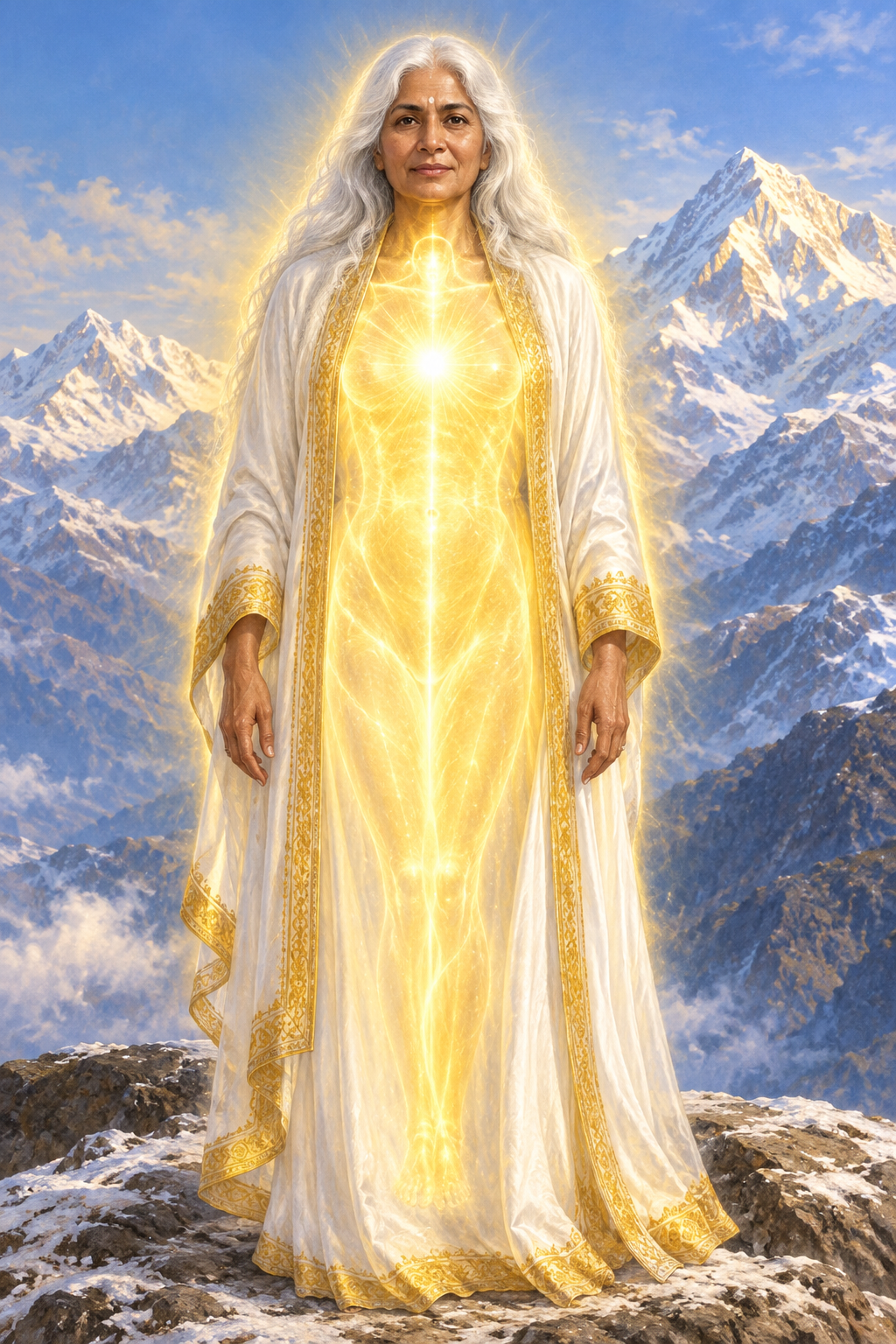
“I was drawn out of my body and immediately was standing “in the astral” beside H.P.B. in London. It was along toward morning there, but she was still seated at her writing desk. While she was speaking to me, very kindly, I could not help thinking how odd it was that an apparently fleshy old lady should be an Adept. I tried to put that impolite thought out of my mind, but she read it, and as if in answer to it her physical body became translucent, revealing a marvellous inner body that looked as if it were formed of molten gold.”
If so inclined, one could well dismiss that as a purely subjective psychic experience to which no weight should be attached. But whatever one thinks of it (and bear in mind that Judge considered it a genuine experience and perception; see Who are you, Madame Blavatsky?), it provides valuable food for thought as to the “marvellous inner body” – glorious and golden – possessed by initiated Adepts.
Victor Endersby sums up the subject by saying:
“There are a very few who, by karmic inheritance of the results of efforts in the past, or current help from Adepts which is likely to remain unknown to their conscious minds – can project a mayavi rupa, and do have a “permanent astral” in embryo at least. But the very fact that the possessor of a developed permanent astral has no Devachan or Kama Loka, and is a Dharmakaya, a Sambhogakaya, or Nirmanakaya, shows the immense gulf that yawns between the wishful thinking and the reality. One who has no Kama Loka is also one who has no personal passions in this life, of whatever kind. One who has no Devachan has arrived at such a perfect understanding of karma that he is unable to feel a sense of injustice as concerns himself, no matter what he suffers or at whose hands; for even the slightest sense of injustice or personal wrong means an immersion in Devachan as inevitable compensation. [Note: See Can There Be Unmerited Suffering? for elaboration on the preceding point.] This should give any individual a good idea, by looking himself over, as to just how far he is likely to have developed this vehicle. Above all, should heed be taken of the remarks on vanity. It is usually, almost invariably, that people imagine themselves to be at the advanced stage of the “permanent astral,” simply because of vanity. Take note of the effects of this fault – the particularly deadly effects. It is also fairly sure that anyone interested in developing the permanent astral is far from the detachment required.” (“The Permanent Astral,” “Theosophical Notes” May 1955)
Some of these remarks by Endersby may seem unduly harsh. While they are intended to do away with self-delusion regarding one’s progress, they could potentially have the effect of making one believe that they realistically stand next to no chance of making any significant and practical occult progress in this present life. There is a danger of going from being overly optimistic to overly pessimistic.
While it is surely true that it is extremely rare for someone to possess a fully developed and completely functional “permanent astral” vehicle, there must be many who – often unknown and unsuspected by themselves – have a partially developed “permanent astral.” Anyone who has followed the Masters’ Path in previous lifetimes, and who has made a reasonably good degree of progress in meditative concentration (Dharana, which is what so much of this hinges on) and ethical discipline and self-purification – anyone, in short, who has some definite proficiency in real Raja Yoga – may well have a “permanent astral” in one or another stage of formation and coherency.
“Hope still. For if the “Secret Path” is unattainable this “day,” it is within thy reach “to-morrow.” Learn that no efforts, not the smallest – whether in right or wrong direction – can vanish from the world of causes.” (“The Voice of The Silence” p. 34, original edition)
“In this system of Yoga no effort is wasted, nor are there any evil consequences, and even a little of this practice delivereth a man from great risk.” (Krishna in the Bhagavad Gita, Ch. 2, p. 15, William Q. Judge rendition)
Endersby’s statement that “It is also fairly sure that anyone interested in developing the permanent astral is far from the detachment required,” may at first seem not to make sense. After all, didn’t the Masters gain such a vehicle because They had the intention and determination to persist with the right Path until it was developed? And aren’t They Masters of Detachment, among many other things?
The key seems to be in the focus and the motive. If one harbours a personal, self-seeking desire to cultivate a “permanent astral” because one wants to enjoy the powers, experiences, and whatever else that goes along with it; if one’s interest is in developing the “permanent astral” – essentially for its own sake – rather than one’s interest being in selflessly serving and aiding humanity and supporting the Masters; if one wants a Bodhisattvic Body without developing a Bodhisattvic consciousness . . . one has certainly missed the whole point and whatever one might, with great difficulty, manage to succeed in developing, will not be the glorious and noble “permanent astral” body as known to and enjoyed by the blessed Initiates, Mahatmas, Nirmanakayas, of the Great White Lodge.
“Both physical and astral matter . . . as well as bodies formed from them, are subject to disintegration. Disintegration into what? Why, into the [elemental] “lives” that compose them.
“The “permanent astral” will then be seen to be the individualized embodiment of “universal brotherhood,” that kind of “conditioned being” which is “at home” on any plane, because in conscious and compassionate harmony with “the Life and the lives” on all planes.
“Genuine reflection upon what is implicit in the phrase, “permanent astral,” discloses it as both the secret of immortality and the secret of death. It is the “vesture” alike of the Dharmakaya, the Sambhogakaya, and the Nirmanakaya. It is yet to be “woven” by the men of our humanity.” (“The “Permanent Astral,”” “Theosophy” Magazine, September 1934)
It is ultimately a matter of initiation, a matter of acquiring permanent, unbroken continuity of consciousness, of building and travelling the internal “Antahkarana” path, of spiritual regeneration through Kundalini, of the opening of the Third Eye. All these and many other factors are all indelibly linked together. It is a long, gradual, difficult, and daunting Path. But if you wish to tread it, take courage from Those who have already trodden it before you, those Great Ones who have become a living sacrifice of love for your benefit and that of all humanity.
~ * ~
This article may have raised more questions about various things. Please make use of the site search function (the magnifying glass symbol at the top of the page) and visit the Articles page to see the complete list of over 400 articles covering all aspects of Theosophy and the Theosophical Movement. As well as those linked to throughout the present article, those listed on the Articles page under “THE MASTERS” and “SPIRITUAL LIVING AND PRACTICE” may be of particular interest.
~ BlavatskyTheosophy.com ~

