
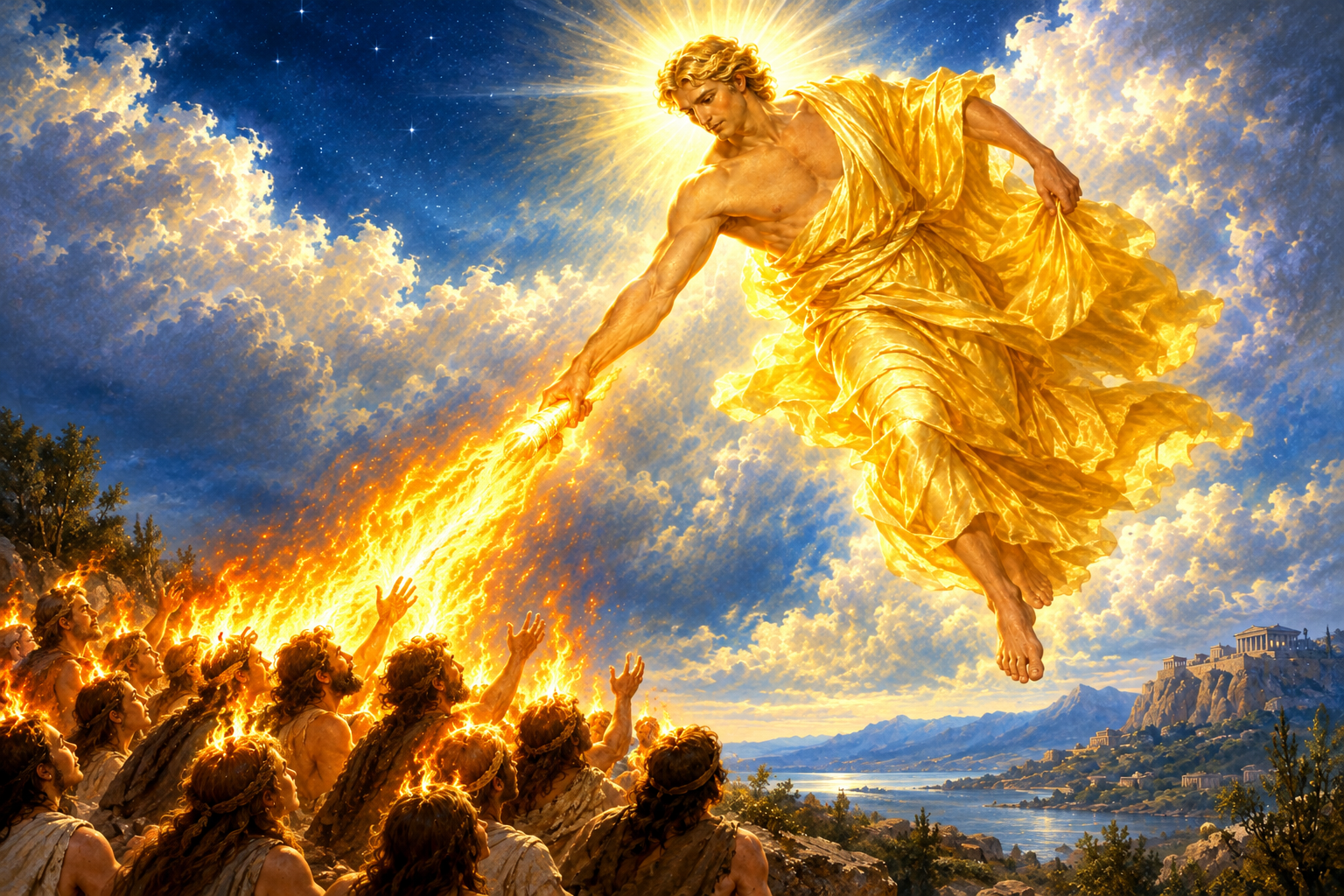
In ancient Greek mythology, Prometheus was a Titan who defied Zeus by stealing fire from the gods to give to humanity, which thus brought about the beginnings of human civilisation. In retaliation, Zeus ordered the creation of Pandora, the first woman, who unleashed suffering upon the world when she opened her infamous box. For his direct punishment, Prometheus was chained to the Caucasus Mountains, as a living and divine sacrifice. An eagle was sent there each day to peck at his liver. Because he was immortal, his liver regenerated every night. This constant alternation through day and night caused him ceaseless suffering. Generations later, Prometheus found his deliverance when the hero Herakles (Hercules) killed the eagle and broke Prometheus’ chains, finally freeing him with Zeus’ eventual consent.
The Prometheus story first appears in Hesiod’s “Theogony” and “Works and Days” (c. 700 B.C.) where he is presented in a mostly negative light. In “Prometheus Bound” (c. 479-430 B.C.) by Aeschylus, he is elevated into a truly noble and self-sacrificing hero who is responsible – through the gift he brought to humanity – for virtually all human civilisation, intellect, progress, and culture. “Prometheus Bound” was part of a trilogy but the other two works – “Prometheus Unbound” and “Prometheus the Fire-Bearer” – became somewhat surprisingly “lost” a long time ago. Much more recently, Percy Bysshe Shelley, the English Romantic poet, wrote his own “Prometheus Unbound” in 1820.
For H. P. Blavatsky and her Adept-Teachers (the Mahatmas, the Brothers, or Masters of Wisdom), Prometheus is a particularly powerful and important symbol and allegory of a sacred metaphysical reality relating to the origins and dawn of human consciousness. The symbolism of Prometheus the Fire-Bringer is virtually identical in nearly every way with that of Lucifer the Lightbringer. These and numerous other synonyms from different times, cultures, and traditions reflect and clothe in a comprehensible and memorable manner one and the same great truth from the Esoteric Doctrine or Wisdom-Religion of ages past, unveiled and explained in “The Secret Doctrine” and other original Theosophical literature more than it ever has been in recorded history.
“Listen to the sad story of mankind: At first mindless, I gave them mind and reason. Not in disparagement of men do I speak, but to show my gifts were governed by good will. For seeing, they saw not, before me. Hearing, they could not listen. All their lives they passed like shapes in dreams, confused and devoid of purpose, until I brought them the fire. They acted without knowledge until I came. Number, the chief of sciences, I invented for them, and how to set down words in writing, the skill of remembrance, mother of the Muses. I distinguished the various modes of prophecy, and was the first to discern from dreams that which Fate has ordained should come to pass. I imparted the hidden sense of voices, sounds, sights met by chance upon the road. I guided mankind to a hidden art, and read to them the intimations of the altar-flames.” (Prometheus in “Prometheus Bound,” written by Aeschylus)
H. P. BLAVATSKY ON
THE ALLEGORY AND SYMBOLISM OF PROMETHEUS
(Please note: You may find these passages difficult to follow if you are not already reasonably familiar with the Theosophical teachings regarding the mystery of the human Ego/Individuality/Soul and its celestial or divine origins. That has been summarised in such articles as Manas – The Mystery of Mind, Ego Is Not A Bad Word, The Monad and The Ego are an Eternal Triad, Dreams and The Dreamer, and The Lunar Pitris and Solar Pitris. It will also be worth reading Lucifer the Lightbringer if you have not already done so.)
“Prometheus (Gr.). The Greek logos; he, who by bringing on earth divine fire (intelligence and consciousness) endowed men with reason and mind. Prometheus is the Hellenic type of our Kumâras or Egos, those who, by incarnating in men, made of them latent gods instead of animals. The gods (or Elohim) were averse to men becoming “as one of us” (Genesis iii., 22), and knowing “good and evil”. Hence we see these gods in every religious legend punishing man for his desire to know. As the Greek myth has it, for stealing the fire he brought to men from Heaven, Prometheus was chained by the order of Zeus to a crag of the Caucasian Mountains.” (“The Theosophical Glossary” p. 263)
“Hence the allegory of Prometheus, who steals the divine fire so as to allow men to proceed consciously on the path of spiritual evolution, thus transforming the most perfect of animals on earth into a potential god, and making him free to “take the kingdom of heaven by violence.” Hence also, the curse pronounced by Zeus against Prometheus, and by Jehovah-Il-da-Baoth against his “rebellious son,” Satan. The cold, pure snows of the Caucasian mountain and the never-dying, singeing fire and flames of an extinguishable hell. Two poles, yet the same idea; the dual aspect of a refined torture: a fire producer — the personified emblem of Φωσφόρος [i.e. phosphorus] of the astral fire and light in the anima mundi—(that element of which the German materialist philosopher Moleschott said: “ohne phosphor kein gedanke,” i.e., without phosphorus no thought), burning in the fierce flames of his terrestrial passions; the conflagration fired by his Thought, discerning as it now does good from evil, and yet a slave to the passions of its earthly Adam; feeling the vulture of doubt and full consciousness gnawing at its heart — a Prometheus indeed, because a conscious, hence a responsible entity.” (“The Secret Doctrine” Vol. 2, p. 244)
“Pausanias shows that the original Kabiric deity was Prometheus. (I. ix. p. 751.)
“But the fact that, astronomically, the Titans-Kabirim were also the generators and regulators of the seasons, and cosmically the great Volcanic Energies, the gods presiding over all the metals and terrestrial works, does not prevent them from being, in their original divine characters, the beneficent Entities who, symbolized in Prometheus, brought light to the world, and endowed humanity with intellect and reason. They are pre-eminently in every theogony — especially in the Hindu — the sacred divine fires, 3, 7, or 49, according as the allegory demands it. Their very names prove it, as they are the Agni-putra (Sons of the Fire) in India, and the genii of the fire under numerous names in Greece and elsewhere. Welcker, Maury, and now Decharme, show the name Kabeiron meaning “the powerful through fire,” from the Greek word Καίω “to burn.” The Semitic Kabirim, “the powerful, the mighty, and the great,” answering to the Greek μεγάλοι δυνατοὶ, are later epithets. They were universally worshipped, and their origin is lost in the night of time. Yet whether propitiated in Phrygia, Phœnicia, the Troad, Thrace, Egypt, Lemnos or Sicily, their cult was always connected with fire; their temples ever built in the most volcanic localities, and in exoteric worship they belonged to Chthonian divinities. Therefore Christianity has made of them infernal gods.
“They are truly “the great, beneficent and powerful Gods,” as Cassius Hermone calls them (See Macrob. Sat. I., iii., c. 4, p. 376).” (“The Secret Doctrine” Vol. 2, p. 363)
“Now the Zohar says that the Ischin, the beautiful B’ne-aleim, were not guilty, but mixed themselves with mortal men because they were sent on earth to do so. . . . Their chief is Azazel.
“But Azazel, whom the Church dogma will associate with Satan, is nothing of the kind. Azazel is a mystery, as explained elsewhere, and it is so expressed in Maimonides, “In More Nevochim” (chapter xxvi., p. 8). “There is an impenetrable mystery in the narrative concerning Azazel.” . . .
“The amount of malicious fancy and fiction bestowed on that “Host” by various fanatical writers is quite extraordinary. Azazel and his “host” are simply the Hebrew “Prometheus,” and ought to be viewed from the same standpoint. The Zohar shows the Ischin chained on the mountain in the desert, allegorically; thus simply alluding to those “spirits” as being chained to the earth during the cycle of incarnation. Azazel (or Azaziel) is one of the chiefs of the “transgressing” angels in Enoch, who descending upon Ardis, the top of Mount Armon, bound themselves by swearing loyalty to each other.
“It is said [in the Book of Enoch] that Azaziel taught men to make swords, knives, shields, to fabricate mirrors (?) to make one see what is behind him (viz., “magic mirrors“). Amazarak taught all the sorcerers and dividers of roots; Amers taught the solution of magic; Barkayal, astrology; Akibeel, the meaning of portents and signs; Tamial, astronomy; and Asaradel taught the motion of the moon. “These seven were the first instructors of the Fourth man” (i.e., of the Fourth Race) [i.e. the early Atlantean Root Race]. But why should allegory be always understood as meaning all that its dead-letter expresses?
“It is the symbolical representation of the great struggle between divine wisdom, nous, and its earthly reflection, Psuche, or between Spirit and Soul, in Heaven and on Earth. In Heaven – because the divine Monad had voluntarily exiled itself therefrom, to descend, for incarnating purposes, to a lower plane and thus transform the animal of clay into an immortal god. For, as Eliphas Levi tells us, “the angels aspire to become men; for the perfect man, the man-god, is above even angels.” On Earth — because no sooner had Spirit descended than it was strangled in the coils of matter.” (“The Secret Doctrine” Vol. 2, p. 376-377)
“The intellectual evolution, in its progress hand-in-hand with the physical, has certainly been a curse instead of a blessing — a gift quickened by the “Lords of Wisdom,” who have poured on the human manas the fresh dew of their own spirit and essence.
“The divine Titan has then suffered in vain; and one feels inclined to regret his benefaction to mankind, and sigh for those days so graphically depicted by Æschylus, in his “Prometheus Bound,” when, at the close of the first Titanic age (the age that followed that of ethereal man, of the pious Kandu and Pramlocha), nascent, physical mankind, still mindless and (physiologically) senseless, is described as—
“”Seeing, they saw in vain;
Hearing, they heard not; but like shapes in dreams,
Through the long time all things at random mixed.”
“Our Saviours, the Agnishwatta and other divine “Sons of the Flame of Wisdom” (personified by the Greeks in Prometheus), may well, in the injustice of the human heart, be left unrecognized and unthanked. They may, in our ignorance of the truth, be indirectly cursed for Pandora’s gift: but to find themselves proclaimed and declared by the mouth of the clergy, the EVIL ONES, is too heavy a Karma for “Him” “who dared alone” — when Zeus “ardently desired” to quench the entire human race — to save “that mortal race” from perdition, or, as the suffering Titan is made to say:—
“”From sinking blasted down to Hades’ gloom.
For this by the dire tortures I am bent,
Grievous to suffer, piteous to behold,
I who did mortals pity! . . . . “
“The chorus remarking very pertinently:—
“”Vast boon was this thou gavest unto mortals . . . .”
“Prometheus answers:—
“”Yea, and besides ’twas I that gave them fire.
Chorus: Have now these short-lived creatures flame-eyed fire?
Prom.: Ay, and by it full many arts will learn. . . . .”
“But, with the arts, the fire received has turned into the greatest curse: the animal element, and consciousness of its possession, has changed periodical instinct into chronic animalism and sensuality. It is this which hangs over humanity like a heavy funereal pall. Thus arises the responsibility of free-will; the Titanic passions which represent humanity in its darkest aspect; “the restless insatiability of the lower passions and desires, when, with self-asserting insolence, they bid defiance to the restraints of law.”
“Prometheus having endowed man, according to Plato’s “Protagoras,” with that “wisdom which ministers to physical well-being,” but the lower aspect of manas of the animal (Kama) having remained unchanged, instead of “an untainted mind, heaven’s first gift” (Æschylus), there was created the eternal vulture of the ever unsatisfied desire, of regret and despair coupled with “the dreamlike feebleness that fetters the blind race of mortals” (p. 556), unto the day when Prometheus is released by his heaven-appointed deliverer, Herakles.
“Now Christians — Roman Catholics especially — have tried to prophetically connect this drama with the coming of Christ. No greater mistake could be made. The true theosophist, the pursuer of divine wisdom and worshipper of ABSOLUTE perfection — the unknown deity which is neither Zeus nor Jehovah — will demur to such an idea.
“Pointing to antiquity he will prove that there never was an original sin, but only an abuse of physical intelligence—the psychic being guided by the animal, and both putting out the light of the spiritual.
“He will say, “All ye who can read between the lines, study ancient wisdom in the old dramas — the Indian and the Greek; read carefully the one just mentioned, one enacted on the theatres of Athens 2,400 years ago, namely “Prometheus Bound.” The myth belongs to neither Hesiod nor Æschylus; but, as Bunsen says, it “is older than the Hellenes themselves,” for it belongs, in truth, to the dawn of human consciousness.
“The Crucified Titan is the personified symbol of the collective Logos, the “Host,” and of the “Lords of Wisdom” or the HEAVENLY MAN, who incarnated in Humanity. Moreover, as his name Pro-me-theus, meaning “he who sees before him” or futurity, shows — in the arts he devised and taught to humanity, psychological insight was not the least. . . .
“Let us pause and see what may be the hidden meaning of this, the most ancient as it is the most suggestive of traditional allegories. As it relates directly to the early races, this will be no real digression.
“The subject of Æschylus’ drama (the trilogy is lost) is known to all cultured readers. The demi-god [i.e. Prometheus] robs the gods (the Elohim) of their secret — the mystery of the creative fire. For this sacrilegious attempt he is struck down by KRONOS and delivered unto Zeus, the FATHER and creator of a mankind which he would wish to have blind intellectually, and animal-like; a personal deity, which will not see MAN “like one of us.”
“Hence Prometheus, “the fire and light-giver,” is chained on Mount Caucasus and condemned to suffer torture. . . .
“The translators of the drama wonder how Æschylus could become guilty of such “discrepancy between the character of Zeus as portrayed in the ‘Prometheus Bound’ and that depicted in the remaining dramas.” (Mrs. A. Swanwick.) This is just because Æschylus, like Shakespeare, was and will ever remain the intellectual “Sphinx” of the ages.
“Between Zeus, the abstract deity of Grecian thought, and the Olympic Zeus, there was an abyss. The latter represented during the mysteries no higher a principle than the lower aspect of human physical intelligence — Manas wedded to Kama; Prometheus — its divine aspect [i.e. Higher Manas] merging into and aspiring to Buddhi — the divine Soul. Zeus was the human soul and nothing more, whenever shown yielding to his lower passions, — the jealous God, revengeful and cruel in its egotism or I-am-ness.
“Hence, Zeus is represented as a serpent — the intellectual tempter of man — which, nevertheless, begets in the course of cyclic evolution the “Man-Saviour,” the solar Bacchus or “Dionysos,” more than a man.
“Dionysos is one with Osiris, with Krishna, and with Buddha (the heavenly wise), and with the coming (tenth) Avatar, the glorified Spiritual Christos, who will deliver the suffering Chrestos (mankind, or Prometheus, on its trial).
“This, say Brahminical and Buddhistic legends, echoed by the Zoroastrian and now by the Christian teachings (the latter only occasionally), will happen at the end of Kaliyuga. It is only after the appearance of Kalki-Avatar, or Sosiosh, that man will be born from woman without sin. Then will Brahmâ, the Hindu deity; Ahura-Mazda (Ormazd), the Zoroastrian; Zeus, the Greco-Olympian Don Juan; Jehovah, the jealous, repenting, cruel, tribal God of the Israelites, and all their likes in the universal Pantheon of human fancy — vanish and disappear in thin air. And along with these will vanish their shadows, the dark aspects of all those deities, ever represented as their “twin brothers” and creatures, in exoteric legend, their own reflection on earth — in esoteric philosophy.
“The Ahrimans and Typhons, the Samaels and Satans, must be all dethroned on that day, when every dark evil passion will be subdued.
“There is one eternal Law in nature, one that always tends to adjust contraries and to produce final harmony. It is owing to this law of spiritual development superseding the physical and purely intellectual, that mankind will become freed from its false gods, and find itself finally — SELF-REDEEMED.
“In its final revelation, the old myth of Prometheus — his proto- and anti-types being found in every ancient theogony — stands in each of them at the very origin of physical evil, because at the threshold of human physical life. KRONOS is “Time,” whose first law is that the order of the successive and harmonious phases in the process of evolution during cyclic development should be strictly preserved — under the severe penalty of abnormal growth with all its ensuing results.
“It was not in the programme of natural development that man — higher animal though he may be — should become at once — intellectually, spiritually, and psychically — the demi-god he is on earth, while his physical frame remains weaker and more helpless and ephemeral than that of almost any huge mammal. The contrast is too grotesque and violent; the tabernacle much too unworthy of its indwelling god.
“The gift of Prometheus thus became a CURSE — though foreknown and foreseen by the HOST personified in that personage, as his name well shows [i.e. “Prometheus” literally meaning “forethought” or “seeing ahead”]. It is in this that rests, at one and the same time, its sin and its redemption.
“For the Host that incarnated in a portion of humanity, though led to it by Karma or Nemesis, preferred free-will to passive slavery, intellectual self-conscious pain and even torture “while myriad time shall flow” — to inane, imbecile, instinctual beatitude [i.e. and thus preferred to be engaged in the cycle of incarnation on Earth, rather than absorbed in the bliss of a Nirvanic state which belonged to it by right].
“Knowing such an incarnation was premature and not in the programme of nature, the heavenly host, “Prometheus,” still sacrificed itself to benefit thereby, at least, one portion of mankind. But while saving man from mental darkness, they inflicted upon him the tortures of the self-consciousness of his responsibility — the result of his free will — besides every ill to which mortal man and flesh are heir to.
“This torture Prometheus accepted for himself, since the Host became henceforward blended with the tabernacle prepared for them, which was still unachieved at that period of formation.
“Spiritual evolution being incapable of keeping pace with the physical, once its homogeneity was broken by the admixture, the gift [i.e. of Manas, or individual self-consciousness, self-conscious individuality and intelligence] thus became the chief cause, if not the sole origin of Evil.
“The allegory which shows KRONOS cursing Zeus for dethroning him (in the primitive “golden” age of Saturn, when all men were demi-gods), and for creating a physical race of men weak and helpless in comparison; and then as delivering to his (Zeus’) revenge the culprit, who despoiled the gods of their prerogative of creation and who thereby raised man to their level, intellectually and spiritually — is highly philosophical.
“In the case of Prometheus, Zeus represents the Host of the primeval progenitors, of the PITAR, the “Fathers” [i.e. Lunar Pitris] who created man senseless and without any mind; while the divine Titan stands for the Spiritual creators, the devas who “fell” into generation [i.e. Solar Pitris]. The former are spiritually lower, but physically stronger, than the “Prometheans”: therefore, the latter are shown conquered.
“”The lower Host, whose work the Titan spoiled and thus defeated the plans of Zeus,” was on this earth in its own sphere and plane of action; whereas, the superior Host was an exile from Heaven, who had got entangled in the meshes of matter. They (the inferior “Host”) were masters of all the Cosmic and lower titanic forces; the higher Titan possessed only the intellectual and spiritual fire.
“This drama of the struggle of Prometheus with the Olympic tyrant and despot, sensual Zeus, one sees enacted daily within our actual mankind: the lower passions chain the higher aspirations to the rock of matter, to generate in many a case the vulture of sorrow, pain, and repentance. In every such case one sees once more —
“”A god . . . in fetters, anguish fraught;
The foe of Zeus, in hatred held by all. . . .”
“A god, bereft even of that supreme consolation of Prometheus, who suffered in self-sacrifice—
“”For that to men he bare too fond a mind. . .”
“as the divine Titan is moved by altruism, but the mortal man by Selfishness and Egoism in every instance.
“The modern Prometheus has now become Epi-metheus, “he who sees only after the event”; because the universal philanthropy of the former has long ago degenerated into selfishness and self-adoration.
“Man will rebecome the free Titan of old, but not before cyclic evolution has re-established the broken harmony between the two natures — the terrestrial and the divine; after which he becomes impermeable to the lower titanic forces, invulnerable in his personality, and immortal in his individuality, which cannot happen before every animal element is eliminated from his nature. When man understands that “Deus non fecit mortem [i.e. “God did not create death”]” (Sap. I., 13), but that man has created it himself, he will re-become the Prometheus before his Fall.” (“The Secret Doctrine” Vol. 2, p. 411-414, 419-422)
“Prometheus . . . He is another victim, for he is crucified on the Cross of Love, on the rock of human passions, a sacrifice to his devotion to the cause of the spiritual element in Humanity.” (“The Secret Doctrine” Vol. 2, p. 561)
“The first boon Prometheus gave to mortals, as he tells the “Chorus,” was to hinder them “from foreseeing death” (256); he “saved the mortal race from sinking blasted down to Hades’ gloom” (244); and then only, “besides” that, he gave them fire (260).
“This shows plainly the dual character, at any rate of the Promethean myth, if Orientalists will not accept the existence of the seven keys taught in Occultism.
“This [i.e. the Promethean gift of fire to ancient mankind] relates to the first opening of man’s spiritual perceptions, not to his first seeing or discovering [physical] fire. For fire was never “discovered,” but existed on earth since its beginning. . . . Let a new race of men — whether evolved from angel or gorilla — appear now on any uninhabited spot of the globe, with the exception perhaps of the Sahara, and a thousand to one it would not be a year or two old before discovering fire, through the fall of lightning setting in flames grass or something else. This assumption, that primitive man lived ages on earth before he was made acquainted with fire, is one of the most painfully illogical of all.
“But old Æschylus was an initiate, and knew well what he was giving out.
“No occultist acquainted with symbology and the fact that Wisdom came to us from the East, will deny for a moment that the myth of Prometheus has reached Europe from Aryavarta [i.e. ancient India]. Nor is he likely to deny that in one sense Prometheus represents fire by friction. . . .
“Decharme, at any rate, seems to have a correct glimmering of the truth; for he unconsciously corroborates by his remarks all that the Occult sciences teach with regard to the Manasa Devas, who have endowed man with the consciousness of his immortal soul: that consciousness which hinders man “from foreseeing death,” and makes him know he is immortal. . . . The monad of the animal is as immortal as that of man, yet the brute knows nothing of this; it lives an animal life of sensation just as the first human would have lived, when attaining physical development in the Third Race, had it not been for the Agnishwatta and the Manasa Pitris. . . .
“”How has Prometheus got into the possession of the (divine) spark?” he asks. “Fire having its abode in heaven, it is there he must have gone to find it before he could carry it down to men, and, to approach the gods, he must have been a god himself.” The Greeks held that he was of the divine race; the Hindus, that he was a Deva. . . .
“The most intuitional among modern writers cannot or will not rise in their conceptions above the level of the Earth and Cosmic phenomena. It is not denied that the moral idea in the myth, as presented in the Theogony of Hesiod, plays a certain part in the primitive Greek conception. The Titan is more than a thief of the celestial fire. He is the representation of humanity — active, industrious, intelligent, but at the same time ambitious, which aims at equalling divine powers. Therefore it is humanity punished in the person of Prometheus, but it is only so with the Greeks.
“With the latter, Prometheus is not a criminal, save in the eyes of the gods. In his relation with the Earth, he is, on the contrary, a god himself, a friend of mankind (φιλάνθρωπος) [i.e. philanthropos], which he has raised to civilization and initiated into the knowledge of all the arts; a conception which found its most poetical expounder in Æschylus.” (“The Secret Doctrine” Vol. 2, p. 523-524, 525-526)
“Prometheus is a symbol and a personification of the whole of mankind in relation to an event which occurred during its childhood, so to say — the “Baptism by Fire” — which is a mystery within the great Promethean Mystery; one that may be at present mentioned only in its broad general features.” (“Pagan Sidereal Worship or Astrology”)
~ * ~
And our singing shall build
In the void’s loose field
A world for the Spirit of Wisdom to wield;
We will take our plan
From the new world of man,
And our work shall be called the Promethean.
(From “Prometheus Unbound” by Percy Bysshe Shelley)
~ * ~
This article may have raised more questions about various things. Please make use of the site search function (the magnifying glass symbol at the top of the page) and visit the Articles page to see the complete list of over 400 articles covering all aspects of Theosophy and the Theosophical Movement. Some which relate closely to this one were linked to near the start.
~ BlavatskyTheosophy.com ~

