
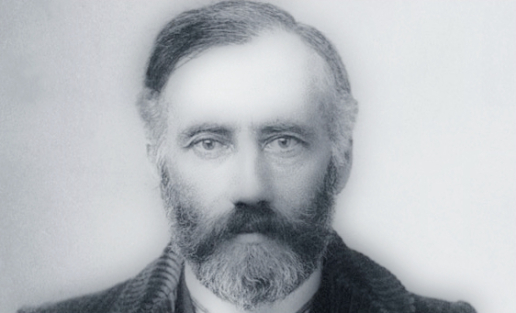
FROM “NOTES ON THE BHAGAVAD GITA” BY WILLIAM Q. JUDGE
(p. 44-46, Theosophy Company edition)
This is the same doctrine as is found in the Isavasaya-Upanishad [i.e. the Ishavasya Upanishad, more commonly known as the Isha Upanishad or Ishopanishad]: The Identity of all Spiritual Beings, and Resignation. And by “Spiritual Beings” is meant all life above the inorganic, for Man is not admitted to be material. There is only one life, one consciousness. It masquerades under all the different forms of sentient beings, and those varying forms with their intelligences mirror a portion of the One Life, thus producing in each a false idea of egoism. A continuance of belief in that false ego produces a continuance of ignorance, thus delaying salvation.
The beginning of the effort to dissipate this false belief is the beginning of the Path; the total dissipation of it is the perfection of Yoga, or union with God.
The entry upon that Path cannot be made until resignation is consummated; for, as the Upanishad and the Bhagavad-Gita say: “All this, whatsoever moves on earth, is to be surrendered to the Lord – the Self. When thou hast surrendered all this; then thou mayest enjoy.” [Note: This is a rendering of the famous first verse of the Isha Upanishad, one of Mahatma Gandhi’s favourite scriptural quotations.]
If this be true, then how necessary to consider philosophy so as to be able to cut off the false belief. And how useless to pursue occultism merely for your own benefit? You may know all about currents and polarities, about any and every phenomenon possible in the astral world, but with the death of your body it is lost, leaving to you only the amount of real Spiritual advance you happen to have made. But once resign and all is possible. This will not ruin your life nor destroy any proper ideals; poor and petty ideals had better be at once lost. It may seem that all ideals are gone, but that will be only the first effect of taking this step.
We must be ready to say at any moment under whatever circumstances, whether expected or unexpected: “It is just what I in fact desired.” For only those ideals can be dissipated which rest upon a lower basis than the highest aim, or which are not in accord with Nature’s (God’s) law. And as our aim ought to be to reach the supreme condition and to help all other sentient beings to do so also, we must cultivate complete resignation to the Law, the expression and operation of which is seen in the circumstances of life and the ebb and flow of our inner being.
All that can be gotten out of wealth, or beauty, or art, or pleasure, are merely pools of water found along our path as it wanders through the desert of life. If we are not seeking them their appearance gives us intense pleasure, and we are thus able to use them for our good and that of others just so long as the Law leaves them to us; but when that superior power removes them, we must say: “It is just what I in fact desired.” Any other course is blindness.
All the passing shows of life, whether fraught with disaster or full of fame and glory, are teachers; he who neglects them, neglects opportunities which seldom the gods repeat. And the only way to learn from them is through the heart’s resignation; for when we become in heart completely poor, we at once are the treasurers and disbursers of enormous riches.
~ * ~
William Judge refers to this same principle in numerous other places and the idea of calmly and confidently affirming to oneself when facing difficulties, troubles, and challenges that “It is just what I in fact desired” is found mentioned by him in “Letters That Have Helped Me” p. 36:
“So I pray you to remove from your mind any distaste for present circumstances. If you can succeed in looking at it all as just what you in fact desired, then it will act not only as a strengthener of your good thoughts, but will act reflexly on your body and make it stronger.”
Elsewhere, Julia Keightley (the recipient of that particular letter from Judge) commented that whereas the personal or lower “I” may not desire the present circumstances or trials at all, the inner and higher “I” – the soul within – always desires and rejoices in the just outworking of the Karmic Law.
In more recent times, an article titled “Renunciation and Responsibility” in the Theosophical magazine “Hermes” began with that opening verse of the Isha Upanishad – “Renounce and then enjoy this world.” – and commented:
“One must even be delighted to discover obstacles, understanding that so-called bad karma is what one unconsciously or unknowingly desired for one’s discipline. Karma is not only what one deserves, but also what one really wants, because it offers a golden opportunity for transmuting past errors and persisting obstacles. Even tainted life-atoms must be welcomed and cleansed, or they will take their revenge if their demand for attention is spurned. They must indeed be discouraged from performing their ludicrous devil dances, and can be gently coaxed into the presence of potent thoughts and feelings of pure benevolence.”
The subject of “life-atoms” can be explored further in such articles as The Transmigration of Life Atoms, Elementals and The Astral Light, and Atoms in Esoteric Science. For more articles on the practical and psychological aspects of spiritual living or to learn more about William Quan Judge, please browse the sections titled “SPIRITUAL LIVING AND PRACTICE” and “H. P. BLAVATSKY AND THEOSOPHY” on the Articles page.
~ BlavatskyTheosophy.com ~
“Thus is devotion the potent power that leads to and makes possible the utter self-renunciation and self-surrender which are the only means for receiving spiritual illumination.”
(Bhavani Shankar, “The Doctrine of The Bhagavad Gita”)
 T H E O S O P H Y