
FROM THE WRITINGS OF H. P. BLAVATSKY
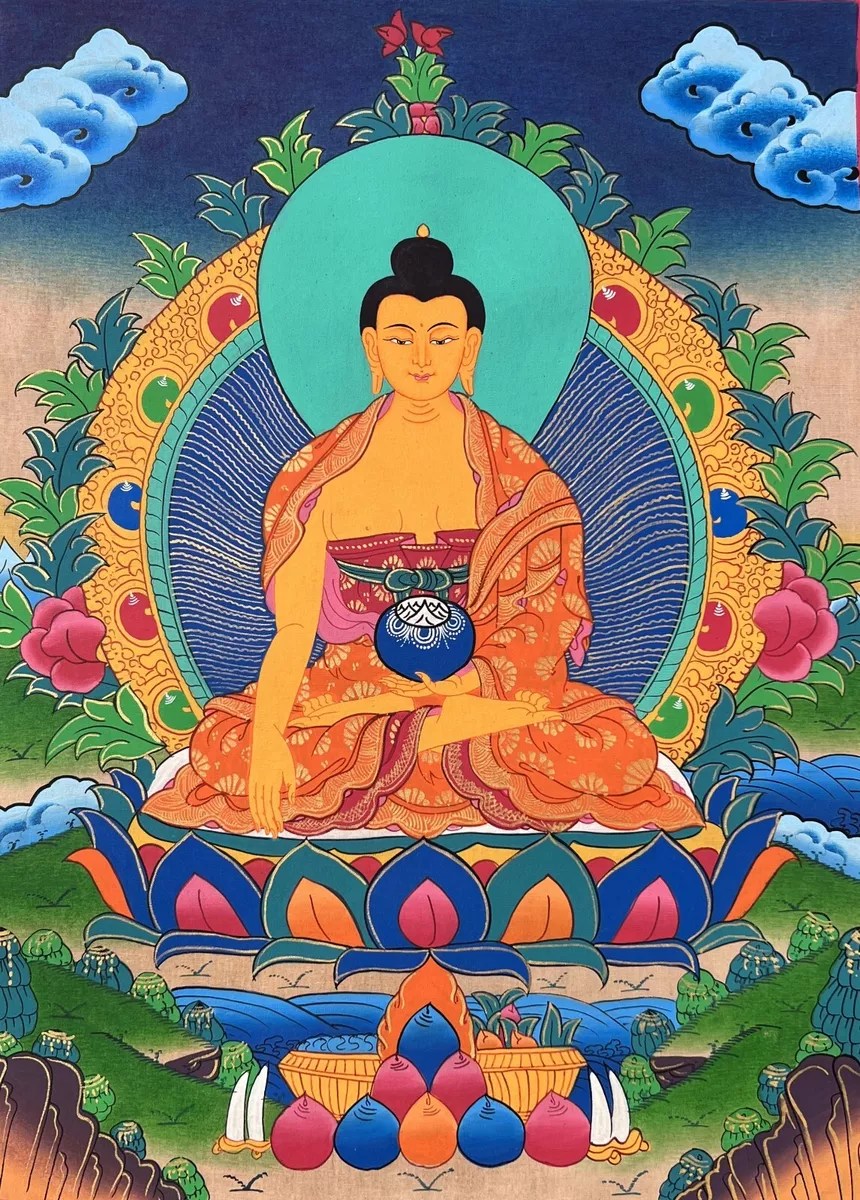
Now the mystery of Buddha lies in this: Gautama, an incarnation of pure Wisdom, had yet to learn in His human body and to be initiated into the world’s secrets like any other mortal, until the day when He emerged from His secret recess in the Himâlayas and preached for the first time in the grove of Benares. . . .
The Buddha is in Nirvâna, it is said, though his once mortal vehicle — the subtle body — of Gautama is still present among the Initiates: nor will it leave the realm of conscious Being so long as suffering mankind needs its divine help — not to the end of this Root Race at any rate. From time to time, He, the “astral” Gautama associates Himself in some most mysterious — to us quite incomprehensible — manner with Avatâras and great saints, and works through them. And several such are named. . . .
Buddhists of the Mahâyana mystic system teach that each BUDDHA manifests Himself (hypostatically or otherwise) simultaneously in three worlds of Being, namely in the world of Kâma (concupiscence or desire — the sensuous universe or our earth) in the shape of a man; in the world of Rûpa (form yet supersensuous) as a Bodhisattva; and in the highest Spiritual World (that of purely incorporeal existences) as a Dhyâni Buddha. The latter prevails eternally in space and time, i.e. from one Mahâ-Kalpa to the other . . .
What is given here is taken from the secret portions of Dus Kyi Khorlo (Kâla Chakra in Sanskrit or the “Wheel of Time” or duration). . . .
The Dhyâni-Buddha, when the world needs a human Buddha, “creates” through the power of Dhyâna (meditation, omnipotent devotion), a mind-born son — a Bodhisattva — whose mission it is after the physical death of his human or Manushya-Buddha to continue his work on earth till the appearance of the subsequent Buddha. The Esoteric meaning of this teaching is clear. . . .
Thus, while the Buddha merges back into Nirvâna whence it proceeded, the Bodhisattva remains behind to continue the Buddha’s work upon earth. It is then this Bodhisattva that may have afforded the lower principles in the apparitional body of Shankarâchârya the Avatâra.
Now to say that Buddha after having reached Nirvâna returned thence to reïncarnate in a new body would be uttering a heresy from the Brâhmanical as well as from the Buddhisic standpoint. Even in the Mahâyâna exoteric School, in the teaching as to the three “Buddhic” bodies, it is said of the Dharmakâya — the formless Being — that once it is taken, the Buddha in it abandons the world of sensuous perceptions for ever and has not nor can he have any more connection with it. To say as the Esoteric or Mystic School teaches, that though Buddha is in Nirvâna he has left behind him the Nirmânakâya (the Bodhisattva) to work after him is quite orthodox and in accordance with both the Esoteric Mahâyâna and the Prasanga Mâdhyâmika Schools, the latter an anti-esoteric and most rationalistic system.
~ * ~
It being left to the option and responsibility of the writer to tell the facts as she personally understood them, the blame for possible misconceptions created must fall only upon her. She has been taught the doctrine but it was left to her sole intuition — as it is now left to the sagacity of the reader — to group the mysterious and perplexing facts together. The incomplete statements herein given are fragments of what is contained in certain secret volumes, but it is not lawful to divulge the details.
The esoteric version of the mystery given in the secret volumes may be told briefly.
The “Mystery of Buddha ” is that of several other Adepts — perhaps of many.
Thus it is averred that Gautama Buddha was reincarnated in Shankarâchâya [i.e. who, according to Theosophy and the majority of the monasteries founded by him, lived around 2,500 years ago, being born only 50 years or so after the death of Gautama Buddha] — that, as is said in Esoteric Buddhism [by A. P. Sinnett]:
“Shankarâchârya simply was Buddha in all respects in a new body.”
While the expression in its mystic sense is true, the way of putting it may be misleading until explained.
Shankara was an Avatâra in the full sense of the term. According to Sayanâchârya, the great commentator on the Vedas, he is to be held as an Avatâra, or direct incarnation of Shiva — the Logos, the Seventh Principle in Nature [i.e. the cosmic Atman] — Himself. In the Secret Doctrine Shri Shankarâchârya is regarded as the abode — for the thirty-two years of his mortal life — of a Flame, the highest of the manifested Spiritual Beings, one of the Primordial Seven Rays.
Shankarâchârya was reputed to be an Avatâra, an assertion the writer implicitly believes in, but which other people are of course at liberty to reject. And as such he took the body of a southern Indian, newly-born Brâhman baby [Note: As HPB is hinting, the baby was already born when “the highest of the manifested Spiritual Beings” directly connected Himself with it, for why would such a Being need to go through the whole process of foetal development in the womb?]; that body, for reasons as important as they are mysterious to us, is said to have been animated by Gautama’s astral personal remains. This divine Non-Ego [i.e. the highest Being or Dhyani, referred to above] chose as its own Upâdhi (physical basis), the ethereal human Ego of a great Sage in this world of forms, as the fittest vehicle for Spirit to descend into.
It is therefore nearer the truth to say — when once we accept such a possibility — that the “astral ”Gautama or the Nirmânakâya was the Upâdhi of Shankarâchâya’s spirit rather than the latter was a reincarnation of the former.
When a Shankarâchârya has to be born [Note: Notice the wording “a Shankaracharya” rather than simply “Shankaracharya”; this suggests that what HPB is here describing applies to all great Avataric incarnations], naturally every one of the principles in the manifested mortal man must be the purest and finest that exist on earth. Consequently those principles that were once attached to Gautama, who was the direct great predecessor of Shankara, were naturally attracted to him [i.e. because Gautama Buddha was “the greatest as the holiest man that ever lived,” as said by the Master K.H. in “The Mahatma Letters” p. 58], the economy of Nature forbidding the re-evolution of similar principles from the crude state. But it must be remembered that the higher ethereal principles [i.e. of anyone] are not, like the lower more material ones, visible sometimes to man (as astral bodies), and they have to be regarded in the light of separate or independent Powers or Gods, rather than as material objects. Hence the right way of representing the truth would be to say that the various principles, the Bodhisattva of Gautama Buddha, which did not go to Nirvâna, reunited to form the middle principles of Shankarâchârya, the earthly Entity.
It is absolutely necessary to study the doctrine of the Buddhas esoterically and understand the subtle differences between the various planes of existence to be able to comprehend correctly the above. Put more clearly, Gautama, the human Buddha, . . . had . . . his Bodhisattva and . . . his Dhyâni-Buddha – [and] assimilated these by his “Dhyâna” (meditation) and thus become a Buddha (“enlightened”). In another manner this is the case with all men; every one of us has his Bodhisattva — the middle principle, if we hold for a moment to the trinitarian division of the septenary group [i.e. if we condense the Seven Principles of the human constitution into spirit, soul, and body, or monad, ego, and personality; thus the role played by the “Gautama Bodhisattva” in Avataric incarnations is that of the individual Soul or Ego] — and his Dhyâni-Buddha or Chohan, the “Father of the Son.” Our connecting link with the higher Hierarchy of Celestial Beings lies here in a nutshell, only we are too sinful to assimilate them.
[The Bodhisattva/Nirmanakaya functioning in this way] becomes simply the vehicle of a “Son of Light” from a still higher sphere, Who being Arûpa [i.e. formless, completely transcendent of all form], has no personal astral body of His own fit for this world. Such “Sons of Light,” or Dhyâni-Buddhas, are the Dharmakâyas of preceding Manvantaras, who have closed their cycles of incarnations in the ordinary sense and who, being thus Karmaless, have long ago dropped their individual Rûpas [i.e. forms or bodies], and have become identified with the first Principle.
Hence the necessity [in Avataric incarnations] of a sacrificial Nirmânakâya, ready to suffer for the misdeeds or mistakes of the new body in its earth-pilgrimage [Note: This statement is important, since it reveals that just as Theosophy often says the Mahatmas or Masters of Wisdom are not infallible, so too even an Avatar is not infallible or absolutely perfect and can even at times commit “misdeeds or mistakes,” some of which can have serious ramifications spanning many centuries, as other sections of these same articles say. But, curiously and mysteriously, these are considered “misdeeds or mistakes of the body,” rather than of the actual entity within. Whatever misdeeds or mistakes an Avatar may make are ultimately mysteries to the uninitiated and nowhere does HPB suggest that an Avatar is any the less worthy of our respect and reverence simply because their body has made mistakes. This same point is again referred to a few paragraphs further on.], without any future reward on the plane of progression and rebirth, since there are no rebirths for him in the ordinary sense.
The Higher Self, or Divine Monad, is not in such a case attached to the lower Ego; its connection is only temporary, and in most cases it acts through decrees of Karma. This is a real, genuine sacrifice, the explanation of which pertains to the highest Initiation of Gñâna [i.e. nowadays more commonly transliterated as Jnana] (Occult Knowledge).
It is stated that at the age of thirty-three, Shankarâchârya, tired of his mortal body, “put it off ”in the cave he had entered, and that the Bodhisattva, that served as his lower personality, was freed
“With the burden of a sin upon him which he had not committed.”
At the same time it is added:
“At whatever age one puts off his outward body by free will, at that age will he be made to die a violent death against his will in his next rebirth.” [Note: One may recall here that Jesus is traditionally said to have been crucified at 33 years of age, and that HPB wrote: “The students of Esoteric Philosophy see in the Nazarene Sage [i.e. Jesus] a Bodhisattva with the spirit of Buddha Himself in Him.”]
Now Karma could have no hold on “Mahâ Shankara” (as Shankara is called in the secret work), as he had, as Avatâra, no Ego of his own, but a Bodhisattva — a willing sacrificial victim. Neither had the latter any responsibility for the deed, whether sinful or otherwise.
Therefore we do not see the point, since Karma cannot act unjustly. There is some terrible mystery involved in all this story, one that no uninitiated intellect can ever unravel. Still there it is, suggesting the natural query “Who then was punished by Karma?” and leaving it to be answered.
A few centuries later Buddha tried one more incarnation, it is said, in ****, [Note: This name is deliberately blanked out by HPB; due to various reasons, such as those just given regarding the age of 33, we personally believe this to be a reference to Jesus or Yeshua, as also did Robert Crosbie.] and again, fifty years subsequent to the death of this Adept, in one whose name is given as Tiani-Tsang. Does “Tiani-Tsang” stand for Apollonius of Tyana? This is a simple surmise. Some things in the life of that Adept would seem to tally with the hypothesis — others to go against it.
The words used would stand when translated:
“Born fifty-two years too early as Shramana Gautama, the son of King Zastang [King Suddhodana]; then retiring fifty-seven years too soon as Mahâ Shankara, who got tired of his outward form. This wilful act aroused and attracted King Karma, who killed the new form of *** at thirty-three, the age of the body that was put off. [At whatever age one puts off his outward body by free will, at that age will he be made to die in his next incarnation against his will – Commentary.] He died in his next (body) at thirty-two and a little over, and again in his next at eighty — a Mâyâ [i.e. illusion], and at one hundred, in reality. The Bodhisatva chose Tiani-Tsang, then again the Sugata became Tsong-Kha-pa, who became thus Dezhin-Shegpa [Tathâgata — “one who follows in the way and manner of his predecessors”]. The Blessed One could do good to his generation as *** but none to posterity, and so as Tiani-Tsang he became incarnated only for the “remains” [of his precedent Karma, as we understand it]. The Seven Ways and the Four Truths were once more hidden out of sight. The Merciful One confined since then his attention and fatherly care to the heart of Bodyul [i.e. Tibet, but notice it is specifically speaking of the heart of Tibet], the nursery grounds of the seeds of truth. The blessed “remains” since then have overshadowed and rested in many a holy body of human Bodhisattvas.”
No further information is given, least of all are there any details or explanations to be found in the secret volume. All is darkness and mystery in it, for it is evidently written but for those who are already instructed. Several flaming red asterisks are placed instead of names, and the few facts given are abruptly broken off. The key of the riddle is left to the intuition of the disciple, unless the “direct followers” of Gautama the Buddha — “those who are to be denied by His Church for the next cycle” — and of Shankarâchârya are pleased to add more.
~ * ~
“Wherefore the ancients say that there is a celestial body always joined with the soul, which is immortal, luminous and star-like.” (Proclus)
It becomes natural then, that the “aerial body” of an Adept should have no such second dying, since it has been cleansed of all its natural impurity before its separation from the physical body. The high Initiate is a “Son of the Resurrection,” “being equal unto the angels,” and cannot die any more (see Luke, xx. 36). It has become too holy and pure, no longer by reflected but its own natural light and spirituality, either to sleep in the unconscious slumber of a lower Nirvânic state, or to be dissolved like any ordinary astral shell and disappear in its entirety.
But in that condition known as the Nirmânakâya [the Nirvânî “with remains,”] he can still help humanity.
“Let me suffer and bear the sins of all [be reincarnated unto new misery] but let the world be saved!” was said by Gautama BUDDHA: an exclamation the real meaning of which is little understood now by his followers. “If I will that he tarry till I come, what is that to thee?” [St. John, xxi. 21.] asks the astral Jesus of Peter. “Till I come” means “till I am reincarnated again” in a physical body.
Yet the Christ of the old crucified body could truly say: “I am with my Father and one with Him,” which did not prevent the astral from taking a form again nor John from tarrying indeed till his Master had come; nor hinder John from failing to recognize him when he did come, or from then opposing him. But in the Church that remark generated the absurd idea of the millennium or chiliasm in its physical sense [i.e. the Rapture or “Second Coming of Jesus Christ” as popularly understood].
Since then the “Man of Sorrows” has returned perchance more than once, unknown to, and undiscovered by, his blind followers. Since then also, this grand “Son of God” has been incessantly and most cruelly crucified daily and hourly by the Churches founded in his name. But the Apostles, only half-initiated, failed to tarry for their Master, and not recognizing him, spurned him every time he returned.
~ * ~
The above are excerpts from H. P. Blavatsky’s articles “The Doctrine of Avataras,” “The Seven Principles,” “The Mystery of Buddha,” and “”Reincarnations” of Buddha,” first published posthumously in 1897 and republished several times since then, including by the United Lodge of Theosophists.
This article may have raised more questions about various things. Please make use of the site search function (the magnifying glass symbol at the top of the page) and visit the Articles page to see the complete list of over 400 articles covering all aspects of Theosophy and the Theosophical Movement. A few which relate closely to this one and shed further light on this subject are:
THE GREAT SACRIFICE: THE MAHA-GURU, THE SILENT WATCHER, THE INITIATOR
MOUNT KAILASH AND THE TEACHERS OF BUDDHA
THE LIFE AND TIMES OF ADI SHANKARACHARYA
JESUS, CHRISTOS OR THE CHRIST PRINCIPLE, AND CHRISTIANITY
THE GREATEST DOCTRINE OF ESOTERIC PHILOSOPHY
~ BlavatskyTheosophy.com ~
 T H E O S O P H Y