
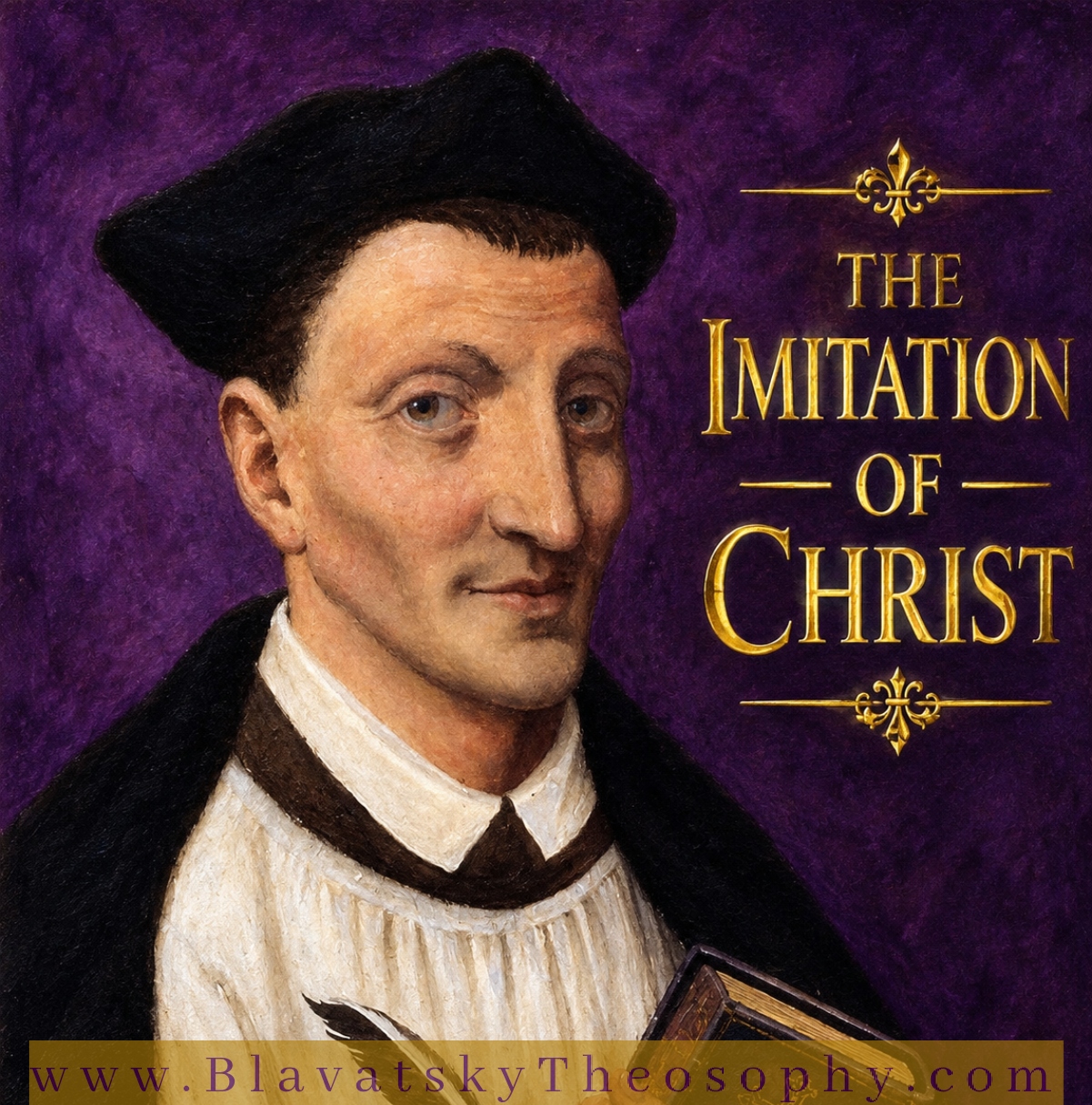
Thomas à Kempis (c. 1380–1471) was a German-Dutch priest in the Roman Catholic Church and a prominent member of the Brethren of the Common Life.
The Brethren of the Common Life, founded in the Netherlands in or around 1375, was in many respects an attempt to reform Catholicism from the dry, abstract, intellectually complex, scholastic theology on which many of the clergy had become fixated. It called for an embracing of a simple yet mystical Christian life, focusing on attaining or cultivating devotion, purity, humility, love, self-denial, and self-mastery, in the midst of practical daily life. Building a fraternal community based on sharing and mutual aid was also a part of this Brotherhood’s endeavours.
These are the qualities which we find repeatedly emphasised throughout “The Imitation of Christ,” the authorship of which is not absolutely definite but which is widely accepted to be by Thomas à Kempis.
Although he was a devout Christian, his writing has universal appeal. Much of it is wholly universal in content, while the parts which directly speak of devotion to Jesus Christ could for the most part equally be read as applying to any other true Master or great Teacher of one’s preference, as also to one’s own Inner God, the Christ within, or the Higher Ego in Theosophical terms. As with the majority of Catholic Mysticism, the work is geared towards practically and experientially becoming a disciple of an ever-living Master, i.e. in this case Jesus. In this respect and others, it should not feel unfamiliar to Theosophists.
Those students of Theosophy who are closely familiar with the writings of William Q. Judge are likely to notice numerous similarities in approach and style, particularly with his “Letters That Have Helped Me” and “Musings on The True Theosophist’s Path.”
Kempis was possibly not an Occultist or Initiate but he was certainly a true Mystic, with a profound and piercing spiritual clarity. (See the article Occultism and Mysticism for an explanation of the difference and the ideal interrelation between the two.) On the other hand, he could have been an Initiate; who can say? It is not at all impossible that he – as a soul – could have belonged in some way to the Brotherhood of Masters and Their Chelas (Disciples), even while potentially being unconscious of that fact in one particular lifetime. The same principle applies to many. Numerous individuals are more advanced than they have ever known, realised, suspected, or been able to access in this present life.
For whatever reason, Theosophical writers have always said very little about Thomas à Kempis and “The Imitation of Christ” but what they have said has always been positive and appreciative. Quite a few Western Theosophists of the late 19th and first half of the 20th century were personally familiar with this book.
In fact, “The Imitation of Christ” is the second most popular and second most translated Christian book in history, second only to the Bible itself. Students of Theosophy who are serious about fulfilling the Second Object of the Theosophical Movement should therefore make themselves familiar with it – not merely intellectually (which would be an approach that Kempis decries) but, most importantly, practically and from the heart, for much of its guidance and recommendations are just as much needed by Theosophists as by Christians.
And of course, there is not necessarily a dichotomy between the two. H. P. Blavatsky declares that true Theosophy and true Christianity are one and the same thing, as can be seen here. A Christian Theosophist, as also a Theosophist with Christian leanings, is just as valid as any Eastern-leaning Theosophist, provided one accepts that “There is no Religion higher than Truth” and that no religion contains or embodies the whole vast, timeless Truth. HPB, in a statement quoted in the article just linked to, says that Theosophists recognise in Jesus one of Those who are spoken of as the Masters of Wisdom.
The selection below represents only a small part of “The Imitation of Christ” but it will give a good overview and feeling of the work. If anyone should wish to obtain their own copy of the complete text, the translation we have quoted from is that done in 1952 by Leo Sherley-Price and republished many times since then, most notably by Penguin Classics.
“Thomas a Kempis wrote for those who wished to eschew dogmas and debates, personal pride and worldly prudence, avarice and ambition, and live the life Jesus showed. His book is simple and seemingly unphilosophical, for he continually repeats his basic teachings in language always as gentle as it is uncompromising. But it is a symphony of the practical spiritual life in which the same problems and possibilities are encountered again and again, like musical phrases whose recurrence gives coherence to the piece whilst rejoicing in fresh combinations on new levels of development and unfoldment. His fervent prayer stands as a description of this noble and selfless Brother of the Common Life: ‘Let nothing remain in this temple of Your glory to offend the sight of Your divine majesty. . . . Guard and preserve the soul of Your servant amid the many perils of this corruptible life. Let Your grace go with me, and guide me in the way of peace to my native land of perpetual light.'” (“Thomas A Kempis,” “Hermes” Magazine, published by the United Lodge of Theosophists in Santa Barbara from 1975-1989; the article is now part of the “Teachers of The Eternal Doctrine” series collated by Theosophy Trust)
EXCERPTS FROM THE IMITATION OF CHRIST
‘He who follows Me shall not walk in darkness,’ says Our Lord. (John 8:12)
In these words Christ counsels us to follow His life and way if we desire true enlightenment and freedom from all blindness of heart (Mark 3:5). Let the life of Jesus Christ, then, be our first consideration. . . .
Whoever desires to understand and take delight in the words of Christ must strive to conform his whole life to Him.
Of what use is it to discourse learnedly on the Trinity, if you lack humility and therefore displease the Trinity? Lofty words do not make a man just or holy; but a good life makes him dear to God. I would far rather feel contrition than be able to define it. If you knew the whole Bible by heart, and all the teachings of the philosophers, how would this help you without the grace and love of God? ‘Vanity of vanities, and all is vanity,’ (Eccles. 1:2) except to love God and serve Him alone (Deut. 6:13). And this is supreme wisdom – to despise the world, and draw daily nearer the kingdom of heaven.
It is vanity to solicit honours, or to raise oneself to high station. It is vanity to be a slave to bodily desires, (Gal. 5:16) and to crave for things which bring certain retribution. It is vanity to wish for long life, if you care little for a good life. It is vanity to give thought only to this present life, and to care nothing for the life to come. It is vanity to love things that so swiftly pass away, and not to hasten onwards to that place where everlasting joy abides.
Keep constantly in mind the saying, ‘The eye is not satisfied with seeing, nor the ear filled with hearing.’ (Eccles. 1:8). Strive to withdraw your heart from the love of visible things, and direct your affections to things invisible. For those who follow only their natural inclinations defile their conscience, and lose the grace of God. [Book 1, Chapter 1]
A humble countryman who serves God is more pleasing to Him than a conceited intellectual who knows the course of the stars, but neglects his own soul (Ecclus.19:22). A man who truly knows himself realizes his own worthlessness, and takes no pleasure in the praises of men. Did I possess all knowledge in the world, but had no love, how would this help me before God, who will judge me by my deeds?
Restrain an inordinate desire for knowledge, in which is found much anxiety and deception. Learned men always wish to appear so, and desire recognition of their wisdom. But . . . a man is unwise if he occupies himself with any things save those that further his salvation. A spate of words does nothing to satisfy the soul, but a good life refreshes the mind, and a clean conscience (1 Tim. 3:9), brings great confidence in God.
The more complete and excellent your knowledge, the more severe will be God’s judgement on you, unless your life be the more holy. Therefore, do not be conceited of any skill or knowledge you may possess, but respect the knowledge that is entrusted to you. If it seems to you that you know a great deal and have wide experience in many fields, yet remember that there are many matters of which you are ignorant. So do not be conceited, (Rom. 11:20) but confess your ignorance. Why do you wish to esteem yourself above others, when there are many who are wiser and more perfect in the Law of God? If you desire to know or learn anything to your advantage, then take delight in being unknown and unregarded.
A true understanding and humble estimate of oneself is the highest and most valuable of all lessons. To take no account of oneself, but always to think well and highly of others is the highest wisdom and perfection. Should you see another person openly doing evil, or carrying out a wicked purpose, do not on that account consider yourself better than him, for you cannot tell how long you will remain in a state of grace. We are all frail; consider none more frail than yourself. [Bk 1, Ch. 2]
Happy the man who is instructed by Truth itself, not by signs and passing words (Num. 12:8), but as It is in itself. Our own conjectures and observations often mislead us, and we discover little. Of what value are lengthy controversies on deep and obscure matters, when it is not by our knowledge of such things that we shall at length be judged? It is supreme folly to neglect things that are useful and vital, and deliberately turn to curious and harmful things. . . .
Those to whom the Eternal Word speaks are delivered from uncertainty. From one Word proceed all things (John 1:3) and all things tell of Him; it is He, the Author of all things, who speaks to us (John 8:25). Without Him no one can understand or judge aright. But the man to whom all things are one, who refers everything to One, and who sees everything as in One, is enabled to remain steadfast in heart, and abide at peace with God.
O God, living Truth (John 14:6) unite me to Yourself in everlasting love (Jer. 31:3)! Often I am wearied by all I read and hear. In You alone is all that I desire and long for. Therefore let all teachers keep silence, and let all creation be still before You; do You, O Lord, speak alone.
The more closely a man is united to You in pure simplicity, the more varied and profound the matters which he understands without effort, for he receives light and understanding from heaven. A pure, simple, and stable man, however busy and occupied, does not become distracted thereby, for he does all things to the glory of God, and strives to preserve himself free from all self-seeking. And what harms and hinders you more than the undisciplined passions of your own heart? . . . Who has a fiercer struggle than he who strives to conquer himself? (Wisd. 10:12) Yet this must be our chief concern – to conquer self, and by daily growing stronger than self, to advance in holiness. . . .
A humble knowledge of oneself is a surer road to God than a deep searching of the sciences. Yet learning itself is not to be blamed, nor is the simple knowledge of anything whatsoever to be despised, for true learning is good in itself and ordained by God; but a good conscience and a holy life are always to be preferred. But because many are more eager to acquire much learning than to live well, they often go astray, and bear little or no fruit. If only such people were as diligent in the uprooting of vices and the planting of virtues as they are in the debating of problems, there would not be so many evils and scandals among the people, nor such laxity in communities.
At the Day of Judgement, we shall not be asked what we have read, but what we have done; not how eloquently we have spoken, but how holily we have lived. . . . He is truly great, who is great in the love of God. He is truly great, who is humble in mind, and regards earth’s higher honours as nothing. He is truly wise who counts all earthly things as dung, in order that he may win Christ. (Phil. 3:8) And he is truly learned, who renounces his own will for the will of God. [Bk 1, Ch. 3]
In the holy Scriptures, truth is to be looked for rather than fair phrases. All sacred scriptures should be read in the spirit in which they were written. In them, therefore, we should seek food for our souls rather than subtleties of speech, and we should as readily read simple and devout books as those that are lofty and profound. Do not be influenced by the importance of the writer, and whether his learning be great or small, but let the love of pure truth draw you to read. Do not inquire, ‘Who said this?’ (Seneca, Epist. 12) but pay attention to what is said (S. Augustine on Ps. 36). . . .
But curiosity often hinders us in the reading of the Scriptures, for we try to examine and dispute over matters that we should pass over and accept in simplicity. If you desire to profit, read with humility, simplicity, and faith, and have no concern to appear learned. . . . [Bk 1, Ch. 5]
Whenever a man desires anything inordinately, at once he becomes restless. A proud and avaricious man is never at rest; but a poor and humble man enjoys the riches of peace. A man who is not yet perfectly dead to self is easily tempted, and is overcome even in small and trifling things. And he who is weak in spirit, and still a prey to the senses and bodily passions, can only with great difficulty free himself from worldly lusts. . . .
True peace of heart can be found only by resisting the passions, not by yielding to them. There is no peace in the heart of a worldly man, who is entirely given to outward affairs; but only in a fervent, spiritual man. [Bk 1, Ch. 6]
If you have any good qualities, remember that others have more; and so remain humble. It does you no harm when you esteem all others better than yourself, but it does you great harm when you esteem yourself above others. True peace dwells only in the heart of the humble: but the heart of the proud is ever full of pride and jealousy. [Bk 1, Ch. 7]
Everyone gladly does whatever he most likes, and likes best those who think as he does; but if God is to dwell among us we must sometimes yield our own opinion for the sake of peace. Who is so wise that he knows all things? So do not place too much reliance on the rightness of your own views, but be ready to consider the views of others. If your opinion is sound, and you forego it for the love of God and follow that of another, you will win great merit. I have often heard that is safer to accept advice than to give it. It may even come about that each of two opinions is good; but to refuse to come to an agreement with others when reason or occasion demand it, is a sign of pride and obstinacy. [Bk 1, Ch. 9]
. . . the discussion of worldly affairs becomes a great hindrance, even though it be with the best of intentions, for we are quickly corrupted and ensnared by vanity. Often I wish I had remained silent, and had not been among men. But why is it that we are so ready to chatter and gossip with each other, when we so seldom return to silence without some injury to our conscience? The reason why we are so fond of talking with each other is that we think to find consolation in this manner, and to refresh a heart wearied with many cares. And we prefer to speak and think of those things which we like and desire, or of those which we dislike. Alas, however, all this is often to no purpose, for this outward consolation is no small obstacle to inner and divine consolation.
We must watch and pray (Matt. 26:41) that our time may not be spent fruitlessly. When it is right and proper to speak, speak to edify (Eph. 4:29). Evil habits and neglect of spiritual progress are the main cause of our failure to guard the tongue (James 3:5). But devout conversation on spiritual matters greatly furthers our spiritual progress, especially with those who are heart and soul with us in the service of God (Acts 2:42). [Bk 1, Ch. 10]
We could enjoy much peace if we did not busy ourselves with what other people say and do, for this is no concern of ours. How can anyone remain long at peace who meddles in other people’s affairs; who seeks occasion to gad about, and who makes little or no attempt at recollection [i.e. repeatedly “centring” oneself in prayer and/or thoughts about God]? Blessed are the single-hearted (Matt. 5:8) for they shall enjoy much peace (Psalm 37:2).
How were some of the Saints so perfect and contemplative? It is because they strove with all their might to mortify in themselves all worldly desires, and could thus cling to God in their inmost heart, and offer themselves freely and wholly to Him. But we are held too firmly by our passions, and are too much concerned with the passing affairs of the world. We seldom completely master a single fault, and have little zeal for our daily progress; therefore we remain spiritually cold or tepid.
If only we were completely dead to self, and free from inner conflict, we could savour spiritual things, and win experience of heavenly contemplation. But the greatest, and indeed the whole obstacle to our advance is that we are not free from passions and lusts, nor do we strive to follow the perfect way of the Saints. But when we encounter even a little trouble, we are quickly discouraged, and turn to human comfort.
If we strove to stand firm in the struggle like men of valour, we should not fail to experience the help of our Lord from heaven. For He is ever ready to help all who fight, trusting His grace; He also affords us occasions to fight that we may conquer. If we rely only on the outward observances of religion, our devotion will rapidly wane. But let us lay the axe to the root (Matt. 3:10), that, being cleansed from our passions, we may possess our souls in peace.
If each year we would root out one fault, we should soon become perfect. But, alas, the opposite is often the case, . . . Oh, if you could only know how great a peace for yourself and how great a joy for your fellows your good endeavour would win, you would have greater care for your spiritual progress. [Bk 1, Ch. 11]
It is good for us to encounter troubles and adversities from time to time, for trouble often compels a man to search his own heart. It reminds him that he is an exile here, and that he can put his trust in nothing in this world. It is good, too, that we sometimes suffer opposition, and that men think ill of us and misjudge us, even when we do and mean well. Such things are an aid to humility, and preserve us from pride and vainglory. For we more readily turn to God as our inward witness, when men despise us and think no good of us. [Bk 1, Ch. 12]
So long as we live in this world, we cannot remain without trial and temptation: as Job says, ‘Man’s life on earth is a warfare’ (Job 7:1). We must therefore be on guard against temptations, and watchful in prayer (1 Pet. 4:7), that the Devil find no means of deceiving us; for he never rests, but prowls around seeking whom he may devour (1 Pet. 5:8). No one is so perfect and holy that he is never tempted, and we can never be secure from temptation.
Although temptations are so troublesome and grievous, yet they are often profitable to us, for by them we are humbled, cleansed, and instructed. All the Saints endured many trials and temptations (Acts 14:22), and profited by them; but those who could not resist temptations became reprobate, and fell away (Ecclus. 9:11). There is no Order so holy, nor place so secluded, where there are no troubles and temptations.
No man can be entirely free from temptation so long as he lives; for the source of temptation lies within our own nature, . . . Many try to escape temptations, only to encounter them more fiercely, for no one can win victory by flight alone; it is only by patience and true humility that we can grow stronger than all our foes.
The man who only avoids the outward occasions of evil, but fails to uproot it in himself, will gain little advantage. Indeed, temptations will return upon him the sooner, and he will find himself in a worse state than before. Little by little and by patient endurance (Col. 1:11) you will overcome them by God’s help, . . . Seek regular advice in temptation, and never deal harshly with those who are tempted, but give them such encouragement as you would value yourself. . . .
In all these trials, our progress is tested; in them great merit may be secured, and our virtue become evident. It is no great matter if we are devout and fervent when we have no troubles; but if we show patience in adversity, we can make great progress in virtue. Some are spared severe temptation but are overcome in the lesser ones of every day, . . . [Bk 1, Ch. 13]
Judge yourself, and beware of passing judgement on others. In judging others, we expend our energy to no purpose; we are often mistaken, and easily sin. But if we judge ourselves, our labour is always to our profit. Our judgement is frequently influenced by our personal feelings, and it is very easy to fail in right judgement when we are inspired by private motives. . . .
Old habits are hard to break, and no one is easily weaned from his own opinions; but if you rely on your own reasoning and ability rather than on the virtue of submission to Jesus Christ (Phil. 3:21), you will but seldom and slowly attain wisdom. For God wills that we become perfectly obedient to Himself, and that we transcend mere reason on the wings of a burning love for Him. [Bk 1, Ch. 14]
Had you but once entered perfectly into the Heart of Jesus and tasted something of His burning love, you would care nothing for your own gain or loss; for the love of Jesus causes a man to regard himself very humbly. The true, inward lover of Jesus and the Truth, who is free from inordinate desires, can turn freely to God, rise above self, and joyfully rest in God.
He who knows all things at their true worth, and not as they are said or reputed to be, is truly wise, (Isa. 54:13) for his knowledge comes from God, and not from man. He who walks by an inner light, and is not unduly influenced by outward things, needs no special time or place for his prayers. For the man of inner life easily recollects himself [i.e. re-centres himself spiritually; the term “recollection” in Catholic Mysticism has this specific meaning], since he is never wholly immersed in outward affairs. Therefore his outward occupations and needful tasks do not distract him, and he adjusts himself to things as they come. . . .
If your inner life were rightly ordered and your heart pure, all things would turn to your good and advantage (Rom. 8:28). As it is, you are often displeased and disturbed, because you are not yet completely dead to self, nor detached from all worldly things. Nothing defiles and ensnares the heart of man more than a selfish love of creatures. If you renounce all outward consolation, you will be able to contemplate heavenly things, and often experience great joy of heart. [Bk 2, Ch. 1]
It is often good for us that others know and expose our faults, for so may we be kept humble.
. . . God protects and delivers a humble man; He loves and comforts him (1 Pet. 5:5; James 4:6). To the humble He leans down and bestows great success, raising him from abasement to honour. To him He reveals His secrets (Matt. 11:25) and lovingly calls and draws him to Himself. Even in the midst of trouble, the humble man remains wholly at peace, for he trusts in God, and not in the world.
Do not consider yourself to have made any spiritual progress, unless you account yourself the least of all men. [Bk 2, Ch. 2]
Firstly, be peaceful yourself, and you will be able to bring peace to others. A man of peace does more good than a very learned man. A passionate man turns even good into evil, and readily listens to evil; but a good and peaceable man turns all things to good. He who is truly at peace thinks evil of no one; but he who is discontented and restless is tormented by suspicions beyond number. He has no peace in himself, nor will he allow others any peace. He often says what he ought not to say, and leaves undone what he should have done. He takes note how other people carry out their duties, but neglects his own. Therefore, before all else, attend diligently to your own affairs; then you may properly be concerned for your neighbour also.
You readily excuse and explain your own doings, but you will not accept the explanations of others. It would be more just to accuse yourself, and to excuse your fellows. If you wish others to bear with you, you must bear with them (Gal. 6:2; 1 Cor. 13:7; Eph. 4:2). See how far you still are from true charity and humility, which feels neither anger nor indignation towards any save itself. . . .
And there are some who are at peace with themselves, and who try to guide others into peace. But all our peace in this present life should depend on humble forbearance rather than on absence of adversity. He who knows the secret of endurance will enjoy the greatest peace. Such a one is conqueror of self, master of the world, a friend of Christ, and an heir of Heaven. [Bk 2, Ch. 3]
There are two wings that raise a man above earthly things – simplicity and purity. . . .
No good deed will prove an obstacle to you if you are inwardly free from uncontrolled desires. And if you are free from uncontrolled desires, and seek nothing but the Will of God and the good of your neighbour, you will enjoy this inner freedom. If your heart be right, then every created thing will become for you a mirror of life and a book of holy teaching. For there is nothing created so small and mean that it does not reflect the goodness of God.
Were you inwardly good and pure, you would see and understand all things clearly and without difficulty. A pure heart penetrates both heaven and hell. As each man is in himself, so does he judge outward things. If there is any joy to be had in this world, the pure in heart most surely possess it; and if there is trouble and distress anywhere, (Rom. 2:9) the evil conscience most readily experiences it. Just as iron, when plunged into fire, loses its rust and becomes bright and glowing, so the man who turns himself wholly to God loses his sloth and becomes transformed into a new creature.
When a man begins to grow dull and lukewarm in spirit, even the smallest labour distresses him, and he eagerly welcomes any worldly comfort. But when he begins to overcome self and advance manfully in God’s way, then he regards as nothing those labours which he previously found so burdensome. [Bk 2, Ch. 4]
There is no other way to life and to true inner peace, than the way of the Cross, and of daily self-denial. Go where you will, seek what you will; you will find no higher way above nor safer way below than the road of the Holy Cross. . . .
Man is not by nature inclined to carry the cross, to love the cross, to chasten the body, and bring it into subjection; (1 Cor. 9:27) to refuse honours, to submit to insults with goodwill, to despise himself and welcome disparagement; to bear all adversity and loss, and to desire no kind of prosperity in this world.
And if you trust in your own strength, you will be unable to achieve any of these things. But if you trust in the Lord, you will be given strength from Heaven, and the world and the flesh will become subject to your will. . . .
When you have arrived at that state when trouble seems sweet and acceptable to you for Christ’s sake, then all is well with you, for you have found paradise upon earth. But so long as suffering is grievous to you and you seek to escape it, so long will it go ill with you, for the trouble you try to escape will pursue you everywhere. . . .
Be assured of this, that you must live a dying life. And the more completely a man dies to self, the more he begins to live to God. (Rom. 6:9 ) No man is fit to understand heavenly things, unless he is resigned to bear hardships for Christ’s sake. Nothing is more acceptable to God, and nothing more salutary for you, than to suffer gladly for Christ’s sake. And if it lies in your choice, you should choose rather to suffer hardships for Christ’s sake, than to be refreshed by many consolations; for thus you will more closely resemble Christ and all His Saints. For our merit and spiritual progress does not consist in enjoying such sweetness and consolation, but rather in the bearing of great burdens and troubles. . . .
He clearly urges both His own disciples and all who wish to follow Him to carry the cross, saying, ‘If any will come after Me, let him deny himself, and take up his cross and follow Me.’ (Mark 8:34) [Bk 2, Ch. 12]
~ * ~
This article may have raised more questions about various things. Please make use of the site search function (the magnifying glass symbol at the top of the page) and visit the Articles page to see the complete list of over 400 articles covering all aspects of Theosophy and the Theosophical Movement. If you liked this article, you may be interested to read the other articles listed on that page under the headings “CHRISTIANITY, JUDAISM, ISLAM” and “SPIRITUAL LIVING AND PRACTICE.”
~ BlavatskyTheosophy.com ~

