
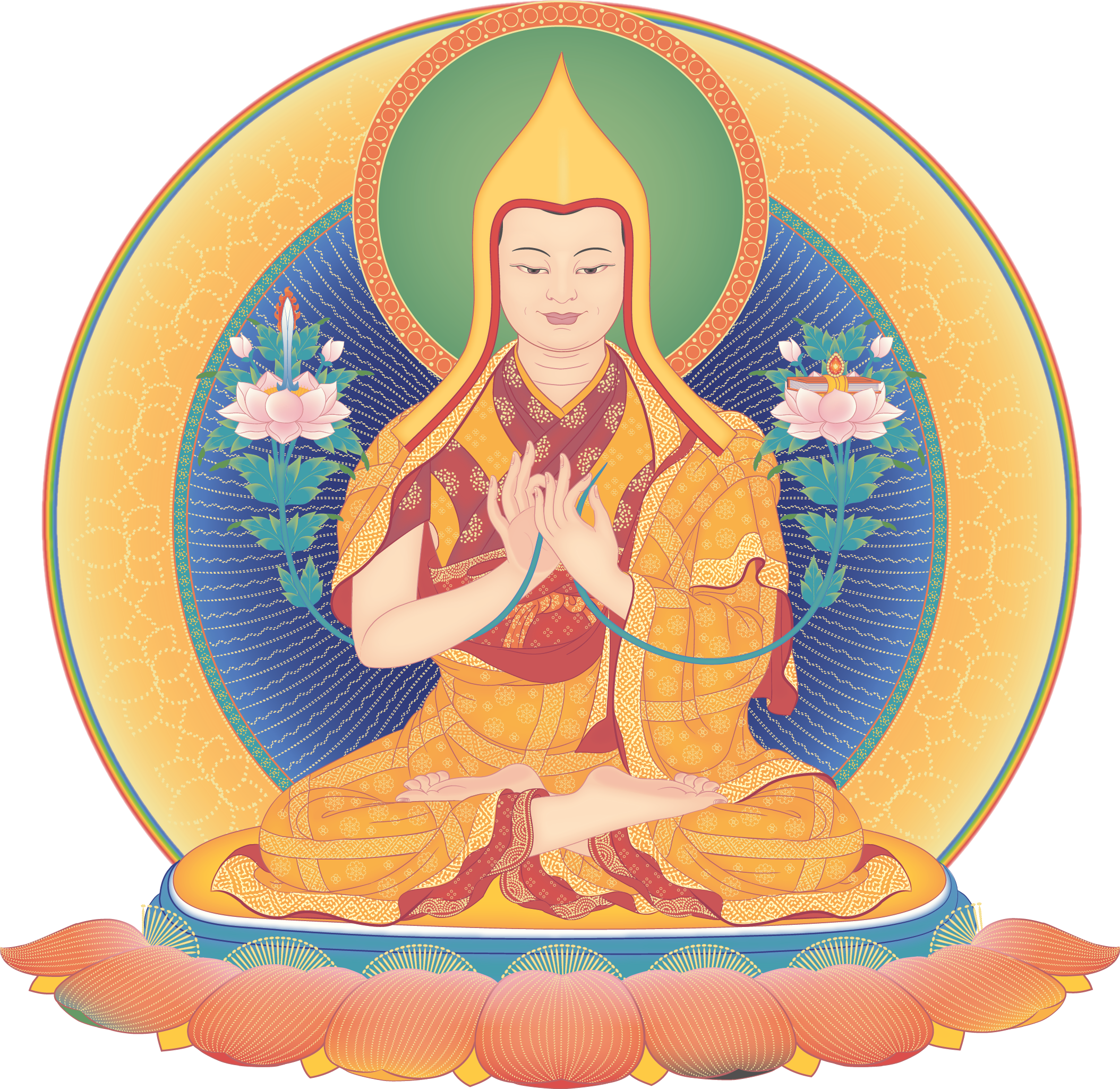
“As a supplement to the Commentaries there are many secret folios on the lives of the Buddhas and Bodhisattvas, and among these there is one on Prince Gautama and another on His reincarnation in Tsong-Kha-pa. This great Tibetan Reformer of the fourteenth century, said to be a direct incarnation of Amita Buddha, is the founder of the Secret School near Shigatse, attached to the private retreat of the Panchen Lama. It is with Him that began the regular system of Lamaic incarnations of Buddhas.”
“The records preserved in the Gon-pa, the chief Lamasery of Tashilhumpo, show that Sang-gyas [i.e. the Tibetan name for Buddha] left the regions of the ‘Western Paradise’ to incarnate Himself in Tsong-Kha-pa, in consequence of the great degradation into which His secret doctrines had fallen.”
(H. P. Blavatsky, “Tsong-Kha-Pa – Lohans in China” article, also in “Reincarnations in Tibet”)
~ * ~
THE FOLLOWING ARE EXCERPTS TAKEN FROM SEVERAL ARTICLES ON THIS SITE
It is said that before the birth in India 2,600 years ago of Siddhartha Gautama – he who became the Buddha, the Enlightened One – the gigantic blue lotus known as the Nila Udumbara burst into flower, something which is always regarded as an important spiritual omen of wonderful things to come. It is also said that the same thing occurred, this time near a lake at the foot of the Himalayas, just before the birth of Tsong-Kha-Pa in 1357 A.D. at Amdo, Tibet.
In “The Theosophical Glossary,” H. P. Blavatsky speaks of Tsong-Kha-Pa as “a famous Tibetan reformer of the fourteenth century, who introduced a purified Buddhism into his country. He was a great Adept, who being unable to witness any longer the desecration of Buddhist philosophy by the false priests who made of it a marketable commodity, put a forcible stop thereto by a timely revolution and the exile of 40,000 sham monks and Lamas from the country . . . Tsong-kha-pa . . . is the founder of the Gelukpa (“yellow-cap”) Sect, and of the mystic Brotherhood connected with its chiefs.”
This “mystic Brotherhood” and the “Secret School” referred to by HPB in the earlier quote are vitally and inseparably connected with the Trans-Himalayan Brotherhood and Esoteric School that are spoken of in Theosophy, although the latter pre-dates Tsong-Kha-Pa and the Gelugpas by millennia or even long ages. (See Mount Kailash and The Teachers of Buddha) The acting chief of the Brotherhood is the great Lama spoken of as the Maha Chohan. It is in the famous “Maha Chohan Letter,” also called “The Great Master’s Letter,” that we find these words, referring to the Dalai Lamas and the Panchen Lamas:
“The incarnations of the Bodhisattva, Padmapani, or Avalokiteshvara and of Tsong-kha-pa and that of Amitabha . . . we are the humble disciples of these perfect Lamas.”
One of HPB’s “inner group” of twelve specially chosen esoteric students was Alice Leighton Cleather, who in 1920 was one of the very first Westerners to be received into the Gelug order of Tibetan Buddhism.
In her book “Buddhism: The Science of Life,” she wrote, “Tsong-Kha-pa, the Hobilgan (Initiate) mentioned by K.H., was an incarnation of the Buddha for the purpose of reforming Tibetan Lamaism. He founded the Gelugpa or Yellow Order and the Hierarchy of the Tashi Lamas [i.e. another name for the Panchen Lamas] in whom he continues to re-incarnate in the manner described by K.H., in order to continue his work for Buddhism and humanity.”
The Master K.H., the Master M., Their Master the Maha Chohan, the great soul who was known to us as “HPB,” and all the other adepts, initiates, and chelas of the Trans-Himalayan Brotherhood, sometimes called the Tibetan Brotherhood, are connected in some way or another with the Gelug branch or school of Tibetan Buddhism, which has the Dalai Lama and the Panchen Lama as its outer representatives in the world. We say “connected in some way or another” because while in her article titled “Elementals” HPB speaks of “the Geluk-pas (yellow-caps), to which latter most of the adepts belong,” she speaks in another article (“Existence of The Himalayan Mahatmas”) of “our Mahatmas, who belong to no sect.”
The Gelugpas (literally meaning the “Virtuous Ones” or “Models of Virtue” and also originally known as the New Kadampas, besides being called the “yellow hats” and “yellow caps”) were officially founded by Tsong-Kha-Pa in 1409, and to the Masters this essentially equates the Gelugpas – and also Tsong-Kha-Pa’s Esoteric School – with being founded by Gautama Buddha himself, since they maintain that Gautama reincarnated in – not as but in – Tsong-Kha-Pa in order to rescue Buddhism from the terrible mess that it had fallen into in Tibet.
Tibetan Buddhism is a form of Mahayana Buddhism but it is also more than that, which is why it’s usually called Vajrayana Buddhism. Vajrayana, practically speaking, is Tantric Mahayana or Esoteric Mahayana. The term “Hinayana,” meaning “small vehicle,” “lesser vehicle,” or “lesser way,” is applied by Mahayanists to what now exists as Theravada Buddhism (often called Southern Buddhism by HPB and others in the Victorian era), while “Mahayana” means “great vehicle,” “greater vehicle,” or “great way,” and “Vajrayana” is translated “diamond vehicle,” “the diamond way,” or “the diamond path,” “diamond road,” etc. Vajrayana began in India among Indian Buddhists but was later almost wholly exported to Tibet. HPB never uses the term “Vajrayana” although she must have known it. She often uses the term “Northern Buddhism” for Tibetan Buddhism, although sometimes she means by it Mahayana Buddhism in general.
The Buddhism of Tibet has two aspects to it: the Sutra teachings and the Tantra teachings, which are also known respectively as the Sutrayana or Paramitayana or Bodhisattvayana and the Tantrayana or Mantrayana, sometimes referred to as “Secret Mantra.” Tibetan Buddhism as a whole is termed Vajrayana but it is specifically the Tantrayana/Mantrayana that makes it Vajrayana.
In the Gelug school of Tibetan Buddhism founded by the Theosophically revered Tsong-Kha-Pa at the start of the 15th century, it is always maintained that the spiritual aspirant must become properly developed and established in the Bodhisattva Ideal and the Bodhisattva Path of developing bodhichitta (the selfless aspiration to attain enlightenment solely to benefit and help all living beings) and perpetually practising the Paramitas (the “glorious virtues” or “transcendental perfections”) – in other words, the Sutrayana – before entering upon training and practice in Tantra.
Vajrayana, particularly its tantric aspect, is what the world knows of today as “Esoteric Buddhism.” For most people familiar with Buddhism, the phrase “Esoteric Buddhism” (often used in Theosophical literature and also the title of a book by A. P. Sinnett systematising teachings received in letters from HPB’s Teachers Morya and Koot Hoomi or Kuthumi) is a synonym for Vajrayana Buddhism. But the Esoteric Buddhism of the Trans-Himalayan Brotherhood is something more profoundly esoteric and secret than what one can now readily find and access in the publicly known Vajrayana, although it is indeed directly connected with the latter.
In the article Kalachakra and Theosophy we wrote:
“The real Kalachakra [Tantra] system and teachings are closely connected with the Masters and Initiates of the Trans-Himalayan Brotherhood and Esoteric School and vice versa. They were also historically considered the speciality of the Panchen Lama of [the Gelugpa] Tashilhumpo Monastery, Shigatse, with which H. P. Blavatsky and her Adept-Teachers were closely connected.
“In “The Mystery of Buddha,” which was initially intended to be published as part of “The Secret Doctrine,” HPB specifically states and explains that “What is given here is taken from the secret portions of Dus Kyi Khorlo (Kala Chakra, in Sanskrit, or the “Wheel of Time,” or duration).”
“Again, in “A Few More Misconceptions Corrected,” she talks about the Kalachakra, called “Dus Kyi Khorlo” in Tibetan, saying:
“. . . the “Dus-kyi Khorlo,” or Tibetan Mysticism. A system as old as man, known in India and practised before Europe had become a continent, “was first known,” we are told [i.e. by the Orientalists and academics], only nine or ten centuries ago. The text of its books in its present form may have “originated” even later, for there are numerous such texts that have been tampered with by sects to suit the fancies of each [Note: This point is important and should help us avoid the mistake of equating the now publicly known Kalachakra Tantra of Tibetan Buddhism with the real thing, although there must inevitably be multiple commonalities]. But who has read the original book on Dus-Kyi Khorlo [i.e. Kalachakra], re-written by Tsong-Kha-pa, with his Commentaries? . . . this grand Reformer burnt every book on Sorcery on which he could lay his hands in 1387 . . . he has left a whole library of his own works – not a tenth part of which has ever been made known.”
“Saying that the Kalachakra is “a system as old as man” seems equivalent to saying that the real Gupta Vidya or Secret Doctrine is the real Kalachakra.”
At Tashilhumpo or Tashilhunpo Monastery in Tibet, historically the seat of the Panchen Lama reincarnation lineage (the Panchen Lamas being the second most important figures in the Gelug or Gelugpa branch of Tibetan Buddhism, the Dalai Lamas being considered the highest, although HPB says that from the perspective of esoteric authority and importance the Panchen Lamas are the highest), there was for centuries a general tantric college for Gelug Lamas, much like there is or was at many Tibetan monasteries, but also a Kalachakra college or school, to which only a very small number of select Lamas were admitted. In the whole vast arena of Tibetan Buddhism, it is only really the Gelugpas and the much smaller and far less influential Jonangpas who pay much attention to the Kalachakra Tantra, and even among the Gelugpas many favour other systems of Gelug tantra, numerous of which were also taught at Tashilhunpo and elsewhere.
This was all going on while H. P. Blavatsky was in Tibet and visiting Tashilhunpo with some of the Masters, and it continued up until the Chinese invasion and virtual destruction of the country in the 1950s. It seems plausible that the Kalachakra school at Tashilhunpo just spoken of, presided over by the Panchen Lamas, who were considered the leading expert on the esotericism of the Kalachakra Tantra, may be the same as “the Secret School near Shigatse, attached to the private retreat of the Panchen Lama” which HPB stated in her article “Tsong-Kha-Pa – Lohans in China” was founded by Tsong-Kha-Pa himself.
In her article “Practical Occultism” HPB translates twelve rules for instructors of chelas in the Tibetan Brotherhood. One speaks of the teacher or Guru imparting to his disciple “the good (holy) words of LAMRIN.” HPB comments: “”Lamrin” is a work of practical instructions, by Tson-kha-pa, in two portions, one for ecclesiastical and exoteric purposes, the other for esoteric use.”
The Lam Rim or Lam Rim Chen Mo – “The Great Treatise on The Stages of The Path to Enlightenment” – is Tsong-Kha-Pa’s most well known work and is nowadays published in English and easily accessible to everyone. It’s possible that by the “portion for esoteric use” she actually means the Ngak Rim Chen Mo, Tsong-Kha-Pa’s other main work, “The Great Exposition of Secret Mantra,” also now published in English. The Lam Rim is the fullest embodiment of his Sutra teachings and the Ngak Rim of his Tantra teachings. It is very likely, however, that what is publicly accessible is not the most truly esoteric and complete versions of these works. HPB’s wording may also mean that there is an exoteric Lam Rim and an esoteric, secret Lam Rim.
Sexual tantra is strictly forbidden to Gelugpa Lamas and monks. This dates back to Tsong-Kha-Pa’s requirement of celibacy and chastity under all circumstances for ordained members of his Order. This is one of the ways in which the Gelug school is unique within Tibetan Buddhism. Sexual tantra is, however, not condemned or warned against by the Gelugpas. They do not express an issue with those of the other schools or traditions of Tibetan Buddhism – i.e. Nyingma, Kagyu, Sakya, and Jonang – practising or promoting it, and in most cases genuinely respect the others’ right to do as they wish.
This piece of information will certainly be most objectionable to students of Theosophy. Some will say and think “Tsong-Kha-Pa could never have inculcated or endorsed such attitudes.” If we believe HPB and the Masters to be reliable sources, it indeed seems extremely unlikely that he would have done so, since his views as to what constitutes black magic would presumably have been the same as the Trans-Himalayan Brotherhood. It is quite possible though that this may actually have its origins with Tsong-Kha-Pa, for his own teachers and gurus belonged to those other schools of Tibetan Buddhism, in which sexual tantra and other dark elements had become welcome and accepted. While Tsong-Kha-Pa himself did not welcome and tolerate such things for his monks or for himself, he did make the practice of “devotion to the Guru” the essential foundation of his teaching and system. As expressed in his “The Foundation of All Good Qualities”:
“The foundation of all good qualities is the kind and perfect, pure Guru;
Correct devotion to him is the root of the path.
By clearly seeing this and applying great effort,
Please bless me to rely upon him with great respect.”
For Gelugpas and all other Tibetan Buddhists, to criticise or depreciate any of one’s gurus and spiritual teachers, or to condemn or demean any organisation or group that they choose to be involved with, is a terrible act with severe karmic consequences. Tsong-Kha-Pa himself affirmed this.
But no “monastic” of the Gelug Order is permitted by Tsong-Kha-Pa’s ordinances to engage in such things and from the Theosophical perspective no-one – monk, layperson, or otherwise – should be attempting any type of sexual yoga. It is a dragging down, to the physical, sensual, bodily plane, of the ideal of real tantra, the sexual aspects of the symbolism, imagery, and language of which are intended to be just that: symbolic. This is shown and explored in great depth in our article Theosophy and Tibetan Buddhist Tantra.
The present Dalai Lama’s older brother directly stated (in his 1968 book “Tibet: An Account of the History, The Religion & The People of Tibet”) that Tsong-Kha-Pa was not in favour or support of sexual tantric practice and taught and inculcated for the Gelugpas a non-sexual, non-sensual system of occult development. Thubten Jigme Norbu (the Dalai Lama’s brother) explained regarding Tsong-Kha-Pa:
“He took the old Gods and demons, images and paintings of which filled the temples and monasteries of the day and nearly all of which had non-Buddhist origins, and he taught the symbolic meaning of each. . . . the Tantric symbols and practices were transmuted for use simply as symbols “with a view to right understanding” on higher planes of mentation. In this way the symbol of sexual union was emphatically declared to be a symbol of the union of knowledge and activity, leading to the right application of knowledge, or power. It in no way licensed sexual activity as a practice leading to spiritual advancement, as some of the old sects now taught. . . . The use of liquor and narcotics was equally forbidden to all Gelukpa, and once again Tsong Khapa saw that it was best to stress the symbolic meaning of intoxication and of meat eating – another practice which some old sects said had spiritual power. To simply deny them . . . would only achieve a limited end within his own following. By offering a symbolic interpretation he hoped to be able to slowly introduce reform into the other sects.”
What Tsong-Kha-Pa taught in this regard is still classed as tantra but it was pure tantra or what H. P. Blavatsky calls “white tantra.”
Tsong-Kha-Pa is often said by the Gelugpas to have combined and united the two aspects of Sutra and Tantra in the most perfect and excellent way, but, unlike the older schools of Tibetan Buddhism, he always emphasised the need to have thoroughly mastered the Sutrayana – i.e. the ethics, virtues, wisdom, and boundless compassion of the Bodhisattva Path – before embarking upon the Tantrayana. Customarily, Gelug monks were only permitted to engage with tantra after being approved and permitted by their instructors.
“Lam Rim” (literally “Stages of The Path”) was not exactly Tsong-Kha-Pa’s own discovery or innovation, although there is of course much that is “his” in his most celebrated work “Lam Rim Chen Mo.” But after Gautama Buddha himself, the 10th century Indian Buddhist teacher Atisha – founder of the Kadampa tradition or school, from which Tsong-Kha-Pa would eventually derive the name “New Kadampa” as a synonym for the Gelugpas – was the primary influence on Tsong-Kha-Pa’s thought, ideas, and teaching. Atisha spent the latter part of his life in Tibet and described his graduated teachings as “Lam Rim.”
Thubten Jigme Norbu explains that much like Tsong-Kha-Pa himself, his predecessor Atisha “saw the terrible state of degeneration that had come about through a misunderstanding of the tantras, but he refused to give in to those who counseled that they should be abolished. He set about teaching the tantras as only a philosopher of his stature could, elevating them to the highest spiritual level, removing them from any but symbolic connection with physical action. He himself, however, advised that only two of the four tantric initiations should generally be considered since the other two could mislead the aspirant. . . . At the same time that he supported the tantras, however, Atisha also taught the pure Theg Chen [i.e. Mind Training] doctrine, free of all tantric elements. One of his greatest contributions to Tibetan Buddhist literature is a discourse in pure Theg Chen tradition upon the different goals that man may set for himself and their relative value. . . . Here he clearly said that the tantras should only be followed by those who had passed through the previous stages of ethical (Theg Men) and philosophical reflection (Theg Chen), and that the actual practice of tantra was a purely spiritual affair, in no way calling for a female counterpart or the use of intoxicants, and in no way permissible for the selfish goal of self-advancement.”
An online article titled “The Gelug Tradition” by Miranda Adams says:
“Often portrayed as quite conservative both doctrinally and politically, there survives in the Gelug tradition a serious tension between the inclusion [and rejection] of officially proscribed teachings. The 5th Dalai Lama famously repressed the Jonang tradition and forcibly converted a number of Jonang, Kagyu, and Nyingma monasteries. Nevertheless many Dalai Lamas and other prominent Gelug hierarchs have engaged in non-Gelug teachings and practices. This has led to a backlash from more conservative members of the tradition, most visibly in the controversy over the deity Dorje Shugden (rdo rje shugs ldan). This Gelug protector deity is embraced by many Gelug followers, said to be charged with keeping the tradition pure (that is, purging the Gelug of those who embrace other, primarily Nyingma, teachings). Seen by many as an attack on the Dalai Lamas from within the tradition, worship of this deity is discouraged by the current Dalai Lama, who, since going into exile and taking on the role of leader of the Tibetan people, has embraced an ecumenical position unacceptable to more conservative-minded Gelug hierarchs.”
This touches upon the Dorje Shugden controversy which has proved very divisive and schismatic within the Gelugpas since the last few decades of the 20th century and has caused the Gelug tradition to be very fractured, with some now rejecting the present Dalai Lama as a spiritual authority. The New Kadampa Tradition founded by Geshe Kelsang Gyatso is the most famous example of this. A few years ago, however, the Reuters news agency provided compelling evidence that the Western Shugden Society, spearheaded by Geshe Kelsang Gyatso and leading NKT members, along with their colleagues in India, were knowingly on the payroll and under the direction of the Chinese government, who were particularly involved with their aggressive public protests and campaigns of harassment and defamation against the Dalai Lama. As soon as Reuters went public with this carefully gathered information, the Western Shugden Society ceased all its activities and soon thereafter legally dissolved itself, without any explanation or statement, an action which seems very much like an admission of guilt.
We will not explore the Dorje Shugden controversy here but quote the above because the Dalai Lama’s great openness to and acceptance of all forms or schools of Tibetan Buddhism may be seen by some Theosophists as one sign of his having distanced himself from what appears to be the position of the Masters of the Trans-Himalayan Brotherhood.
In the 1970s, the Dalai Lama issued a statement that “the teachings of these schools can be used without any contradiction whether one practices the way of the Sutra or that of the Tantra, or with both together. Though there are many schools of Buddhist thought in Tibet, the differences between them are only superficial, and there is no schism within the system as is to be found in Christianity.” One might ask why, if this is true, Tsong-Kha-Pa even bothered to establish the Gelugpas in the first place! Why go to the tremendous effort and labour of establishing a new system and emphasising how it differs from the others if “the differences between them are only superficial”? It is widely believed that such statements as these from the Dalai Lama are intended to counteract the problems of extreme sectarianism, which has been prevalent in Tibet for centuries.
Nonetheless, all biographical accounts of the life and spiritual journey of Tsong-Kha-Pa himself – including accounts from his own personal disciples – show that prior to establishing the Gelugpas he studied seriously, respectfully, and at length, with advanced Lamas from various other Tibetan Buddhist schools, including the Nyingmapas that had been founded by Padmasambhava and which is often viewed as akin to the polar opposite of the Gelugpa approach and attitude to things. His main inspiration was seemingly always the original Kadampa tradition established by Atisha but he apparently did not confine himself to that in either his studies or his meditative and tantric practices. Tsong-Kha-Pa was famously an eclectic synthesiser of knowledge.
In her “Theosophical Glossary” entry for “Dugpas,” H. P. Blavatsky’s wording implies that Tibetan Buddhism became to a large extent degraded and corrupted sometime between its establishment and the time of Tsong-Kha-Pa. The insinuation is that when Buddhism was established in Tibet around the 8th century C.E./A.D. – and which was due very largely and indispensably to Padmasambhava, as no-one has ever denied – it was not problematic. In fact, HPB confirms more specifically elsewhere that this was the case, saying “Between the ninth and tenth centuries . . . in those days, the pure religion of Sakya Muni had already commenced degenerating into that Lamaism, or rather fetichism, against which four centuries later, Tsong-kha-pa arose with all his might.” (“Reincarnations in Tibet”)
“As a supplement to the Commentaries there are many secret folios on the lives of the Buddhas and Bodhisattvas, and among these there is one on Prince Gautama [i.e. Gautama Buddha, the historical Buddha of 2,600 years ago] and another on His reincarnation in Tsong-Kha-pa [Note: That Tsong-Kha-Pa was an incarnation of Buddha himself was a secret teaching, which has never been disclosed or even hinted at by any Gelugpa or other Lamas, but which HPB made public to the world, albeit saying very little indeed on the matter. He is generally believed by Gelugpas to have been in some way an emanation of the Bodhisattva Manjushri, who he described as his main inspirer.]. This great Tibetan Reformer of the fourteenth century said to be a direct incarnation of Amita [i.e. Amitabha] Buddha is the founder of the secret School near Tji-gad-je [i.e. Shigatse in Tibet] attached to the private retreat of the Teshu Lama [i.e. Panchen Lama, often referred to in HPB’s time as the Tashi Lama or other variants of this, due to his monastery being Tashilhumpo].” (“Amita Buddha, Kwan-Shai-Yin and Kwan-Yin — What the “Book of Dzyan” and the Lamaseries of Tsong-Kha-Pa Say”)
“Tsong-Kha-pa . . . was an incarnation of Amita Buddha Himself. The records preserved in the Gon-pa, the chief Lamasery of Tda-shi-Hlumpo [i.e. Tashilhumpo or Tashilhunpo Monastery in Shigatse, Tibet, historically the seat of the Panchen Lama], show that Sang-gyas [i.e. the Tibetan name for Buddha] left the regions of the “Western Paradise” [i.e. a Buddhist name for a particular celestial realm – the “Pure Land” of Amitabha Buddha – but said by HPB to often mean Shambhala] to incarnate Himself in Tsong-Kha-pa, in consequence of the great degradation into which His secret doctrines had fallen [in Tibet].” (“Tsong-Kha-Pa – Lohans in China”)
For more on the above points, please see The Mystery of Buddha.
Two apparently antithetical philosophical worldviews exist within Mahayana Buddhism: Madhyamaka (often spelt “Madhyamika” during the time of H. P. Blavatsky) and Yogachara or Yogācāra (typically written as “Yogacharya” by HPB and her contemporaries). Both these fundamental perspectives have their original basis in different Mahayana scriptures in which the Buddha himself is presented as having taught both perspectives on different occasions. In some instances, the two schools of thought base themselves on the same set of scriptures but interpret and understand them differently. There is also a third and less frequently encountered philosophical viewpoint, known as Shentong or Tathagatagarbha, which has its basic ideological origins and inspiration in the Yogachara approach but which is not the same as it, although sometimes the two are blended together.
Madhyamaka (popularised by Nagarjuna in India in the 2nd to 3rd century C.E./A.D.) and Yogachara (popularised by Asanga and his half-brother Vasubandhu in India in the 4th century C.E.) agree on the vast majority of Buddhist concepts and doctrines. But where they disagree is on some of the most fundamental questions, such as “What is the nature of reality?” and “What is the ultimate nature of ourselves?”
Madhyamaka and Yogachara agree that the nature of everything is emptiness, voidness, or shunyata in Sanskrit. But Madhyamaka holds that emptiness is itself empty and completely devoid of any essence, self, or actual reality. Emptiness does not truly exist in any absolute sense. Emptiness, like everything phenomenal, is itself subject to ceaseless impermanence and flux, and only has any “existence” in interdependence on all other things, hence is just as subject to “dependent origination” as is everything else. In Prasangika-Madhyamika, emptiness itself is considered phenomenal, as it is maintained that there is nothing “noumenal.”
Madhyamaka believes that anything that can be affirmed about the ultimate nature of reality must of necessity be false and a mistaken approach that can only lead to problems. Even such phrases as “the ultimate nature of reality” or “the ultimate reality” are typically avoided, since they can lead to notions of an ultimate, absolute, eternal “Something,” whereas for them, although they acknowledge that everything is Shunyata or emptiness, they are careful to make it known that this emptiness is not conceived as any type of ultimate, infinite, absolute, eternal, self-existent Reality or Principle or Essence or Energy, but is literally an empty emptiness, devoid of any true reality or independent, permanent, unchanging existence of its own. Some Madhyamakas may not hold to such an idea – and texts typically considered Madhyamaka scriptures, such as the Prajnaparamita sutras, do not take their negation to such an extreme extent – but this is certainly the view of Prasangika-Madhyamaka.
To the surprise and bewilderment of many Theosophists, all the evidence that is available exoterically shows Tsong-Kha-Pa to have been an ardent Prasangika-Madhyamaka. Some scholars consider his version of Prasangika-Madhyamika to be the most extreme form of it.
At the same time, he often wrote of his reverence for Asanga but this seems to have only been a partial reverence, as he also spent much time (such as in his Lam Rim Chen Mo) criticising and attempting to refute Yogachara doctrines, dismissively calling the Yogacharas “essentialists,” and arguing that they can only be correctly understood when filtered through the lens of Madhyamaka. He nonetheless made clear his great and uncritical appreciation for some of Asanga’s less overtly “Yogachara” writings, such as his celebrated book Bodhisattvabhumi, “The Stages of a Bodhisattva” or “Levels of The Bodhisattva Path.”
It is important to bear in mind, however, that although the Prasangika-Madhyamaka approach is taken by Tsong-Kha-Pa and the Gelugpas in general in their sutra teachings (i.e. their exoteric, outer teachings, aimed primarily at the uninitiated), a more esoteric and quite a lot more Theosophical position is taken in their tantra teachings. What we wrote in The Essence of Buddhism is applicable here:
“The tantric or esoteric teachings of Tibet’s Vajrayana Buddhism [describe] a twofold but eternally indivisible and unbroken continuum [in the human being]: the mindstream, continually accompanied and enveloped by an extremely subtle “energy field,” sometimes called a field of subtlest prana, the subtlest energy “wind,” or subtlest body, which is the carrier or vehicle of the reincarnating mind, in whatever state or plane of consciousness it may be in, including life on earth and the experiences between lives. This is said to be of the highest and purest nature of light. . . . Some of the tantric (i.e. esoteric) teachings of Tibetan Buddhism state that at the ultimate level of non-dual reality, there is an indivisible unity of “absolute Space” and “primordial consciousness” or “primordial wisdom.” This is also expressed as absolute Space (i.e. that bare, boundless, unconditioned, unmanifest Space beyond, behind, or hidden within manifested space or the space we see in the sky) ever vibrating with infinite energy.”
One can find, for example, the Dalai Lama – the leading figurehead of the Gelug school of Tsong-Kha-Pa – occasionally publicly teaching the perspective just described above, and explaining that it is tantric, while the vast majority of the time he publicly teaches and promotes the non-tantric or non-esoteric Prasangika-Madhyamaka perspective.
There are several statements in the writings of H. P. Blavatsky that certainly give the impression that the Madhyamaka approach and philosophical worldview in general, and including its Prasanga or Prasangika variant, is of no esoteric importance or significance and is untheosophical and of no genuine value. But the more deeply one looks into her writings, the more one discovers extremely positive statements about Madhyamaka and also Prasangika-Madhyamaka.
“Mâdhyamikas (Sk.). . . . It was probably at first a sect of Hindu atheists. A later school of that name, teaching a system of sophistic nihilism, that reduces every proposition into a thesis and its antithesis, and then denies both, has been started in Tibet and China. It adopts a few principles of Nâgârjuna, who was one of the founders of the esoteric Mahayâna systems, not their exoteric travesties. The allegory that regarded Nâgârjuna’s “Paramartha” [i.e. the 100,000 verse Prajnaparamita Sutra or “Perfection of Wisdom Sutra in One Hundred Thousand Lines,” the largest of the Prajnaparamita or Madhyamaka sutras, which Nagarjuna is said to have brought back with him from “the realm of the Nagas” after being invited there by them; HPB repeatedly refers to the text as “Paramartha,” which is not its title but it does indeed deal with the subject of Paramartha or “the ultimate”] as a gift from the Nâgas (Serpents) shows that he received his teachings from the secret school of adepts, and that the real tenets are therefore kept secret.” (“The Theosophical Glossary” p. 196)
“To say as the Esoteric or Mystic School teaches, that though Buddha is in Nirvâna he has left behind him the Nirmânakâya (the Bodhisattva) to work after him is quite orthodox and in accordance with both the Esoteric Mahâyâna and the Prasanga Mâdhyâmika Schools, the latter an anti-esoteric and most rationalistic system.” (“The Mystery of Buddha”)
But let us read this extremely positive appraisal by HPB of the esoteric Prasangika-Madhyamaka:
“And if the Yogâchâryas may be compared with or called the Tibetan Vishishtadwaitîs [i.e. meaning semi-dualists, a term used originally for one of the three main philosophical perspectives in Hindu Vedanta] the Prasanga School is surely the Adwaita [i.e. non-dualist, as in the Advaita Vedanta of Adi Shankaracharya in Hinduism] Philosophy of the land. It was divided into two: one was originally founded by Bhavya [i.e. Bhaviveka, 6th century C.E., considered the founder of the Svatantrika form of Madhyamaka] the Svantatra Madhyamika School and the other by Buddhapâlita [i.e. a contemporary of Bhaviveka and founder of Prasangika Madhyamaka, which a century later was expanded on and more strongly codified by Chandrakirti, whose approach in turn greatly influenced Tsong-Kha-Pa in 14th/15th century Tibet]; both have their exoteric and esoteric divisions. It is necessary to belong to the latter to know anything of the esoteric doctrines of that sect, the most metaphysical and philosophical of all. Chandrakirti (Dava Dagpa) wrote his commentaries on the Prasanga doctrines and taught publicly; . . . Thus the followers of the Prasanga School are nearer to Esoteric Buddhism than are the Yogâchâryas; for their views [i.e. those of the Prasanga-Madhyamaka, also written Prasangika-Madhyamaka] are those of the most secret Schools, and only the echo of these doctrines is heard in the Yamyangshapda [i.e. “Yamyang” is the Tibetan name “Jamyang,” equivalent to Manjushri, but we have not been able to work out what specific text this is referring to, aside from it probably being a standard Madhyamaka text; Schlagintweit’s “Buddhism in Tibet,” from which HPB at times heavily paraphrased but also criticised parts of, speaks of “Jam Yang Shapda” and implies that this was the name of a Tibetan philosopher] and other works in public circulation and use.” (“A Few More Misconceptions Corrected”)
So here we see the point being repeated that, as we put it earlier, “the “real tenets” of Nagarjuna’s esoteric Madhyamaka are “kept secret,”” and only their echo – i.e. a version of them, which can be distorted, and not the thing itself – is found in the publicly known Madhyamaka teachings.
But what about HPB’s numerous statements elsewhere that it is the Esoteric Yogacharya School – which she also calls the Secret Aryasanga School, Occult Aryasanga School, and simply the Esoteric Yogacharyas, who pre-dated by hundreds of years the historically known Arya Asanga and his public Yogacharya or Yogachara school – who possess the highest esoteric knowledge (including the Secret Book of Dzyan and Book of The Golden Precepts) and occult powers and that they are the Trans-Himalayan Esoteric School of the real Esoteric Buddhism?
Unless there are typographical errors or simply sheer mistakes in these passages from HPB – which is certainly a possibility, especially as these are quoted from unused drafts which she never approved for publication and were only published six years after her death – we can only assume that “The followers of the Prasanga School are nearer to Esoteric Buddhism than are the Yogâchâryas; for their views are those of the most secret Schools” is meant in the sense of “The followers of the Esoteric and publicly unknown Prasanga School are nearer to Esoteric Buddhism than are the Exoteric and publicly known Yogâchâryas; for their views are those of the most secret Schools.”
Although many mysteries and vaguenesses must still inevitably remain, further references regarding this, provided in the article Nagarjuna, Madhyamaka & Prasangika, might make it at least a little less confusing as to why the Theosophically revered Tsong-Kha-Pa and the Gelugpas which he founded, along with the leading Gelug figureheads such as the successive Panchen Lamas and Dalai Lamas, all adopted and maintained the Prasangika-Madhyamaka as their foundational philosophical basis and perspective, rather than choosing the Yogachara approach.
Interestingly, in HPB’s article “Are Dreams But Idle Visions?” she herself argues for a very Prasangika-Madhyamaka viewpoint: “We will then prove, perhaps, to the satisfaction of the non-prejudiced that the Absolute, or the Unconditioned, and (especially) the Unrelated, is a mere fanciful abstraction, a fiction, unless we . . . regard the Absolute merely as the aggregate of all intelligences, the totality of all existences, incapable of manifesting itself except through the interrelationship of its parts, as it is absolutely incognizable and non-existent outside its phenomena, and depends entirely on its ever-correlating forces, dependent in their turn on the One Great Law.” In other words, there is no Absolute unless by “Absolute” one means simply the collective aggregate of everything phenomenal, a collective aggregate which is indeed “dependent on, and, therefore, relative to other things” and thus subject in its own subtle way to what Buddhism calls dependent origination – this being exactly the essence of the Prasangika-Madhyamaka perspective of Tsong-Kha-Pa and others.
In “The Mahatma Letters” we find the Masters promulgating this same position several times. The Master M. writes in his “Cosmological Notes” that “The absolute and infinite is composed of the conditioned and finite. [The “infinite final cause” is] conditioned in [its] modes of existence and attributes, and as individual aggregates – unconditioned and eternal in their sum or as a collective aggregate.” From this and the previous quote, one could easily conclude that the absolute or ultimate reality is devoid of any fixed and unchanging permanence, is not truly independent in the sense of having its own unique existence transcendent of and separate from everything else, and is devoid of “self” or independent, isolated “essence” due to not truly being a “unit” or a “thing in itself” – and then the apparent serious discrepancy between Tsong-Kha-Pa’s ardent Prasangika position and that generally understood to be the Theosophical one is at last dissolved and resolved.
In “The Mahatma Letters,” the Master K.H. refers to “the highest form of adeptship man can hope for on our planet” and says that Gautama Buddha – who he calls the greatest and holiest man that ever lived – attained it and that the most recent person since Buddha to reach to such a state was Tsong-Kha-Pa. (p. 43-44)
All Theosophists are familiar with the idea that in the last quarter of every century an effort is made by the Great Brotherhood (of which the Trans-Himalayan Brotherhood is the chief, but not the only, centre) to bring about a progressive degree of spiritual awakening for humanity, especially the humanity of the western world. It was none other than Tsong-Kha-Pa, we are told, who instituted this centennial effort or end-of-century effort.
At the end of the 18th century, Franz Anton Mesmer was the main public agent of the Brotherhood for that effort and we read in “The Theosophical Glossary,” “It was the Council of “Luxor” which selected him – according to the orders of the “Great Brotherhood” – to act in the XVIIIth century as their usual pioneer, sent in the last quarter of every century to enlighten a small portion of the Western nations in occult lore. It was St. Germain who supervised the development of events in this case; and later Cagliostro was commissioned to help, but having made a series of mistakes, more or less fatal, he was recalled. Of these three men who were at first regarded as quacks, Mesmer is already vindicated. The justification of the two others will follow . . .”
At the end of the 19th century, it was of course H. P. Blavatsky, who was helped and assisted the most effectively in the work by her friend and associate William Quan Judge. Together, along with several others, they founded the modern Theosophical Movement on 17th November 1875. That date of 17th November, stated by HPB in “The Secret Doctrine” to be of great esoteric significance, was interestingly also the date chosen (in 1950) for the present Dalai Lama’s enthronement as full leader of Tibet.
The most recent centennial effort would have been at the end of the 20th century, during the 1975-2000 period. Many Theosophists remain somewhat – or even very – uncertain as to what exactly happened during this period, in terms of the Masters’ public work. Both B. P. Wadia and Raghavan Iyer presented the interesting idea that Tsong-Kha-Pa only instituted seven “centenary impulsions” – with 1975-2000 marking the seventh and culmination – rather than an unending chain of them.
Perhaps part of the answer and explanation to all of these things can be found in these words written by HPB, which were not published until after she had passed away, although they do appear in an abbreviated form in her article “Tibetan Teachings”:
“Among the commandments of Tsong-Kha-pa there is one that enjoins the Rahats (Arhats) to make an attempt to enlighten the world, including the “white barbarians,” every century, at a certain specified period of the cycle. Up to the present day none of these attempts has been very successful. Failure has followed failure. Have we to explain the fact by the light of a certain prophecy? It is said that up to the time when Panchen Rimpoche (the Great Jewel of Wisdom) condescends to be reborn in the land of the P’helings (Westerners), and appearing as the Spiritual Conqueror (Chom-den-da), destroys the errors and ignorance of the age, it will be of little use to try to uproot the misconceptions of P’heling-pa (Europe): her sons will listen to no one.”
We all have suffered, we all do suffer, and we all will suffer; this is the first of Buddha’s Four Noble Truths. Tsong-Kha-Pa encourages us to remind ourselves of the many positive aspects and potentials of this:
“Suffering has five good qualities: (1) The good quality of spurring you on to liberation. This is because if you had no suffering, you would not develop the determination to be free of it. (2) The good quality of dispelling arrogance. This is because when suffering strikes you, it reduces your sense of superiority. (3) The good quality of causing you to shun sin. This is because when you experience very painful feelings, they arise from nonvirtue, so if you do not want these effects, you must avoid their causes. (4) The good quality of causing you to like cultivating virtue. This is because when you are tormented with suffering, you desire happiness, and once you want it, you must cultivate the virtue that causes it. (5) The good quality of producing compassion for those who wander in cyclic existence. This is because after you have assessed your own situation, you think, “Other beings suffer like this.” (Tsong-Kha-Pa, Lam Rim Chen Mo, Vol. 2, on the Paramita of Patience and “Reflecting on the good qualities of suffering”)
“Our world-honoured Tsong-kha-pa closing his fifth Damngag reminds us that ‘every sacred truth, which the ignorant are unable to comprehend under its true light, ought to be hidden within a triple casket concealing itself as the tortoise conceals his head within his shell; ought to show her face but to those who are desirous of obtaining the condition of Anuttara Samyak Sambodhi [i.e. synonymous with ultimate bodhichitta; see The Essence of Buddhism]‘ – the most merciful and enlightened heart. There is a dual meaning, then, even in the [Tibetan Buddhist] canon thrown open to the people, and, quite recently, to Western scholars. . . . [These records] contain no fiction, but simply information for future generations, who may, by that time, have obtained the key to the right reading of them.” (“The venerable Chohan-Lama” quoted in H. P. Blavatsky’s article “Tibetan Teachings”)
 T H E O S O P H Y
It is said, that “The Secret Doctrine” contains preparation for the true Kalachakra initiation.
An aspect of his reform, was on inner planes, an Occult reform. An aspect of this was that the head of the Red Caps had to incarnate in his “dominion.”
This cycle, in one sense, an intense battle for the thinking, the ideas, of humankind,
There is a direct relationship between the thinking ( the basis of action) and actions of humanity, that generate causation that aids or hinders the work OF THE GREAT BROTHERHOOD.
IT IS NO ACCIDENT that Shigatse has been lost. The head of the Red Caps no longer has to incarnate at……………….
The statues of Bamiyan target practice for the Taliban in Afghanistan. No accident.
It is suggested, that a great inner battle is waging. All attempts being made to negate the work and teachings given by those GREAT TEACHERS that are behind the true effort of Presenting Theosophy to the world.
Distort and materialize their teachings, and the key is lost to the right understanding of the Teachers, their teachings, and the end in view that leads to …………….
In older versions of “Light on the Path” there is at the beginning-
“FOR THE PERSONAL USE OF THOSE WHO ARE IGNORANT OF THE EASTERN WISDOM, AND WHO DESIRE TO ENTER WITHIN ITS INFLUENCE.”
Distort the original teachings and how to enter the ancient current is lost.
Loved the research thanks!!
So who is this person and how will we know? Grace Knoche says in the “Mystery Schools ” most of the buddhas and prophets come back during winter solstice,could he have arrived on the Sag\Cap cusp?
Hello Tim, when you say “who is this person?” are you referring to Tsong Kha-pa? We have not read the book by Grace Knoche that you mention but we are aware that as a former Leader of “The Theosophical Society – Pasadena” she was naturally very influenced by the teachings of G. de Purucker . . . but Purucker’s teachings are in some major respects not representative at all of the original Theosophical teachings, i.e. those of H. P. Blavatsky and William Q. Judge.
This idea you refer to about the Winter Solstice we know to be related to some of Purucker’s ideas and in light of what we know about him and his other teachings we do not give it any credence.
Rather than taking our word for it that Purucker made serious and unfounded alterations to the teachings of Theosophy, you’re invited to take a look at such articles on this site as “The Point Loma & Pasadena “Successorship” Claim Exposed” (https://blavatskytheosophy.com/the-point-loma-pasadena-successorship-claim-exposed/), “The Divine Plan” by Geoffrey Barborka – A Review” (https://blavatskytheosophy.com/the-divine-plan-by-geoffrey-barborka-a-review/), and “Purucker Says The Absolute Was Once a Man” (https://blavatskytheosophy.com/purucker-says-the-absolute-was-once-a-man/).