

Mahayana Buddhism is the largest and most influential form of Buddhism in the world, accounting for around 65 to 70% of the world’s Buddhists. It is the Buddhism of such countries as Tibet, China, Japan, Mongolia, Bhutan, Vietnam, South Korea, Russia, and others too.
Mahayana Buddhism includes such traditions as Vajrayana (the tantric Mahayana of Tibet and surrounding countries), the Chan Buddhism of China, the Zen Buddhism of Japan, and Pure Land Buddhism of China and Japan.
Two apparently antithetical philosophical worldviews exist within Mahayana: Madhyamaka (often spelt “Madhyamika” during the time of H. P. Blavatsky) and Yogachara or Yogācāra (typically written as “Yogacharya” by HPB and her contemporaries). Both these fundamental perspectives have their original basis in different Mahayana scriptures in which the Buddha himself is presented as having taught both perspectives on different occasions. In some instances, the two schools of thought base themselves on the same set of scriptures but interpret and understand them differently. There is also a third and less frequently encountered philosophical viewpoint, known as Shentong or Tathagatagarbha, which has its basic ideological origins and inspiration in the Yogachara approach but which is not the same as it, although sometimes the two are blended together. We will refer to this later.
Madhyamaka (popularised by Nagarjuna in India in the 2nd to 3rd century C.E./A.D.) and Yogachara (popularised by Asanga and his half-brother Vasubandhu in India in the 4th century C.E.) agree on the vast majority of Buddhist concepts and doctrines. But where they disagree is on some of the most fundamental questions, such as “What is the nature of reality?” and “What is the ultimate nature of ourselves?”
Both speak frequently of Shunyata – emptiness or voidness – and both typically deny the existence of anything that can properly be called “self” or “Self,” although some of the “Books of Maitreya” transcribed by Asanga do affirm that the Buddha Nature which is equally present within all beings is a type of pure, universal, impersonal Self or Atman. And, as mentioned, both typically have genuine great respect for the same scriptures and sacred texts but emphasise some more than the other and arrive at different understandings on the most primary metaphysical subject.
To summarise it as briefly and simply as possible: Is there an ultimate or absolute underlying essence and definite primordial reality at the innermost core of human beings and of all manifestation?
Yogachara says yes, even though it typically considers “self,” “soul,” or “spirit,” to be misnomers for this. Madhyamaka – especially the Prasangika form of Madhyamaka – ordinarily says no.
We added the word “ordinarily,” as there are some Buddhists who might describe themselves as Madhyamaka but actually adhere to a sort of hybrid or blend of Madhyamaka and Yogachara perspectives, such as the Nyingma, Kagyu, and Jonang schools of Tibetan Buddhism. Nyingmapas (whose earliest founders, such as Padmasambhava, were tantric or deeply esoteric Yogacharas who made clear that they did not agree with Madhyamaka thought and openly criticised it; some later Nyingmapas sought to create a Yogachara-Madhyamaka synthesis) and Kagyupas are actually mostly predominantly Yogachara-esque in their thought but do not subscribe to all aspects of the classical Yogachara of Asanga and Vasubandhu. Some members of these schools – especially the Jonangpas – also subscribe to the Shentong understanding of the Tathagatagarbha (Buddha Nature) sutras. Some of these might answer the above question with a resounding “yes” while others would say “yes and no” and then proceed to elaborate.
Yogachara takes the route of affirming while Madhyamaka prefers to deny and negate, using what has been called “the negative dialectic” of non-affirming negation.
In other words, Madhyamaka believes that anything that can be affirmed about the ultimate nature of reality must of necessity be false and a mistaken approach that can only lead to problems. Even such phrases as “the ultimate nature of reality” or “the ultimate reality” are typically avoided, since they can lead to notions of an ultimate, absolute, eternal “Something,” whereas for them, although they acknowledge that everything is Shunyata or emptiness, they are careful to make it known that this emptiness is not conceived as any type of ultimate, infinite, absolute, eternal, self-existent Reality or Principle or Essence or Energy, but is literally an empty emptiness, devoid of any true reality or independent, permanent, unchanging existence of its own. Some Madhyamakas may not hold to such an idea – and texts typically considered Madhyamaka scriptures, such as the Prajnaparamita sutras, do not take their negation to such an extreme extent – but this is certainly the view of Prasangika-Madhyamaka.
Both Madhyamaka and Yogachara are seeking to practise the Middle Way or Middle Path enjoined by Buddha. The very name “Madhyamaka” literally means “middle way” while “Yogachara” means “yoga practice.”
The Buddha always stressed the need and value of the Middle Way in everything, a central and direct way that avoids all extremes, exaggerations, and diversions of whatever kind. His most well known enunciation of the Middle Way was in regard to one’s actions: enlightenment cannot be reached through either harsh and self-punitive asceticism nor through a sensually indulgent and hedonistic way of life.
But the Middle Way doesn’t mean combining aspects of both extremes. Instead, it represents the unique “centre path” that stands firmly between both extremes and does not contain either of them.
In the example of one’s actions just given, the Middle Way prescribed by Gautama Buddha was what he called the Noble Eightfold Path. In this, one is directly or practically involved with life but conducts oneself in the most noble and elevated way possible, both outwardly and inwardly, through right intention, right speech, right action, right livelihood, right effort, right concentration, etc.
In the Middle Way as applied to philosophical outlook and understanding, the aim is to avoid the two extremes of eternalism or absolutism and nihilism or non-existence.
In the Yogachara view, Madhyamaka – and especially its Prasangika form – has failed in its attempt to find the Middle Way and has ended up dangerously close to nihilism (H. P. Blavatsky strongly agrees, as we will see shortly, although surprisingly she doesn’t lay the blame for this with Nagarjuna, like most would, but implies that his teachings have been misunderstood, misrepresented, and distorted in their present form; it’s also important to note that the nihilism referred to here is not the same as the gloomy nihilism of an atheist-materialist but rather a much more subtle and abstruse type of metaphysical nihilism.) while the Madhyamakas consider Yogachara to be far from the Middle Way, due to what they perceive as its “absolutist” and “essentialist” (i.e. believers in an inherent “essence” or real and abiding nature within things) tendencies. That essence or nature is still spoken of in Yogachara in almost exclusively “negative” terminology, such as emptiness, the existence of the no-self, the existence of non-existence, the unconditioned reality of non-duality, etc. but this is still too definite, affirmative, and absolutist to the perceptions of a true Madhyamaka, for whom the slightest “definite” statement regarding what Shunyata is is a step too far.
Buddha taught that it is a mistake to see the world and our experience of life as real but that it is also a mistake to see it as unreal. The logical mind and intellectual reasoning cannot satisfactorily solve that paradox. Only a direct and experiential perception of things, arrived at largely through meditation and which inevitably transcends all possible formulation in words, can do so. Madhyamaka and Yogachara agree that although gaining understanding through words can be useful up to a certain point, it is ultimately inadequate.
There is also the Tathagatagarbha (Buddha Nature) perspective, known as Shentong, which is not the same as Yogachara but has some links with it, mainly due to one of the main Tathagatagarbha sutras being the Uttara Tantra, one of the five Books of Maitreya transcribed or recorded by Asanga but attributed in authorship and inspiration to the Bodhisattva Maitreya, the future Buddha. Tathagatagarbha sutras directly affirm that our Buddha Nature is indeed true, pure Self – the Atman – and, while still speaking of Shunyata or emptiness/voidness, they maintain that the ultimate reality is both voidness and fullness. As one would expect, this is even more distasteful to the Madhyamaka than is the Yogachara. We should add though that all forms of Mahayana Buddhism believe in and speak of “Buddha Nature” but their understanding and definition of it differs.
In a way that will inevitably be somewhat oversimplified, we may very briefly sum up the chief distinction between Madhyamaka, Yogachara, and Shentong/Tathagatagarbha thought as follows:
MADHYAMAKA – The nature of everything is emptiness. Emptiness is itself empty and completely devoid of any essence, self, or actual reality. Emptiness does not truly exist in any absolute sense. Emptiness, like everything phenomenal, is itself subject to ceaseless impermanence and flux, and only has any “existence” in interdependence on all other things, hence is just as subject to “dependent origination” as is everything else. In Prasangika-Madhyamika, emptiness itself is considered phenomenal, as it is maintained that there is nothing “noumenal.”
YOGACHARA – The nature of everything is emptiness. Emptiness has an actual reality and a definite, absolute existence, in the sense that emptiness is the unconditioned, unmanifest, unchanging, independent, absolutely non-dual, ultimate reality and essence within as well as beyond everything. It should be called no-self or non-self rather than “Self” but this no-self is true Reality. Madhyamaka and Yogachara agree that nothing called “self” has any true existence but Yogachara adds that the non-self is true Existence. It should nonetheless still be conceived and spoken of in a very cautious way, so as to avoid the extreme of absolutism or eternalism.
SHENTONG/TATHAGATAGARBHA – As above for YOGACHARA but replacing the last two sentences with: Although non-self to all ordinary perception or conception, it can, however, be called Self or Atman (since it is the only real self there is) and spoken of in definite language and affirmative speech, including such synonyms as true Self, pure Self, the Buddha within, the Buddha Self, the eternal, infinite, omnipresent Buddha, the Buddha Element, the Diamond Self, Primordial Wisdom, the infinite Ground of all, etc., provided one makes very clear that this Self is universal, equally present in all, not individual or personal in any way whatsoever, and is a totally egoless Self, i.e. “Self” in the sense of “Essence,” rather than in the sense of “I.” It is empty or void of everything manifested, dualistic, relative, conditioned, finite, and impermanent, and thus devoid of anything that is ordinarily conceivable, hence is termed emptiness or voidness, but is not a literally empty emptiness or void voidness.
On the basic premise of Buddha’s Middle Way, if the world is neither real nor unreal, then it would follow that those who say that we have or are a self are in error but that those who maintain that the only truth on the matter is that we have no self is also a fundamental mistake – which would apply to almost all Buddhists!
As it is, the Madhyamaka worldview largely triumphed and the Yogachara school became essentially defunct, though some of its ideas can still be found – blended in varying degrees with those of Madhyamaka – in numerous expressions of Mahayana Buddhism around the world.
Tsong-Kha-Pa (1357-1419) was the founder of the Gelug school of Tibetan Buddhism and is greatly respected in Theosophy, due to various reasons touched upon here. To the surprise and bewilderment of many Theosophists, all the evidence that is available exoterically shows Tsong-Kha-Pa to have been an ardent Prasangika-Madhyamaka. Some scholars consider his version of Prasangika-Madhyamika to be the most extreme form of it.
At the same time, he often wrote of his reverence for Asanga but this seems to have only been a partial reverence, as he also spent much time (such as in his Lam Rim Chen Mo) criticising and attempting to refute Yogachara doctrines, dismissively calling the Yogacharas “essentialists,” and arguing that they can only be correctly understood when filtered through the lens of Madhyamaka. He nonetheless made clear his great and uncritical appreciation for some of Asanga’s less overtly “Yogachara” writings, such as his celebrated book Bodhisattvabhumi, “The Stages of a Bodhisattva” or “Levels of The Bodhisattva Path.”
It is important to bear in mind, however, that although the Prasangika-Madhyamaka approach is taken by Tsong-Kha-Pa and the Gelugpas in general in their sutra teachings (i.e. their exoteric, outer teachings, aimed primarily at the uninitiated), a more esoteric and quite a lot more Theosophical position is taken in their tantra teachings. What we wrote in The Essence of Buddhism is applicable here:
“The tantric or esoteric teachings of Tibet’s Vajrayana Buddhism [describe] a twofold but eternally indivisible and unbroken continuum [in the human being]: the mindstream, continually accompanied and enveloped by an extremely subtle “energy field,” sometimes called a field of subtlest prana, the subtlest energy “wind,” or subtlest body, which is the carrier or vehicle of the reincarnating mind, in whatever state or plane of consciousness it may be in, including life on earth and the experiences between lives. This is said to be of the highest and purest nature of light. . . . Some of the tantric (i.e. esoteric) teachings of Tibetan Buddhism state that at the ultimate level of non-dual reality, there is an indivisible unity of “absolute Space” and “primordial consciousness” or “primordial wisdom.” This is also expressed as absolute Space (i.e. that bare, boundless, unconditioned, unmanifest Space beyond, behind, or hidden within manifested space or the space we see in the sky) ever vibrating with infinite energy.”
One can find, for example, the Dalai Lama – the leading figurehead of the Gelug school of Tsong-Kha-Pa – occasionally publicly teaching the perspective just described above, and explaining that it is tantric, while the vast majority of the time he publicly teaches and promotes the non-tantric or non-esoteric Prasangika-Madhyamaka perspective.
This article will admittedly only get more complex and confusing from here, such is the subject matter. Whether it will prove worth it in the end is for those few, who are sufficiently interested in these particular subjects to read it all the way through, to judge.
~ * ~
There are several statements in the writings of H. P. Blavatsky that certainly give the impression that the Madhyamaka approach and philosophical worldview in general, and including its Prasanga or Prasangika variant, is of no esoteric importance or significance and is untheosophical and of no genuine value. But the more deeply one looks into her writings, the more one discovers extremely positive statements about Madhyamaka and also Prasangika-Madhyamaka. Our aim in this article is to try to work out how to make sense of these seeming contradictions and arrive at a clearer perspective of what HPB’s point and position in this regard actually is.
Since many Theosophists unfortunately only focus on the negative, let’s start with those, which among students of the original Theosophical teachings are the most familiar words on this subject:
“Mâdhyamikas (Sk.). . . . It was probably at first a sect of Hindu atheists. A later school of that name, teaching a system of sophistic nihilism, that reduces every proposition into a thesis and its antithesis, and then denies both, has been started in Tibet and China. It adopts a few principles of Nâgârjuna, who was one of the founders of the esoteric Mahayâna systems, not their exoteric travesties. The allegory that regarded Nâgârjuna’s “Paramartha” [i.e. the 100,000 verse Prajnaparamita Sutra or “Perfection of Wisdom Sutra in One Hundred Thousand Lines,” the largest of the Prajnaparamita or Madhyamaka sutras, which Nagarjuna is said to have brought back with him from “the realm of the Nagas” after being invited there by them; HPB repeatedly refers to the text as “Paramartha,” which is not its title but it does indeed deal with the subject of Paramartha or “the ultimate”] as a gift from the Nâgas (Serpents) shows that he received his teachings from the secret school of adepts, and that the real tenets are therefore kept secret.” (“The Theosophical Glossary” p. 196)
“To say as the Esoteric or Mystic School teaches, that though Buddha is in Nirvâna he has left behind him the Nirmânakâya (the Bodhisattva) to work after him is quite orthodox and in accordance with both the Esoteric Mahâyâna and the Prasanga Mâdhyâmika Schools, the latter an anti-esoteric and most rationalistic system.” (“The Mystery of Buddha”)
“This is the bone of contention between the Mâdhyamikas and the Yogâchâryas, the former denying and the latter affirming that every object exists owing to a previous cause or by a concatenation [Note: This seems to be an erroneous statement, as the principle of “dependent origination,” which is what HPB is referring to, is a fundamental Buddhist doctrine affirmed equally by the Madhyamakas and Yogacharas.]. The Mâdhyamikas are the great Nihilists and Deniers, for whom everything is parikalpita, an illusion and an error in the world of thought and the subjective, as much as in the objective universe [i.e. Parikalpita is often defined as “conceptual imputation,” “artificial labelling,” “imaginary,” “falsely perceived”; the word is actually a Yogachara term but whereas Yogachara speaks of the threefold nature or tri-svabhava of everything in manifestation – parikalpita (imaginary, i.e. illusory conceptions and meanings superimposed by people onto any and all phenomena), paratantra (dependent, i.e. interdependent; the fact of “dependent origination” or pratityasamutpada reigning throughout manifestation, thus resulting in the constant, unceasing flow and flux of phenomena as a chain of causation), parinishpanna/paramartha (truly existent, perfected, consummate, transcendental, the true and absolutely non-dual nature of reality, i.e. shunyata: “thatness” which is empty and void of anything that can be in any way conceptualised) – these being simply the three ways of looking at and perceiving any and each experience, Madhyamakas are typically not keen on this trisvabhava doctrine, since in a number of ways – and especially in its explanation of parinishpanna – it sounds too “absolutist” or in other words doesn’t simply negate everything like Madhyamakas are prone to do.] The Yogâchâryas are the great spiritualists [i.e. in the true and original meaning of the term, which is explained in True Materialism and True Spiritualism].” (“The Voice of The Silence,” explanatory note, p. 91, original edition)
“Prasanga Madhyamika (Sk.). A Buddhist school of philosophy in Tibet. It follows, like the Yogâchârya system, the Mahâyâna or “Great Vehicle” of precepts; but, having been founded far later than the Yogâchârya, it is not half so rigid and severe. It is a semi-exoteric [i.e. also, by definition, semi-esoteric] and very popular system among the literati and laymen.” (“The Theosophical Glossary” p. 260)
“As said in the Scriptures: “The Past time is the Present time, as also the Future, which, though it has not come into existence, still is”; according to a precept in the Prasanga Madhyamika teaching, whose dogmas have been known ever since it broke away from the purely esoteric schools.” (“The Secret Doctrine” Vol. 1, p. 43)
It seems that the two main points in the above are (1) Madhyamaka as commonly taught and understood is a system of sophistic nihilism and denial of the true existence and legitimacy of everything – by which Theosophy means not its material existence and empirical legitimacy but the transcendent spiritual essence or reality at the core of everything – and this denial or dismissal is understandably considered an exoteric travesty, (2) While the attitude we have just described is attributed by Madhyamakas primarily to Nagarjuna, in reality he was far more truly esoteric in his approach and teaching and the “real tenets” of Nagarjuna’s esoteric Madhyamaka are “kept secret.”
How much of what is popularly attributed to Nagarjuna is a faithful representation of what Nagarjuna actually wrote and taught is a mystery. HPB seems to be saying that they have “only a few principles” in common.
With this in mind, let us read this extremely positive appraisal by HPB of the esoteric Prasangika-Madhyamaka:
“And if the Yogâchâryas may be compared with or called the Tibetan Vishishtadwaitîs [i.e. meaning semi-dualists, a term used originally for one of the three main philosophical perspectives in Hindu Vedanta] the Prasanga School is surely the Adwaita [i.e. non-dualist, as in the Advaita Vedanta of Adi Shankaracharya in Hinduism] Philosophy of the land. It was divided into two: one was originally founded by Bhavya [i.e. Bhaviveka, 6th century C.E., considered the founder of the Svatantrika form of Madhyamaka] the Svantatra Madhyamika School and the other by Buddhapâlita [i.e. a contemporary of Bhaviveka and founder of Prasangika Madhyamaka, which a century later was expanded on and more strongly codified by Chandrakirti, whose approach in turn greatly influenced Tsong-Kha-Pa in 14th/15th century Tibet]; both have their exoteric and esoteric divisions. It is necessary to belong to the latter to know anything of the esoteric doctrines of that sect, the most metaphysical and philosophical of all. Chandrakirti (Dava Dagpa) wrote his commentaries on the Prasanga doctrines and taught publicly; . . . Thus the followers of the Prasanga School are nearer to Esoteric Buddhism than are the Yogâchâryas; for their views [i.e. those of the Prasanga-Madhyamaka, also written Prasangika-Madhyamaka] are those of the most secret Schools, and only the echo of these doctrines is heard in the Yamyangshapda [i.e. “Yamyang” is the Tibetan name “Jamyang,” equivalent to Manjushri, but we have not been able to work out what specific text this is referring to, aside from it probably being a standard Madhyamaka text; Schlagintweit’s “Buddhism in Tibet,” from which HPB at times heavily paraphrased but also criticised parts of, speaks of “Jam Yang Shapda” and implies that this was the name of a Tibetan philosopher] and other works in public circulation and use.” (“A Few More Misconceptions Corrected”)
So here we see the point being repeated that, as we put it earlier, “the “real tenets” of Nagarjuna’s esoteric Madhyamaka are “kept secret,”” and only their echo – i.e. a version of them, which can be distorted, and not the thing itself – is found in the publicly known Madhyamaka teachings.
Considering the utterly non-dualistic approach of Madhyamaka, it is not surprising that HPB likens Prasangika-Madhyamaka to Advaita philosophy. But what is puzzling is her comparison of the Yogachara philosophy with Vishishtadvaita. Yogachara is thoroughly non-dualist too and not semi-dualist. The famous Prasangika, Chandrakirti, attempted to denounce Yogachara by calling it “Advaita Vedanta in disguise.” In “The Secret Doctrine” Vol. 2, p. 637, HPB writes:
“The “heel of Achilles” of orthodox Brahmanism is the Adwaita philosophy, whose followers are called by the pious “Buddhists in disguise”; as that of orthodox Buddhism is Northern mysticism, as represented by the disciples of the philosophies of Aryasanga (the Yogacharya School) and Mahayana, who are twitted in their turn by their correligionists as “Vedantins in disguise.” The esoteric philosophy of both these can be but one if carefully analysed and compared, as Gautama Buddha and Shankaracharya are most closely connected, if one believes tradition and certain esoteric teachings. Thus every difference between the two will be found one of form rather than of substance.”
Incidentally, the Sanskrit word “prasanga” has been translated as “consequence” and relates to the emphasis on logical and consequentialist reasoning and rigorous philosophical debate used by these exponents of Madhyamaka. “Reductio ad absurdum” is how the main Prasangika philosophical method has been described. By reducing to absurdity their opponents’ arguments, they seek to show the absurd consequences (i.e. prasanga) and illogical self-contradictions of the latter’s positions.
So we saw how H. P. Blavatsky explained that the Madhyamaka school “was divided into two: one was originally founded by Bhavya [i.e. Bhaviveka, 6th century C.E., considered the founder of the Svatantrika form of Madhyamaka] the Svantatra Madhyamika School and the other by Buddhapâlita [i.e. a contemporary of Bhaviveka and founder of Prasangika Madhyamaka, which a century later was expanded on and more strongly codified by Chandrakirti, whose approach in turn greatly influenced Tsong-Kha-Pa in 14th/15th century Tibet]; both have their exoteric and esoteric divisions. It is necessary to belong to the latter to know anything of the esoteric doctrines of that sect, the most metaphysical and philosophical of all.”
This is interesting in that it seems to be saying that there is an exoteric and an esoteric Svatantrika-Madhyamaka and an exoteric and esoteric Prasangika-Madhyamaka. And as HPB says in that same passage that “the followers of the Prasanga School are nearer to Esoteric Buddhism than are the Yogâchâryas; for their views are those of the most secret Schools,” one could assume that specifically the Esoteric Prasangika-Madhyamaka School is the most important and significant one in the Masters’ view.
But what about HPB’s numerous statements elsewhere that it is the Esoteric Yogacharya School – which she also calls the Secret Aryasanga School, Occult Aryasanga School, and simply the Esoteric Yogacharyas, who pre-dated by hundreds of years the historically known Arya Asanga and his public Yogacharya or Yogachara school – who possess the highest esoteric knowledge (including the Secret Book of Dzyan and Book of The Golden Precepts) and occult powers and that they are the Trans-Himalayan Esoteric School of the real Esoteric Buddhism?
Unless there are typographical errors or simply sheer mistakes in these passages from HPB – which is certainly a possibility, especially as these are quoted from unused drafts which she never approved for publication and were only published six years after her death – we can only assume that “The followers of the Prasanga School are nearer to Esoteric Buddhism than are the Yogâchâryas; for their views are those of the most secret Schools” is meant in the sense of “The followers of the Esoteric and publicly unknown Prasanga School are nearer to Esoteric Buddhism than are the Exoteric and publicly known Yogâchâryas; for their views are those of the most secret Schools.”
If, as the Rig Veda says, “Truth is one, though the Sages call it by many names,” the genuinely esoteric Yogachara and the genuinely esoteric Madhyamaka may actually converge very closely with one another or may even be the same thing. The celebrated Nyingma Lama Dudjom Rinpoche (1904-1987) quoted the following obscure passage in his text titled “Great Madhyamaka”:
“The Madhyamaka of the Prāsaṅgika and the Svātantrika is the coarse, outer, exoteric Madhyamaka. It should indeed be expressed by those who profess well-informed intelligence during debates with extremist outsiders, during the composition of great treatises, and while establishing texts which concern supreme reasoning. However, in order for the subtle, inner, esoteric Madhyamaka to be experientially cultivated, one should meditate on the nature of Yogācāra-Madhyamaka, these two inseparable, both inherently harmonising with one another in indivisible union.” (this is apparently from “Jewel Lamp of the Madhyamaka” by Bhavya)
Dudjom Rinpoche then goes on to critique both the exoteric Madhyamaka and exoteric Yogachara views and approaches, while at the same time synthesising key aspects of Yogachara, Madhyamaka, and especially Tathagatagarbha teaching, particularly focusing on the Uttara Tantra, one of the five Books of Maitreya received by Arya Asanga (founder of the Yogachara school).
In her “Theosophical Glossary” entry for “Aryasangha” (p. 32-33), HPB contrasts the purely esoteric and secret Yogacharya or Yogachara or Yogācāra system of the one who she calls the original Aryasanga – who was apparently an “Arhat, a direct disciple of Gautama, the Buddha” about 2,600 years ago – and of which the world knows nothing except the very little disclosed about it by HPB, with the exoteric or public Yogachara of the historically known Aryasanga or Asanga. And then she remarks:
“The Mahayana religious works . . . contain all and far more of the fundamental tenets of the [Esoteric] Yogacharya system [than do those of the exoteric and publicly known Yogachara system].”
From the context, by “the Mahayana religious works” here she can presumably only mean non-Yogachara Mahayana scriptures. This would thus consist largely of works that are typically classed as Madhyamaka, such as Buddha’s Prajnaparamita Sutras (the Diamond Sutra and Heart Sutra being the most well known of these), plus those that combine Yogachara and Madhyamaka principles but pre-date the historically known Asanga, such as the Lankavatara Sutra and Avatamsaka Sutra, and the Tathagatagarbha or Buddha Nature Sutras, the most famous of which is the Mahaparinirvana Sutra.
If we understand HPB’s statement correctly, scriptures from all of these categories – the most numerous of which is the Madhyamaka – have much more in common with the Esoteric Yogachara teachings – which apparently embody Gautama Buddha’s own authentic esoteric teachings – than the texts and teachings of the public Yogachara school do, as odd or surprising as that may sound.
Although many mysteries and vaguenesses must still inevitably remain, the above information might have made it at least a little less confusing as to why the Theosophically revered Tsong-Kha-Pa and the Gelugpas which he founded, along with the leading Gelug figureheads such as the successive Panchen Lamas and Dalai Lamas, all adopted and maintained the Prasangika-Madhyamaka as their foundational philosophical basis and perspective, rather than choosing the Yogachara approach.
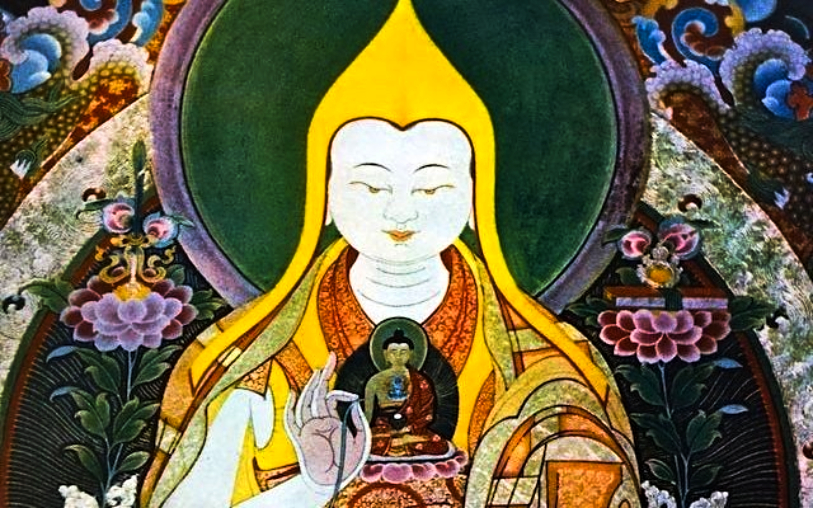
The publicly known teachings of such beings are in reality only the outer shell of their entirely secret, esoteric teaching. Rather than engage in the strange dichotomy of teaching Prasangika-Madhyamaka publicly but Yogachara privately to the initiated few, it seems more likely – in light of what we have read so far – that his purely esoteric teachings, which have not become publicly known but of which HPB says that he gave many, were those of the “esoteric division” of the Prasangika-Madhyamaka school, “the most metaphysical and philosophical of all.” This is of course only a hypothesis and should not be taken as authoritative but we saw that even among some who call themselves Madhyamakas there is a recognition of there being a “coarse, outer, exoteric Madhyamaka” and a “subtle, inner, esoteric Madhyamaka,” the latter of which synthesises what is true from both Madhyamaka and Yogachara.
~ * ~
NAGARJUNA
In an explanatory note to “The Voice of The Silence” (p. 82, original edition) H. P. Blavatsky calls Nagarjuna “the founder of the Mâdhyamika School” but in others of the following quotes she describes him as the founder of Mahayana Buddhism itself.
He could reasonably be called the founder of the extremely influential and pervasive Madhyamika or Madhyamaka school (which was and is a school of thought, rather than an actual independent organised group called “Madhyamaka”) within Mahayana Buddhism but according to history he was not the founder of Mahayana Buddhism as a whole. Mahayana Buddhism originates in the teachings of Gautama Buddha himself and so in fact does Madhyamaka. Buddha’s Prajnaparamita teachings are the scriptural basis for Madhyamaka; Nagarjuna merely codified, commented, and elaborated on them. As a distinct and public form of Buddhism, Mahayana already existed in the time of Nagarjuna but it’s true that it was still young and that Nagarjuna’s work had an influential role upon its subsequent character and development.
“Nagarjuna laid it down, as a rule that “every Buddha has both a revealed and a mystic doctrine.” The “exoteric is for the multitudes and new disciples,” . . .” (H. P. Blavatsky, “World-Improvement Or World-Deliverance”)
“Nâga (Sk.). . . . The Nâga is ever a wise man, endowed with extraordinary magic powers, in South and Central America as in India, in Chaldea as also in ancient Egypt. In China the “worship” of the Nâgas was widespread, and it has become still more pronounced since Nâgarjuna (the “great Nâga”, the “great adept” literally), the fourteenth Buddhist patriarch, visited China.” (“The Theosophical Glossary” p. 222)
“Nâgârjuna (Sk.). An Arhat, a hermit (a native of Western India) converted to Buddhism by Kapimala and the fourteenth Patriarch, and now regarded as a Bodhisattva-Nirmanakaya. He was famous for his dialectical subtlety in metaphysical arguments; and was the first teacher of the Amitâbha doctrine [Note: “The Amitabha doctrine” is a reference to Pure Land Buddhism, in which the main focus is devotion towards Amitabha Buddha, who is said to reside in and rule over a pure land or celestial Buddha-realm, which devotees seek to be reborn into. Both Nagarjuna of the Madhyamaka Mahayanists and Vasubandhu (Asanga’s brother) of the Yogachara Mahayanists promoted this path – as also did Tsong-Kha-Pa in Tibet – but it only formed a very minor part of their work and focus. They described it as “the easy path,” most suited for those who feel unable to pursue anything more rigorous and demanding. But the main reason they and others were in support of this doctrine was that Gautama Buddha himself had apparently taught it, as found in a number of Mahayana scriptures. Esoterically, however, Amitabha is indicated by HPB to be, in one sense, the “Maha-Guru” spoken of in “The Secret Doctrine” and his Pure Land is Shambhala, an actual yet mysterious land here on this Earth, in Central Asia, in which dwell many Initiates, Masters, and Bodhisattvas. The third section of “The Voice of The Silence” encourages esoteric aspirants to become “co-workers” of Amitabha and proceeds to briefly use some symbolism derived from Pure Land teachings. In Tibetan Buddhism, the much more esoteric and complex tantric practice of Deity Yoga largely replaces the Amitabha devotion, which is most popular in China and Japan.] and a representative of the Mahayâna School. Viewed as the greatest philosopher of the Buddhists, he was referred to as “one of the four suns which illumine the world”. He was born 223 B.C. [Note: Around 150 A.D./C.E. according to extensive modern research; this seems more plausible than the date given by HPB, as there is no evidence of Nagarjuna’s ideas appearing in the Buddhist world until the 2nd century, nor do ancient historical records begin mentioning his activities until then.], and going to China after his conversion converted in his turn the whole country to Buddhism.” (“The Theosophical Glossary” p. 223)
“When the misuse of dogmatical orthodox Buddhist Scriptures had reached its climax and the true spirit of the Buddha ’s Philosophy was nearly lost several reformers appeared from India who established an oral teaching. Such were Bodhidharma and Nâgârjuna, the authors of the most important works of the contemplative School in China during the first centuries of our era.” (“The Doctrine of The Eye and The Doctrine of The Heart”)
“The learned Orientalist and Tibetan traveller Professor Emil Schlagintweit mentions in one of his works on Tibet a national legend to the effect that Nâgârjuna received the book Paramârtha or according to others, the book Avatamsaka from the Nâgas, fabulous creatures of the nature of serpents, who occupy a place among the beings superior to man and are regarded as protectors of the law of Buddha. To these spiritual beings Shâkyamuni [i.e. Gautama Buddha] is said to have taught a more philosophical religious system than to men who were not sufficiently advanced to understand it at the time of his appearance. Nor are men sufficiently advanced for it now; for “the more philosophical religious system” is the Secret Doctrine, the Occult Eastern Philosophy which is the cornerstone of all sciences rejected by the unwise builders even at this day and more today perhaps than ever before in the great conceit of our age. The allegory means simply that Nâgârjuna having been initiated by the “Serpents” – the Adepts, “the wise ones” – and driven out from India by the Brâhmans [i.e. orthodox Hindu priests], who dreaded to have their Mysteries and sacerdotal Science divulged (the real cause of their hatred of Buddhism), went away to China and Tibet where he initiated many into the truths of the hidden Mysteries taught by Gautama Buddha.” (“Traces of The Mysteries”)
“The human Bodhisattvas are candidates, so to say for perfect Buddhaship (in Kalpas to come), and with the option of using their powers now if need be. “Perfect” Buddhas are simply “perfect” Initiates. All these are men and not disembodied Beings, as is given out in the Hinayâna exoteric books. Their correct character may be found only in the secret volumes of Lugrub or Nâgârjuna, the founder of the Mahâyâna system who is said to have been initiated by the Nâgas (fabulous “Serpents,” the veiled name for an Initiate or Mahâtmâ). The fabled report found in Chinese records that Nâgârjuna considered his doctrine to be in opposition to that of Gautama Buddha until he discovered from the Nâgas that it was precisely the doctrine that had been secretly taught by Shâkyamuni Himself is an allegory and is based upon the reconciliation between the old Brâhmanical secret Schools in the Himâlayas and Gautama’s Esoteric teachings, both parties having at first objected to the rival schools of the other. The former the parent of all others, had been established beyond the Himâlayas [i.e. meaning in this context Tibet; see Mount Kailash and The Teachers of Buddha] for ages before the appearance of Shâkyamuni. Gautama was a pupil of this; and it was with them, those Indian Sages, that He had learned the truths of the Sunyata, the emptiness and impermanence of every terrestrial, evanescent thing, and the mysteries of Prajñâ-Pâramitâ, or “knowledge across the River,” which finally lands the “Perfect One” in the regions of the One Reality.” (“A Few More Misconceptions Corrected”)
“The work from which I here translate forms part of the same series as that from which the “Stanzas” of the Book of Dzyan were taken, on which the Secret Doctrine is based. Together with the great mystic work called Paramârtha [i.e. the 100,000 verse Prajnaparamita Sutra; see earlier explanations in this article], which, the legend of Nâgârjuna tells us, was delivered to the great Arhat by the Nâgas or “Serpents” (in truth a name given to the ancient Initiates), the “Book of the Golden Precepts” claims the same origin.” (“The Voice of The Silence,” translated by H. P. Blavatsky from The Book of The Golden Precepts, Preface, p. vi, original edition)
“The Madhyamika school traces its origin to Nagarjuna, the brilliant philosopher and formidable dialectician who flourished in the late second century A.D. Taking Buddha’s advocacy of the Middle Way between harmful extremes, between avid indulgence and austere asceticism, and between sterile intellectualization and suffocating mental torpor, Nagarjuna developed a rigorous dialectical logic by which he reduced every philosophical standpoint to an explosive set of contradictions. This did not lead to the closure of scepticism, as the less vigorously pursued pre-Socratic philosophies did, but rather to the elusive standpoint that neither existence nor non-existence can be asserted of the world and of everything in it. The Madhyamikas, therefore, refused to affirm or deny any philosophical proposition. Nagarjuna sought to liberate the mind from its tendencies to cling to tidy or clever formulations of truth, because any truth short of shunyata, the voidness of reality, is inherently misleading. Relative truths are not like pieces of a puzzle, each of which incrementally adds to the complete design. They are plausible distortions of the truth and can seriously mislead the aspirant. They cannot be lightly or wholly repudiated, however, for they are all the seeker has, and so he must learn to use them as aids whilst remembering that they are neither accurate nor complete in themselves.
“By the fifth century two views of Nagarjuna’s work had emerged. The followers of Bhavaviveka thought that Madhyamika philosophy had a positive content, whilst those who subscribed to Buddhapalita’s more severe interpretation said that every standpoint, including their own, could be reduced to absurdity, which fact alone, far more than any positively asserted doctrine, could lead to intuitive insight (prajna) and Enlightenment. Chandrakirti’s remarkable defence of this latter standpoint deeply influenced Tibetan Buddhist traditions as well as those schools of thought that eventually culminated in Japan in Zen. Nagarjuna’s dialectic revealed the shunya or emptiness of all discursive, worldly thought and its proliferating categories.
“For the Madhyamikas, whatever can be conceptualized is therefore relative, and whatever is relative is shunya, empty. Since absolute inconceivable truth is also shunya, shunyata or the void is shared by both Samsara and Nirvana. Ultimately, Nirvana truly realized is Samsara properly understood. The fully realized Bodhisattva, the enlightened Buddha who renounces the Dharmakaya vesture to remain at the service of suffering beings, recognizes this radical transcendental equivalence. The Arhant and the Pratyeka Buddha, who look to their own redemption and realization, are elevated beyond any conventional description, but nonetheless do not fully realize or freely embody this highest truth. Thus for the Madhyamikas, the Bodhisattva ideal is the supreme wisdom, showing the unqualified unity of unfettered metaphysics and transcendent ethics, theoria and praxis, at the highest conceivable level.
“Madhyamika thought rooted itself in the remarkable collection of Mahayana sutras known as the Prajnaparamita (or perfection of wisdom) literature. These sutras, from the one hundred thousand verses of Shatasahasrika Prajnaparamita to the terse Heart Sutra and the short Vajrachchedika (literally, “Diamond Cutter”, but commonly called Diamond Sutra), share the same themes skilfully expounded at different lengths. According to these sutras, all dharmas or elements of existence are shunyata or void. Although many human beings are terrified of voidness, as is shown by the instinctive dread of the dark and the unknown, this arises from a basic misunderstanding of shunyata. It is unchanging, deathless, unqualified reality. If one understands shunyatashunyata, the Voidness of the Void, one recognizes that it is not any “nothing” one knows or can imagine. Being truly unknown, there is no sufficient reason to dread it. Rather than entertain vague, ill-conceived and inchoate images of the imageless, one would do better to practise the paramitas, the dynamic virtues of the Noble Eightfold Path leading to the inestimable glory which the ignorant world calls shunyata solely because it is beyond its ken. The Bodhisattva, however, sees the plenitude of that Void as well as the emptiness of the phenomenal world, and so he labours in joy for the redemption of those who suffer from abject ignorance.” (Raghavan Iyer, “Buddha and The Path to Enlightenment” Part 3: “The Dharma and The Sangha”)
“Nagarjuna became the friend of kings, repaired monasteries and stupas, and spread the teachings of the Buddha. His skill as an exponent of Dharma made him famous throughout India, and it attracted the Nagas, the guardians of wisdom who dwell in Nagaloka outside of Jambudvipa. They attended his discourses in the guise of young boys and were so deeply moved that the king of the Nagas invited him to visit their realm. This tradition holds that the Nagas were guardians of the Mahayana sutras, the arcane teachings of the Buddha, and scholars generally agree that these texts came out of south India, though their ultimate origin remains unknown. Nagarjuna persuaded the Naga king to allow him to take some of the scriptures back to Jambudvipa, where he placed them before the world. Another account avers that Nagarjuna was given the Mahayana sutras by a sage who dwelt in the secret fastnesses of the Himalayas. Given the rich symbolism surrounding the Nagas, who are sometimes said to be high spiritual Initiates, both stories may tell the truth. Until this time, Nagarjuna had been known as Arjuna because his mother had given birth to him under an arjuna tree, thus recalling the birth of the Buddha, and ‘Naga’ was prefixed to it because of his intimate friendship with the Nagas. . . .
“The impact of Nagarjuna’s teaching is as awesome as the story of his life. He was hailed as the father – and perhaps founder – of the Madhyamika or ‘Middle Way’ school of Buddhist thought. He made accessible the great Mahayana scriptures, and especially the Prajnaparamita sutras, and wrote commentaries and explanations. In addition, he composed verses which distilled the teaching of the Buddha in a way that disciples of every school could appreciate, and he wrote letters which set forth practical rules which kings could follow even while fulfilling their duties. He was one of “the four suns which illumined the world”, the other three being Ashvaghosha, Kumaralabdha and Aryadeva. In Tibet, Nagarjuna is revered as an incarnation of Manjushri. Nagarjuna is honoured wherever Mahayana Buddhist thought prevails, and his works survive in Sanskrit, Tibetan and Chinese. . . .
“Building on the metaphysical doctrines delineated by Ashvaghosha, Nagarjuna sought to abolish contention amongst the schools by showing that assertions arising out of relative truth lead invariably to absurdity. Since absolute truth cannot be formulated, Nagarjuna could say, “I have no pratijna – proposition or position – to defend.” His fourfold negative dialectic reduced any standpoint to incoherence insofar as it claimed to embody the truth. But Nagarjuna did not aim to turn monks into sceptics, but rather to make them sceptical of the images and formulations of truth which they were tempted to convert into dogmas. Once stripped of the insidious belief that one’s deepest insights are somehow the absolute truth itself, one is open to authentic wisdom. Nagarjuna responded to the desire for spiritual knowledge by expounding the meaning of the Prajnaparamitasutra in its different forms. For those who were sufficiently grounded in their understanding of the arcane teachings, he provided methods of practice in his strict monastic disciplines, advice on living the spiritual life through his verses, and secret instruction in magic for those who were ready and could make spiritual use of such knowledge.
“Nagarjuna insisted that all understanding must be rooted in a clear recognition that there are two levels of truth, relative truths which may be useful in a limited context but are illusory from a more inclusive standpoint, and absolute truth which is concealed by all relativities. . . .
“If the distinction between the two kinds of truth is grasped, one will recognize that ultimate truth can be neither conceptualized nor formulated. In addition, however, every relative truth falls short of absolute truth by reifying entities and objects when, in fact, they are empty of independent reality. . . .
“Given the centrality of these doctrines, how could different schools dogmatize the teachings of the Buddha? For Nagarjuna, anupalambha, non-contentiousness, was the heart of the Buddha’s message, and the tendency to make exclusive or absolute claims was a sad example of graha, clinging, a manifestation of tanha, the thirst for embodied existence. Thus, the very doctrine which could emancipate humanity had become yet another means of bondage. Nonetheless, this unfortunate misapplication demonstrated the thirst in human beings for the Real, but without dharmanam bhutapratyaveka – right understanding – spiritual aspiration is inverted and becomes craving for concretion and form. . . .
“Nagarjuna’s analysis of categories, the elements of existence and of the understanding aimed to reveal the shunyata or void-ness of conditioned existence and the voidness of shunyata itself. Through the reversal of clinging to form by cleaving to shunyata, it is possible to awaken the Real, to see the voidness of the seeming full and the fullness of the seeming void.
“Nagarjuna’s dialectic was not simply apophatic [i.e. negating], because his negation of every standpoint did not simply prove them false but appreciated their relative truth without confining one to any particular formulation. “Everything holds good in the case of one who is in agreement with shunyata“, Nagarjuna taught. Prajna, the capacity to discern the degree and level of truth in every standpoint while recognizing the relative nature of them all, is the key to the Madhyamika or Middle Way. As the principle of comprehension, it is that Way. . . .
“As one’s understanding increases through garnering the truth present in limited perspectives, the dualism which alienates the individual from himself gradually gives way before a dawning metapsychological integration that also reveals a harmony with the whole of Nature through a recognition of its divine ground, shunyata. As sectarian dogmas fall away, the aspirant discovers that Truth is no view yet underpins all views, just as they each reflect some aspect of it to a degree. The aim and purpose of the Madhyamika is to instil a sense of the Real through recognition that conditioned reality is based upon, rooted in and nothing but shunyata. . . .
“Although Nagarjuna’s fame is due in large measure to his stunning dialectical paradoxes, he did not devise them for idle amusement. He was convinced that anyone who assiduously meditated upon shunyata would possess the alchemical key which, when used to unlock the portals on the Middle Way, would lead one to the elixir of life. He gave a talisman for all aspirants in the Mahaprajnaparamitashastra:
“”There is realization of Reality, but not as it is imagined in any extremes. Neither anything nor nothing, devoid of all prapanca – conceptualization and elaboration – this is what is called realization of the Way. If one were free from extremes, then prapanca itself would be the Way. Bodhi is itself the Way, the Way is itself bodhi.”” (Elton Hall, “Nagarjuna,” “Teachers of The Eternal Doctrine” series, published by Theosophy Trust; first published by the United Lodge of Theosophists, Santa Barbara)
~ * ~
“Paramartha [i.e. “absolute” or “ultimate”] . . . This word, however, is the bone of contention between the Yogacharya and the Madhyamika schools of Northern Buddhism. The scholasticism of the latter makes of Paramartha (Satya) something dependent on, and, therefore, relative to other things, thereby vitiating the whole metaphysical philosophy of the word Absoluteness. [Note: This is specifically the Prasangika-Madhyamaka position and is found in some of the writings attributed to Tsong-Kha-Pa as well as Nagarjuna: the latter is often quoted as saying “The ultimate truth or reality (paramartha satya) is that there is no ultimate truth or reality,” while Tsong-Kha-Pa states that Shunyata – emptiness or voidness – is itself really only a “conventional phenomenon” and not anything primal or noumenal, hence that Shunyata is completely devoid of anything that could remotely be considered as “essence” or “true reality.” To call it either “the real” or “the unreal” would be grossly unphilosophical from the perspective of Tsong-Kha-Pa’s and Nagarjuna’s known writings. But if these are some of what HPB calls the “exoteric travesties” and all-denying “sophistic nihilism” which contain only a few mere echoes of the true Madhyamaka and Prasangika tenets, how much of such ideas did Tsong-Kha-Pa and Nagarjuna actually teach? This we cannot answer but it would be sophistic on our own part – not to mention naive – to assume that every time these or other great figures say something we don’t personally like or agree with that it must necessarily have been fraudulently “written into” their texts after their death. Things are not always the way we would like them to be and there is much we still do not understand.] The other school very rightly denies this interpretation. [Note: However, compare our brief summary of Tsong-Kha-Pa’s position in the preceding square-bracketed note, plus our brief overview/explanation of the general Madhyamaka view in the first part of this article, with the following from HPB’s article “Are Dreams But Idle Visions?” in which she herself argues for a very Prasangika-Madhyamaka viewpoint: “We will then prove, perhaps, to the satisfaction of the non-prejudiced that the Absolute, or the Unconditioned, and (especially) the Unrelated, is a mere fanciful abstraction, a fiction, unless we . . . regard the Absolute merely as the aggregate of all intelligences, the totality of all existences, incapable of manifesting itself except through the interrelationship of its parts, as it is absolutely incognizable and non-existent outside its phenomena, and depends entirely on its ever-correlating forces, dependent in their turn on the One Great Law.” In other words, there is no Absolute unless by “Absolute” one means simply the collective aggregate of everything phenomenal, a collective aggregate which is indeed “dependent on, and, therefore, relative to other things” and thus subject in its own subtle way to what Buddhism calls dependent origination – this being exactly the essence of the Prasangika-Madhyamaka perspective of Tsong-Kha-Pa and others. In “The Mahatma Letters” we find the Masters promulgating this same position several times, suggesting perhaps that this is Their real position and HPB’s “Transactions” statement simply her own independent idea on the subject. The Master M. writes in his “Cosmological Notes” that “The absolute and infinite is composed of the conditioned and finite. [The “infinite final cause” is] conditioned in [its] modes of existence and attributes, and as individual aggregates – unconditioned and eternal in their sum or as a collective aggregate.” From this and the previous quote, one could easily conclude that the absolute or ultimate reality is devoid of any fixed and unchanging permanence, is not truly independent in the sense of having its own unique existence transcendent of and separate from everything else, and is devoid of “self” or independent, isolated “essence” due to not truly being a “unit” or a “thing in itself” – and then the apparent serious discrepancy between Tsong-Kha-Pa’s ardent Prasangika position and that generally understood to be the Theosophical one is at last dissolved and resolved.]
Q. Does not the Esoteric Philosophy [i.e. Theosophy] teach the same doctrines as the Yogachârya School?
A. Not quite. But let us go on.” (H. P. Blavatsky, “Transactions of The Blavatsky Lodge” p. 54)
“Without a foundation in the conventional truth (samvritisatya), the significance of the ultimate truth (paramarthasatya) cannot be taught. Without understanding the significance of the ultimate, liberation is not achieved. By a misperception of emptiness, a person of little intelligence is destroyed, like a snake incorrectly seized or like a spell incorrectly cast. For that reason — that the Dharma is deep and difficult to understand and to learn — the Buddha’s mind despaired of being able to teach it.” (Nagarjuna, Mulamadhyamakakarika)
“I am not, I will not be. I have not, I will not have. This frightens all children, and kills fear in the wise.” (Nagarjuna, Ratnavali)
“All the dogmatists have been terrified by the lion’s roar of shunyata (emptiness, voidness). Wherever they may reside, shunyata lies in wait!” (Nagarjuna, quoted in “Master of Wisdom: Teachings of The Buddhist Master Nagarjuna”)
“With all its many risks, this life endures no more than windblown bubbles in a stream. How marvellous to breathe in and out again, to fall asleep and then awake refreshed.” (“Nagarjuna’s Letter to A Friend”)
~ * ~
FROM BUDDHA’S TEACHING IN THE HEART SUTRA
“The holy Bodhisattva Avalokiteshvara, absorbed in the profound practice of prajnaparamita (perfection of wisdom), looked in compassion upon the five skandhas, the psychophysical personality aggregates, and perceived that their nature was shunyata (emptiness).
“O Sariputra,” Avalokiteshvara said, “form is emptiness and emptiness is form. Emptiness is no different from form and form is no different from emptiness. Whatever is form is emptiness and whatever is emptiness is form (rupa). And so also with the other four skandhas: feeling or sensation (vedana), discrimination (samjna), habitual tendencies and dispositions (samskara), and consciousness (vijnana). . . .
“[Also] there are neither the twelve nidanas (the interlinked components of the chain of causation) nor their negations. There are no “four noble truths” either: there is no suffering, no cause of suffering, no cessation of suffering, and there is no path. . . .
“Therefore, Sariputra, the Bodhisattva without mental impediments, without notions of attainment and non-attainment, rests in reliance upon Prajnaparamita. Without mental impediments, he is undisturbed. He has fearlessly confronted and transcended the false tendencies to crave for permanence, comfort, concept of self, or any form of pleasure. It is in this way that Nirvana is gained.”
Theosophists who are familiar with the metaphysical and philosophical approach taken by H. P. Blavatsky and her Adept-Teachers (the Mahatmas or Masters of Wisdom) can hardly be blamed if after reading the above excerpt from the Heart Sutra they assume it to be just a prime example of that “sophistic nihilism” that HPB spoke of. But it’s always best not to assume anything. In this case, HPB in fact quoted approvingly from some of these Heart Sutra verses in her article known as “Notes On Some Aryan-Arhat Esoteric Tenets.”
To support her point that absolute, abstract, infinite Space is the “field” in which all manifestation – from the most abstrusely metaphysical down to the most material – occurs and is therefore the ultimate Reality, she quotes this translation of the Heart Sutra:
“That which we call Form (Rûpa) is not different from that which we call Space (Shûnyatâ) . . . Space is not different from Form. Form is the same as Space; Space is the same as Form. And so with the other Skandhas, whether Vedanâ, or Sanjña, or Sanskâra or Vijñana they are each the same as their opposite.”
FROM BUDDHA’S TEACHING IN THE DIAMOND SUTRA
“This teaching, Subhuti, is known as Prajnaparamita, the perfection of wisdom, and you should remember it as such. Yet the very discourse the Tathagata [i.e. Buddha] has taught as ‘the perfection of wisdom’ is exactly the teaching which is not the perfection of wisdom. Thus it is only called Prajnaparamita.” [Note: This may remind us of the opening sentence of Lao Tzu’s Tao Te Ching: “The Tao that can be told is not the eternal Tao; The name that can be named is not the eternal Name.” Likewise, the actual perfection of WISDOM cannot be literally contained in nor expressed by nor imparted by a book, text, or teaching, although these can guide a person part of the way towards it.] . . .
“Beings attached to concepts of self or entity, who think of a personality, or who have an inferior resolve, cannot possibly hear this discourse on dharma. Those who have not taken the Bodhisattva
Vow cannot learn this teaching, nor remember, recite or study it. It is impossible for them. . . .
“One who sets out on the Bodhisattva Path should continuously think, ‘I must lead all beings to absolute Nirvana; nevertheless, even when all beings have been led to Nirvana, no being in reality has been led to Nirvana.’ For if the idea of a being, entity or personality should arise in him, he is not a Bodhisattva. . . . the Tathagata teaches that all dharmas are devoid of self and are not beings, entities or personalities. . . . Subhuti, the Bodhisattva who continually dwells on the selflessness of all dharmas, however, is known by the Tathagata, the supremely Enlightened One, as a Bodhisattva of Great Courage.” . . . [Note: The Sanskrit word “dharma” has multiple meanings in Buddhism; often it is a synonym for Buddha’s Teaching but can also mean (1) righteousness, (2) duty, (3) any component of phenomenal existence, i.e. any unit among the countless units that constitute the manifested Universe. It is this latter sense in which it is meant in Buddha’s famous and fundamental teaching on the three marks of existence, sometimes called the three seals or three universal truths: “All dharmas are subject to impermanence (anitya), all dharmas are subject to suffering (dukha), all dharmas are devoid of self (anatma).”]
“. . . the Tathagata has taught that in reality, beings are not beings, even though he has called them ‘beings’. . . . Therefore, Enlightenment is called supreme (anuttara). This dharma is identical only with itself, and is undifferentiated. Therefore it is called ‘supreme Enlightenment’. . . .
“Does a Tathagata ever think, ‘I have liberated beings’? Never imagine this, Subhuti, for there is no being to be liberated by the Tathagata. If the Tathagata thought to liberate any being, a concept of self, entity or personality would have arisen in Him. The Tathagata has taught that the concept of self is no concept. Nevertheless, common people cling to the concept of self. . . .”
“Whereupon the Tathagata taught these stanzas:
“Who sees Me by form,
Who sees Me in sound,
Perverted are his footsteps upon the Way;
For he cannot perceive the Tathagata.
The Buddhas are seen through dharma,
From dharma-bodies their guidance comes;
But the nature of dharma is never discerned,
It cannot be grasped by the mind alone.
. . .
“Like a meteor, like darkness, as a flickering lamp,
An illusion, like hoar-frost or a bubble,
Like clouds, a flash of lightning, or a dream:
So is all conditioned existence to be seen.”
~ * ~
It is only natural and reasonable that most people will prefer one philosophical or metaphysical system and approach over another and consider one to more fully embody Truth than another, whether it be preferring Yogachara over Madhyamaka, Madhyamaka over Yogachara, complete Shentong over both of them, or anything else. Many different karmic factors combine to bring about such favouritisms within human minds.
From the Theosophical perspective, it is also the case that some things are indeed – in reality – more true than others.
However, if we would be fit participants in the unfoldment of this New Age that dawned around the start of the 20th century, the Aquarian Age, and if we would be fit citizens of the humanity of the future, we have to be able – and also joyously willing – to make the needed effort to not merely understand the technicalities of differing systems of thought in an external way – as if looking in at them from the outside – but to mentally inhabit multiple metaphysical perspectives and philosophical worldviews simultaneously.
This does not mean one has to agree with them all – and that would be a self-contradictory impossibility anyway – but one has to be able to adopt at will the mindset and perspective of a Madhyamaka, a Yogachara, a Theravadin, a Hindu, a fundamentalist Christian, an atheist, an agnostic, a conservative, a socialist, and so on and so forth.
One cannot truly and deeply understand and appreciate any perspective other than one’s own unless one can respectfully and humbly “inhabit” it as and when required. In most cases, this is not something anyone can just instantly begin to do but the first step is to have such a wish and intention.
A natural inclination towards UNIVERSALITY and SYNTHESIS – broad, liberal, but still thoroughly philosophical – is essential if one would keep moving forward with the Aquarian tidal wave of transformation.
The influential Theosophist Raghavan Iyer (1930-1995), who himself well embodied these principles, expressed it in his book “Parapolitics: Toward The City of Man” p. 253:
“Hence the crucial question arises: Which individuals will emerge anywhere in the world who will exemplify a high level of self-consciousness in the sustained and creative release of internal energies? Intellectually, who can inhabit simultaneously many different metaphysical perspectives? . . . The person of tomorrow will be able to see the world not only as a Nietzschean, as a Freudian, and as a Marxist, but in many other modes as well – through Zen, through Shankara, Lao Tzu, and so on. He will learn conceptual flexibility. Those who actually engage in systematic contemplation have an advantage.”
~ * ~

This article may have raised more questions about various things. Please make use of the site search function (the magnifying glass symbol at the top of the page) and visit the Articles page to see the complete list of over 400 articles covering all aspects of Theosophy and the Theosophical Movement. You may like other articles listed under the heading “BUDDHISM AND TAOISM.”
Other articles closely related to this one include
THEOSOPHY AND TIBETAN BUDDHIST TANTRA
~ BlavatskyTheosophy.com ~
 T H E O S O P H Y