
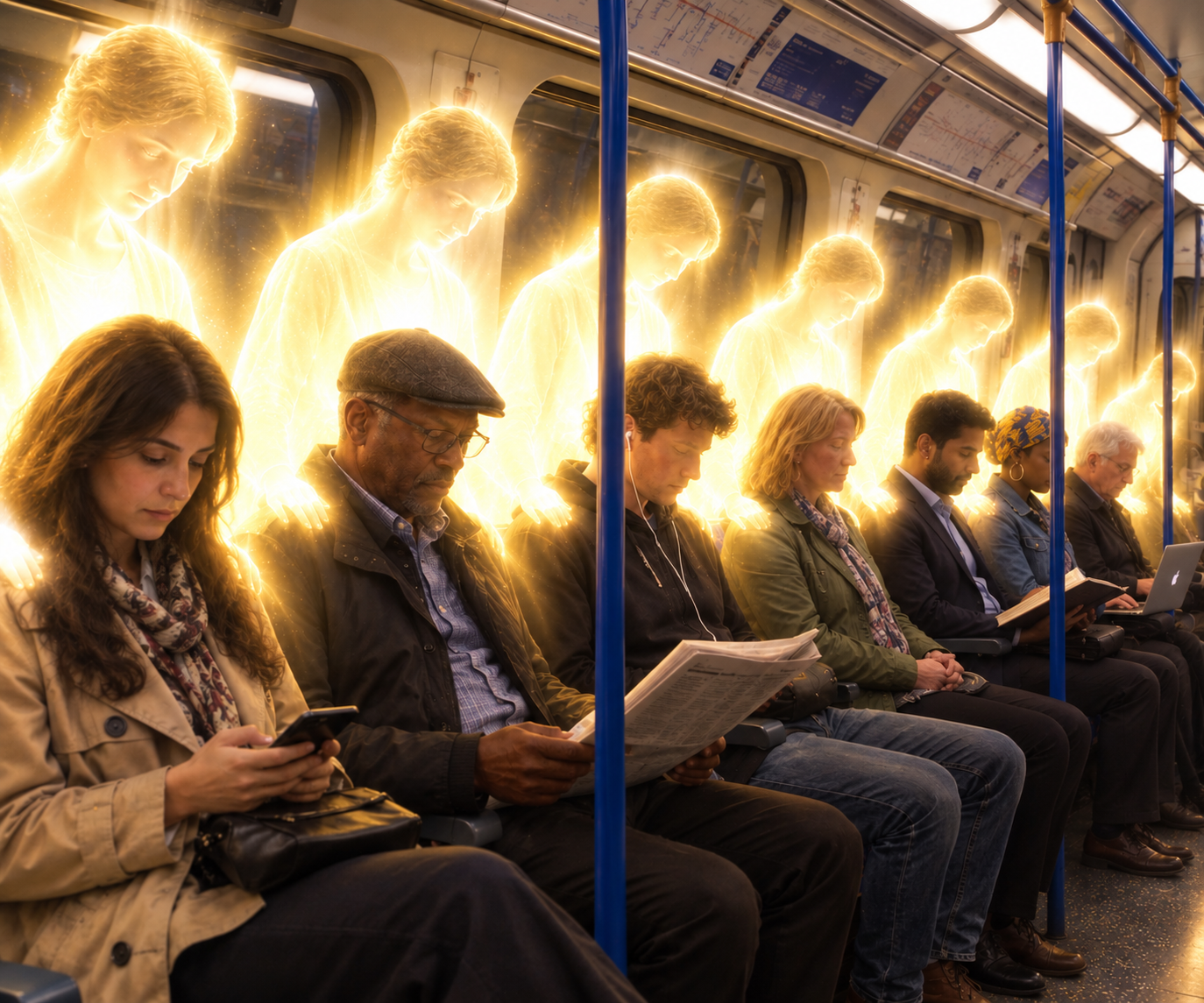
“For he will give his angels charge over you, to guard you in all your ways. In their hands they will bear you up, lest you dash your foot against a stone.” (Psalm 91:11-12)
In the Esoteric Philosophy taught by H. P. Blavatsky and those who she called the Masters, it is explained that each human being does indeed have a guardian angel, as is commonly believed by so many, but that this guardian angel is not actually a being external to ourselves, which is how most people think of it. Instead, our guardian angel is ourselves . . . not our personal self, which possesses neither the knowledge, insight, or capacity to guard, guide, protect, and rescue itself other than to a purely mundane extent . . . but our inner, spiritual, divine self.
Technically, this is termed the individual Higher Ego, which exists in unison with the universal Higher Self. In language with which many of us are much more familiar, our divine guardian is our soul. What you generally think of as being you is not you. You eternally transcend this mortal personality, body, and brain-consciousness which you ordinarily consider to be yourself. What we typically think of as “me,” “myself,” “I,” etc., is in reality but a karmic product, the resultant conglomeration of effects that have arisen due to causes set in motion in the preceding life and lives. Each of these lives has been a “mask” with which the real you has clothed itself as a matter of karmic necessity and learning.
That real you is closer to “you” than anyone or anything could be, and constantly seeks to guide, guard, protect, and help you, though it does not dare to break the boundaries of divine Justice. In other words, it will not override or circumvent whatever limitations you have unwittingly made to its aid through your own misdeeds or misuse of your human faculties. Hence, although we are a unity, we end up existing as a sort of duality, at least until our lower nature succeeds in reunifying itself with our higher nature. The latter is our internal guardian angel. But the Occult Doctrine reveals that some people also have an external guardian angel, who is in fact one of the Nirmanakayas (Bodhisattvas), who are Adepts and Initiates (often disembodied ones) belonging to the Brotherhood of Masters. One may never be fully conscious of their assistance, yet one may unwittingly be guarded by such an unseen individual, provided it has been earned and merited. Sometimes, as seen in a few of the following excerpts, the line between these two types of guardian is blurred.
There are a couple of passages in which HPB seems at first glance to dismiss the whole notion of guardian angels but these are more an anomaly than anything else. We will save them until the end. First, let’s see some of her more positive and affirmative statements on this subject, in some of which terms from ancient Western philosophy are used for our inner guardian angel, such as Genius and Dæmon.
~ * ~
“INTERNAL” GUARDIAN ANGELS
“The idea of guardian angels of men, races, localities, cities, and nations, was taken by the Roman Catholics from the pre-christian occultists and pagans. Symmachus (Epistol, I. X) writes: “As souls are given to those who are born, so genii are distributed to the nations. Every city had its protecting genius, to whom the people sacrificed.” There is more than one inscription found that reads: Genio civitates — “to the genius of the city.”” (HPB, “Theories about Reincarnation and Spirits”)
“But they [i.e. the ancients, who were wiser than us] believed in destiny, which from birth to death every man is weaving thread by thread around himself, as a spider does his cobweb; and this destiny is guided either by that presence termed by some the guardian angel, or our more intimate astral inner man, who is but too often the evil genius of the man of flesh. Both these lead on the outward man, but one of them must prevail; and from the very beginning of the invisible affray the stern and implacable law of compensation steps in and takes its course, following faithfully the fluctuations.” (HPB, “Isis Unveiled” Vol. 2, p. 593)
“Double Image. The name among the Jewish Kabbalists for the Dual Ego, called respectively: the Higher, Metatron, and the Lower, Samael. They are figured allegorically as the two inseparable companions of man through life, the one his Guardian Angel, the other his Evil Demon.” (HPB, “The Theosophical Glossary” p. 104)
“Fravashis [in Zoroastrianism] are the spirit-prototypes, the inner guardian angels of all souls — sub-human, human, as well as super-human — Ahuramazda [i.e. the God of Light] himself having a Fravashi. H.P.B. speaks of it as “the spiritual counterpart of the still more spiritual original.” Each Fravashi has attached to it Bod (Theosophic Buddhi) and Ahuramazda confers with these Fravashi-Bod.”
“The doctrine of Fravarshi is of special interest to the student of Theosophy. Every creature, whatever the body may happen to be, has its spiritual counterpart which is Fravarshi.” (B. P. Wadia, “The Zoroastrian Philosophy and Way of Life”)
“Like the Vourdalak, or Vampire, of the Servian tale, the brain [of the person approaching soullessness] feeds and lives and grows in strength and power at the expense of its spiritual parent. Then the already half-unconscious soul, now fully intoxicated by the fumes of earthly life, becomes senseless, beyond hope of redemption. It is powerless to discern the splendor of its higher spirit, to hear the warning voice of its “guardian Angel,” and its “God.”” (HPB, “Isis Unveiled” Vol. 2, p. 368-369)
“. . . the word “demon,” however, as in the case of Socrates, and in the spirit of the meaning given to it by the whole of antiquity, standing for the guardian Spirit, an “Angel,” not a devil of Satanic descent, as theology will have it.” (HPB, “The Secret Doctrine” Vol. 2, p. 478)
“The dæmons, according to this theory, are intermediate beings between the divine perfection and human sinfulness, and he [i.e. Xenocrates, Greek philosopher of the 4th century B.C.] divides them into classes, each subdivided into many others. But he states expressly that the individual or personal soul is the leading guardian dæmon of every man, and that no dæmon has more power over us than our own. Thus the Daimonion of Socrates is the God or Divine Entity which inspired him all his life. It depends on man either to open or close his perceptions to the Divine voice.” (HPB, “Isis Unveiled” Vol. 1, p. xix-xx)
“Dæmon (Gr.). In the original Hermetic works and ancient classics it has a meaning identical with that of “god”, “angel” or “genius.” The Dæmon of Socrates is the incorruptible part of the man, or rather the real inner man which we call Nous or the rational divine Ego. At all events the Dæmon (or Daimôn) of the great Sage was surely not the demon of the Christian Hell or of Christian orthodox theology. The name was given by ancient peoples, and especially the philosophers of the Alexandrian school, to all kinds of spirits, whether good or bad, human or otherwise. The appellation is often synonymous with that of gods or angels. But some philosophers tried, with good reason, to make a just distinction between the many classes.” (HPB, “The Theosophical Glossary” p. 94)
“This is precisely what the Esoteric philosophy teaches. The flame of genius is lit by no anthropomorphic hand, save that of one’s own Spirit. It is the very nature of the Spiritual Entity itself, of our Ego, which keeps on weaving new life-woofs into the web of reincarnation on the loom of time, from the beginnings to the ends of the great Life-Cycle. This it is that asserts itself stronger than in the average man, through its personality; so that what we call “the manifestations of genius” in a person, are only the more or less successful efforts of that EGO to assert itself on the outward plane of its objective form — the man of clay — in the matter-of-fact, daily life of the latter. The EGOS of a Newton, an Æschylus, or a Shakespeare, are of the same essence and substance as the Egos of a yokel, an ignoramus, a fool, or even an idiot; and the self-assertion of their informing genii depends on the physiological and material construction of the physical man. No Ego differs from another Ego, in its primordial or original essence and nature. That which makes one mortal a great man and of another a vulgar, silly person is, as said, the quality and make-up of the physical shell or casing, and the adequacy or inadequacy of brain and body to transmit and give expression to the light of the real, Inner man; and this aptness or inaptness is, in its turn, the result of Karma. Or, to use another simile, physical man is the musical instrument, and the Ego, the performing artist. The potentiality of perfect melody of sound, is in the former — the instrument — and no skill of the latter can awaken a faultless harmony out of a broken or badly made instrument. This harmony depends on the fidelity of transmission, by word or act, to the objective plane, of the unspoken divine thought in the very depths of man’s subjective or inner nature.” (HPB, “Genius”)
“The Hermetic philosophers called Theoi, gods, Genii and Daimones (in the original texts), those Entities whom we call Devas (gods), Dhyan Chohans, Chitkala (Kwan-yin, the Buddhists call them), and by other names. The Daimones are — in the Socratic sense, and even in the Oriental and Latin theological sense — the guardian spirits of the human race; “those who dwell in the neighbourhood of the immortals, and thence watch over human affairs,” as Hermes has it. In Esoteric parlance, they are called Chitkala, some of which are those who have furnished man with his fourth and fifth Principles [i.e. Kama and Manas; desire and mind] from their own essence; and others the Pitris so-called. This will be explained when we come to the production of the complete man. The root of the name is Chiti, “that by which the effects and consequences of actions and kinds of knowledge are selected for the use of the soul,” or conscience the inner Voice in man.” (HPB, “The Secret Doctrine” Vol. 1, p. 288)
“Remember that every man has a god within, a direct ray from the Absolute, the celestial ray from the One; that he has his “god” within, not outside, of himself.” (HPB, “Transactions of The Blavatsky Lodge” p. 53)
“All is impermanent in man except the pure bright essence of Alaya [i.e. the Universal Soul or Logos, or in the most simple terms comprehensible to Westerners: God]. Man is its crystal ray; a beam of light immaculate within, a form of clay material upon the lower surface. That beam is thy life-guide and thy true Self, the Watcher and the silent Thinker, the victim of thy lower Self.” (“The Voice of The Silence” p. 57, original edition, translated by H. P. Blavatsky from The Book of The Golden Precepts)
“The star under which a human Entity is born, says the Occult teaching, will remain for ever its star, throughout the whole cycle of its incarnations in one Manvantara. But this is not his astrological star. The latter is concerned and connected with the personality, the former with the INDIVIDUALITY [i.e. the immortal Monad-Ego or higher Triad – of Atma-Buddhi-Manas – which endures from life to life, whereas the “personality” means the mortal personal self, which exists for only one incarnation]. The “Angel” of that Star, or the Dhyani-Buddha will be either the guiding or simply the presiding “Angel,” so to say, in every new rebirth of the monad, which is part of his own essence, though his vehicle, man, may remain for ever ignorant of this fact.” (HPB, “The Secret Doctrine” Vol. 1, p. 572)
“EXTERNAL” GUARDIAN ANGELS
“A Nirmanakaya [was] an adept or a yogi during life, has since become a member of that invisible Host which ever protects and watches over Humanity within Karmic limits. Mistaken often for a “Spirit”, a Deva, God himself, &c., a Nirmanakaya is ever a protecting, compassionate, verily a guardian angel, to him who becomes worthy of his help. . . . instead of going into selfish bliss, he chooses a life of self-sacrifice, an existence which ends only with the life-cycle, in order to be enabled to help mankind in an invisible yet most effective manner.” (HPB, “The Theosophical Glossary” p. 231, Entry for “Nirmanakaya”)
“There are those among the Bodhisatwas and the Lha . . . who voluntarily relinquish the blessing of the attainment of perfect freedom, and remain in their personal selves, whether in forms visible or invisible to mortal sight — to teach and help their weaker brothers.
“Some of them prolong their life on earth — though not to any supernatural limit; others become ‘Dhyan-Chohans,’ a class of the planetary spirits or ‘devas’ who, becoming, so to say, the guardian angels of men, are the only class out of the seven-classed hierarchy of spirits in our system who preserve their personality. These holy Lha, instead of reaping the fruit of their deeds, sacrifice themselves in the invisible world . . . and remain in . . . the world of bliss nearest to the earth.” (A Tibetan Initiate quoted by H. P. Blavatsky, “Tibetan Teachings”)
“Jacob Boehme [was] the nursling of the genii (Nirmanakayas) who watched over and guided him.” (HPB, “The Secret Doctrine” Vol. 1, p. 494; Jakob Böhme was an influential German Christian Mystic of the 16th-17th centuries.)
~ * ~
But a further statement from H. P. Blavatsky in “The Secret Doctrine” stands out in contrast against the above and seems wholly iconoclastic and dismissive:
“Angels . . . are neither “ministering” nor “protecting” angels; nor are they “Harbingers of the Most High” still less the “Messengers of wrath” of any God such as man’s fancy has created. To appeal to their protection is as foolish as to believe that their sympathy may be secured by any kind of propitiation; for they are, as much as man himself is, the slaves and creatures of immutable Karmic and Kosmic law. The reason for it is evident. Having no elements of personality in their essence they can have no personal qualities, such as attributed by men, in their exoteric religions, to their anthropomorphic God.” (Vol. 1, p. 276)
It is true, as outlined earlier, that everything proceeds according to the Law of Karma and, in light of that, to ask or beg one’s guardian angel to act beyond those self-created karmic limits with which one is surrounded must be ineffective. It will always act and help us as far as our karma permits, and this may sometimes be much further than we would suspect. But that they are “ministering” and “protecting” angels was endorsed by her in the above compilation of quotes.
At another time, she remarked:
“The Occultists do not accept the doctrine of “guardian angels,” for reasons heretofore fully explained, in these pages. They do, however, believe most firmly in the personal, divine spirit in man, the source of his inspiration and his all-sufficient “angel” and “guardian.”” (“The Teachings of Allan Kardec,” “The Theosophist” August 1883)
If our personal, divine spirit is our all-sufficient “angel and guardian,” is this not akin to saying that we DO have guardian angels but that these are our own higher and inner being, rather than a purely external entity that intervenes “from outside” to rescue us?
So although HPB at times dislikes and at other times merely tolerates the term “guardian angels,” her own words make clear that they do exist but that they are to be defined or explained somewhat differently than in conventional religion and spirituality. Yet most Christians, for example, believe one’s guardian angel always accompanies one and is always close at hand, which doesn’t seem especially different from the Eastern esoteric view.
One factor not mentioned in the above is that many people report being providentially saved, rescued, or protected, by a deceased loved one, who appears to them in a shining light or in ethereal form or in some cases even appearing completely physical. This naturally leads some to conclude that it is our departed mother, father, grandparent, sibling, child, or friend, who fulfils the role of our guardian angel. Theosophy provides an explanation for this but to understand it clearly it is necessary to comprehend the teachings about death and Devachan (the heavenly state), presented in such articles as Death and The Afterlife and When We Die.
In short, if our loved one is in the condition of heavenly rest, peace, and bliss that precedes another life on Earth, that peace is not shattered by knowing of our difficulties and dangers. Instead, their heavenly state is actually an unwittingly self-created experience. They see and feel us there with them, and have no recollection of having died or even that there is such a thing as death. They interact in their own Devachan with these illusory representations of ourselves and others who they cherished. It is therefore akin to the happiest and most perfect dream imaginable. Yet their love for us – who they have no awareness of really being still on an entirely different plane of existence to them – is such a powerful spiritual force that at times it manifests in our earthly life, exactly when we need it. One who is sufficiently psychically sensitive may on such an occasion be able to perceive the identity of the being whose protecting love it is. But the “Devachani” will in reality be entirely oblivious to all that drama. Blavatsky explains:
“We are with those whom we have lost in material form, and far, far nearer to them now, than when they were alive. And it is not only in the fancy of the Devachanee, as some may imagine, but in reality. For pure divine love is not merely the blossom of a human heart, but has its roots in eternity. Spiritual holy love is immortal, and Karma brings sooner or later all those who loved each other with such a spiritual affection to incarnate once more in the same family group. Again we say that love beyond the grave, illusion though you may call it, has a magic and divine potency which reacts on the living. A mother’s Ego filled with love for the imaginary children it sees near itself, living a life of happiness, as real to it as when on earth – that love will always be felt by the children in flesh. It will manifest in their dreams, and often in various events – in providential protections and escapes, for love is a strong shield, and is not limited by space or time. As with this Devachanic “mother,” so with the rest of human relationships and attachments, save the purely selfish or material. Analogy will suggest to you the rest.” (“The Key to Theosophy” p. 150)
~ * ~
“See that you do not despise one of these little ones; for I tell you that in heaven their angels always behold the face of my Father who is in heaven.” (Jesus, Matthew 18:10)
An angel freed Peter from prison: “And when he knocked at the door of the gateway, a maid named Rhoda came to answer. Recognizing Peter’s voice, in her joy she did not open the gate but ran in and told that Peter was standing at the gate. They said to her, “You are mad.” But she insisted that it was so. They said, “It is his angel!” (Acts 12:13-15 – the wording implies that one’s own angel would naturally be assumed to resemble or be a more transcendental “copy” of oneself.)
“Are the angels not all ministering spirits sent forth to serve, for the sake of those who are to obtain salvation?” (Hebrews 1:14)
“Then the angel said to me, “Write: ‘Blessed are those who are invited to the wedding banquet of the Lamb.'” . . . I fell at his feet to worship him, but he said to me, “You must not do that! I am a fellow servant with you and with your brethren . . . Worship God!” (Revelation 19:10, repeated in 22:8-9)
~ * ~
This article may have raised more questions about various things. Please make use of the site search function (the magnifying glass symbol at the top of the page) and visit the Articles page to see the complete list of over 400 articles covering all aspects of Theosophy and the Theosophical Movement.
To learn how and where angels fit in to the evolutionary pattern of the Cosmos, please see Are There Parallel Lines Of Evolution Or A Single Evolutionary Chain?
~ BlavatskyTheosophy.com ~

