
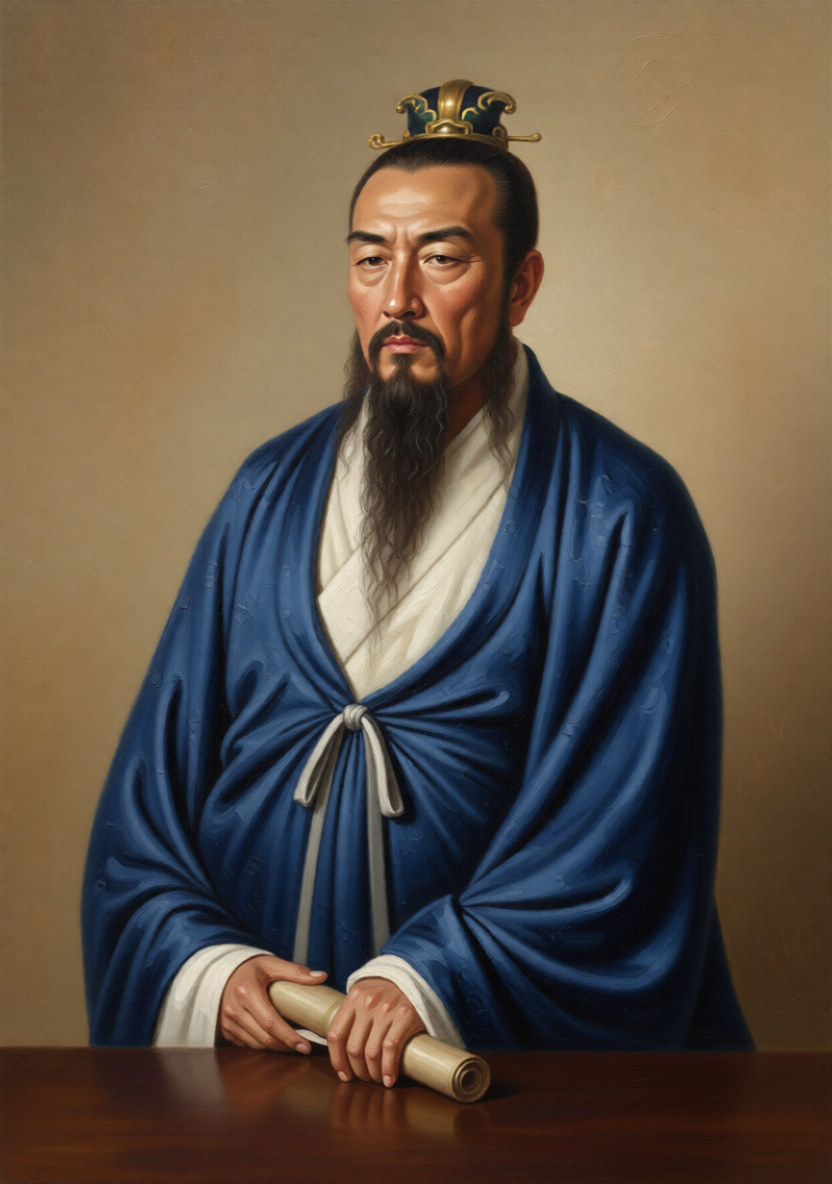
“The Confucianists love virtue for its own sake, and try to do good unselfishly without perpetually looking to reward and profit.” (H. P. Blavatsky, “The Secret Doctrine” Vol. 1, p. 440)
“Confucius did not admit of a future life . . . If he rejected it, it was on the ground of what he calls the changes — in other words, rebirths — of man, and constant transformations. He denied immortality to the personality of man — as we do — not to MAN.” (“The Secret Doctrine” Vol. 1, p. 440)
“The old archaic map of Cosmogony is full of lines in the Confucian style, of concentric circles and dots. Yet all these represent the most abstract and philosophical conceptions of the Cosmogony of our Universe. . . .
“Confucius, one of the greatest sages of the ancient world, believed in ancient magic, and practised it himself . . . Nevertheless, even in his age — i.e., 600 B.C., Confucius and his school taught the sphericity of the Earth and even the heliocentric system; while, at about thrice 600 years after the Chinese philosopher, the Popes of Rome threatened and even burnt “heretics” for asserting the same. He is laughed at for speaking of the “Sacred Tortoise.” No unprejudiced person can see any great difference between a tortoise and a lamb as candidates for sacredness, as both are symbols and no more.” (“The Secret Doctrine” Vol. 1, p. 441)
“To this day it is evident that [Theosophists] have utterly failed to understand the meaning of the term “Fifth and Sixth Rounders.” But it is simply this: every “Round” brings about a new development and even an entire change in the mental, psychic, spiritual and physical constitution of man, all these principles evoluting on an ever ascending scale.
“Thence it follows that those persons who, like Confucius and Plato, belonged psychically, mentally and spiritually to the higher planes of evolution, were in our Fourth Round as the average man will be in the Fifth Round, whose mankind is destined to find itself, on this scale of Evolution, immensely higher than is our present humanity.
“Similarly Gautama Buddha — Wisdom incarnate — was still higher and greater than all the men we have mentioned, who are called Fifth Rounders, while Buddha and Sankaracharya are termed Sixth Rounders, allegorically.” (“The Secret Doctrine” Vol. 1, p. 162)
~ * ~
Confucius, or rather Kongfuzi, is not mentioned very often in the Theosophical literature but when he is, he is spoken of very positively, as shown above.
He lived in China from around 551-479 B.C. Lao Tzu or Laozi, the father of Taoism, is estimated to have been born around 581 to 571 B.C., meaning that he was 20 or 30 years older than Confucius. It appears that they were both partly contemporaneous with the Buddha. Pythagoras and – according to Theosophy and some Hindus – Adi Shankaracharya are two other spiritual luminaries who were active in this same general period.
Confucianism – also called by its adherents Ruism, “ru” meaning “ethical scholars” or “men of virtue” – cannot really be called a religion. It is a non-theistic ethical and social philosophy, in which the secular is the sacred.
To better understand and appreciate the excerpts which we will shortly share from the Analects (compiled by disciples of Confucius after his death) as well as the criticisms of Confucius and Confucianism found in the leading texts of Taoism – including the Tao Te Ching or Daodejing itself, even though Lao Tzu is traditionally held by many to have been a spiritual teacher to Confucius – it’s necessary to understand some of the fundamentals or key concepts of Confucianism.
* Benevolence or Humaneness (ren)
This is the highest Confucian virtue, which essentially encompasses all the others. Mencius or Mengzi, “the Second Sage” of Confucianism, who lived c. 371-289 B.C., added some slightly more mystical, metaphysical, or quasi-Taoist elements to Confucius’ rather stark philosophy, by teaching that human beings are naturally and inherently benevolent or humane and righteous, and that this is our “innate nature,” our “true mind,” which we must uncover and recover.
* Righteousness (yi)
This goes hand in hand with benevolence, so that the two are almost always spoken of together. Confucianism is therefore thought of as the philosophy of benevolence and righteousness.
* Virtue (te or de)
* Propriety or Ritual or Rites (li)
This is also translated as “decorum,” “ceremony,” “good form,” “societal etiquette,” etc. “Ritual” or “rites” are not meant here in the Western religious sense but instead refer to behavioural prescriptions and obligations, embodied in rules (such as rules for mourning) which Confucius thought society should follow and abide by, in order to maintain benevolence and righteousness collectively and individually. It is largely this rather mechanical and externalised approach to goodness which so irked Lao Tzu and the Taoists. The latter favour almost entirely the opposite approach. H. P. Blavatsky does not comment on these points, focusing instead on her and her Teachers’ knowledge of the otherwise unknown esoteric side of Confucius and his teachings, though they reveal extremely little about this.
* The Gentleman or the Nobleman (junzi)
This is the ideal person from the Confucian perspective. Everyone can and should so transform their conduct as to become a true Gentleman, a noble person in the true sense of the word. The masculine-gendered term is used, as Confucianism unfortunately addresses itself solely to men, and Confucius had only male disciples. Women can of course gain just as much inspiration and benefit from his work, however.
* Filial Piety or Filial Devotion or Familial Responsibility (xiao)
This is one’s duty to one’s parents, which is one of the most fundamental principles and practices in Confucianism. This includes reverence for elders, as well as ancestor veneration.
* Reciprocity (shu)
This is the same principle which is enshrined in the scriptures of almost every single religion on Earth, i.e. the “Golden Rule” of “treat others the way you would like to be treated.” In the Analects, it is expressed from the negative standpoint, i.e. “do not do to others what you do not want them to do to you,” but this is simply another way of stating the same universal guideline.
* Trustworthiness or Loyalty or Faithfulness (xin)
Since there is a strong political element and application to Confucianism, this includes patriotic loyalty to one’s ruler and country. But it also applies to one’s ordinary friendships and relationships: one ought to exude dependability and integrity.
* The Way (tao or dao)
In Confucianism, the Tao has a far less mystical and much more pragmatic and mundane meaning than in Taoism. In effect, the Tao or Way upheld by Confucius means the Way of Living inculcated by his ethical and social philosophy. He appears to never speak of Tao as a metaphysical Principle, the Source and Essence of all, as in the Tao Te Ching. Nonetheless, he does not deny this, and his teaching is not wholly devoid of metaphysical elements, as will be seen later and also in the next point.
* Heaven (tian)
Confucius repeatedly makes mention of “the will of Heaven,” “the mandate of Heaven,” and so forth. When the term “Heaven” is encountered in Chinese religions, one should not assume it to have the same meaning as what Christianity typically understands by it. Heaven, for Confucius, for Lao Tzu and Taoism, as also for Chinese Buddhists, refers to a transcendental but impersonal “Moral Order,” the “Natural Order” of the cosmos. In “The Classic of Filial Piety,” believed by some to be the work of Confucius, Heaven and Earth are seen as the supreme Parents, or Father and Mother respectively, though not in any anthropomorphic sense.
* The Doctrine of the Mean or the Middle Way (zhongyong)
In Confucianism and Taoism, the “Middle Way” does not bear exactly the same connotations as in Buddhism, where it is often used to describe the Buddha’s abstruse and metaphysically complex philosophical position regarding anatta or “non-self.” For Confucius, the term is simply of practical ethical application: do not go to any extremes, always stay in balance in all things. This is considered to be much more difficult and much more profound and far-reaching than one might imagine.
Naturally, the ethical qualities of courtesy, respectfulness, honesty, harmony, and peace also play a prominent role in Confucian thought. Confucius also strongly promoted engagement with music, the arts, and learning or education.
The Analects of Confucius has been described as “arguably the single most influential work on the philosophical, religious, and cultural life of the Chinese people.” It has also been said: “The single most influential philosophical work in all of Chinese history, The Analects of Confucius has shaped the thought and customs of China for centuries and has played a key role in the development of nearby countries, such as Korea, Japan, and Vietnam.”
As a great Teacher belonging – as HPB strongly implies – to the Great Lodge of Initiates or Brotherhood of the Masters of Wisdom, the Soul who was Confucius has certainly had a profoundly far-reaching effect and influence on the East Asian world, and largely for good. We add the qualifying term “largely” because Confucianism can quite easily degenerate into mere formalism, authoritarianism, empty ritualism, extreme bureaucracy, and even materialism, as well as be taken advantage of by leaders or elders for their own purposes.
Today’s Chinese government has often been described as heavily influenced by Confucianism, at least in an external sense. Many young Chinese people have become anti-Confucian, as they hold it ultimately responsible for many of the abuses in Chinese society, including ingrained misogyny.
There are one or two statements in the Analects which speak dismissively and demeaningly of women. Yet we ought to remember that the same thing can be found in varying degrees in all ancient cultures, religions, philosophies, and scriptures. It is not unique to Confucianism and although many people today have thankfully progressed beyond misogynistic attitudes, their presence cannot in itself justify the wholesale discarding of a particular system of thought.
As one reads these quotes from the Analects, it should become apparent that there is a vast difference between Confucius himself and the majority of his followers; although there is nothing remotely esoteric in his known words, they breathe a certain lightness, openness, and zest, which Confucians and Neo-Confucians themselves are often lacking.
H. P. Blavatsky sometimes refers appreciatively to the phrase “The Great Extreme,” which she describes as Confucius’ term for the Absolute or Absoluteness, the one ultimate, infinite Reality. “Great Extreme” is a translation of Taiji, which is also translated “Great Absolute” or “Supreme Ultimate.” Taiji is held to be the unconditioned, non-dual source from which the dual forces or polarities of Yin and Yang arise.
This all appears in the Great Treatise or Commentary on the I Ching or Yijing (the Book of Changes), which treatise was widely attributed in Victorian times to Confucius but is now held by scholars and historians to postdate him by a century or more. Chinese tradition has maintained since ancient times that this work was authored by Confucius, so it remains somewhat unclear. If it is by him, it is of quite a different character to the words and impression of Confucius which come to light in the Analects.
Incidentally, the I Ching is conventionally dated to 3,000 or more years ago – longer, in the Theosophical view – and is the oldest known text to speak of Tao and of Yin and Yang. It thus became the root from which Taoism in particular, and Confucianism to a lesser extent, derived some of their foundational ideas and core understandings.
~ * ~
FROM THE ANALECTS OF CONFUCIUS
“The Master said, Young people should be filial at home, brotherly with others, circumspect, and trustworthy. Let them act kindly towards the populace in general, and befriend those of benevolent character. If, they have any energy left over after that, they ought to study the arts.” (1:6)
“The Master said, When a Gentleman eats, he doesn’t try to stuff himself. When he chooses a house, he is not overly concerned about comfort. He is attentive to his affairs, careful in his words, and looks to those who have the Tao, in order to correct himself. He is the kind of person who can be called a lover of learning.” (1:14)
“The Master said, Don’t worry about whether other people understand you. Worry about whether you understand other people.” (1:16)
“The Master said, The three hundred poems of the Book of Odes can all be summed up in a single phrase: Think no low thoughts.” (2:2)
“The Master said, Guide the people with government orders, regulate them with punishments, and the people will seek to evade the law and will be without shame. But guide them with virtue, regulate them with propriety, and they will have a sense of shame and become upright.” (2:3)
“The Master said, At fifteen I set my mind on learning; by thirty I had found my footing; at forty I was free from confusion; by fifty I understood the will of Heaven; by sixty I learned to listen to others; by seventy I could follow my heart’s desires without overstepping the line.” (2:4)
“Meng Yi Zi asked about filial piety. The Master replied, Never break the rules . . . While your parents are alive, serve them according to the rules of propriety. When they die, bury them according to the rules of propriety. Then make sacrifices to them in accordance with the rules of propriety.” (2:5)
“Ziyou asked about filial piety. The Master said, Nowadays this is taken to mean just seeing that one’s parents have enough to eat. But we do that much for dogs and horses. If in addition to this, we do not truly reverence our parents, what is the difference?” (2:7)
“The Master said, Be thoroughly versed in the old, and understand the new – then you can be a teacher.” (2:11)
“The Master said, The Gentleman is fair-minded and not partisan. The petty man is partisan and not fair-minded.” (2:14)
“The Master said, Learning without thought is pointless. Thought without learning is dangerous.” (2:15)
“The Master said, You (Zilu), shall I teach you what knowledge is? When you know a thing, to admit that you know. When you don’t know, to admit that you don’t know. That’s what true knowledge is.” (2:17)
“Ji Kangzi asked, How can I make the common people respectful, loyal, and diligent in their work? The Master said, If you supervise them with strictness, they will be respectful. If you are filial and compassionate, they will be loyal. If you give promotions to those who are good, and teach those who are not good, the people will be diligent.” (2:20)
“The Master said to Master Zeng, Shen, my Tao has one theme running throughout! Master Zeng said, Yes. After the Master had left, the disciples asked, What did he mean? Master Zeng said, The Master’s Tao consists of loyalty and reciprocity alone.” (4:15)
“The Master said, The Gentleman is alert to what is right. The petty man is alert to what is profitable.” (4:16)
“The Master said, When you see a worthy person, think about how you can equal him. When you see an unworthy person, reflect on your own conduct.” (4:17)
“The Master said, The Gentleman desires to be hesitant in speech but prompt in action.” (4:24)
“Zilu said, I would like to hear the Master’s desires. The Master said, To free old people from worry, to be trustworthy toward my friends, and to be at all times helpful to the young.” (5:26)
“The Master said, It’s hopeless! I have yet to see anyone who can recognise his faults, look within himself, and put the blame there.” (5:27)
“The Master said, In a village of ten households there are certain to be those who are as loyal and trustworthy as I am, but none who are my equal in love of learning!” (5:28)
“Fan Chi asked about wisdom. The Master said, Work to lead the people toward what is right. Respect the gods and spirits but keep them at a distance – this can be called wisdom.” (6:22)
“The Master said, The virtue embodied in the doctrine of the Mean is of the highest order. But it has long been rare among people.” (6:29)
“The Master said, If they’re not eager to learn, I don’t enlighten them; if they’re not struggling to put it into words, I don’t assist them. I hold up one corner to show them, and if they cannot then lift up the other three unaided, I don’t go on.” (7:8)
“These subjects the Master did not discuss: strange occurrences, feats of strength, rebellion, the gods.” (7:20)
“The Master said, When I walk with two others, I’m guaranteed to find a teacher.” (7:21)
“The Master was both mild and sharp-spoken, dignified but not oppressively so, respectful but relaxed.” (7:36)
“The Master observed four prohibitions: no wilfulness, no obstinacy, no narrow-mindedness, no egotism.” (9:4)
“Standing by a stream, the Master said, Does it not flow on like this, never ceasing, day or night?” (9:17)
“When Confucius was among the people of the community, he was mild and deferential, almost as if he was unable to speak. When he was in the ancestral temple of the ruler or at court, he spoke at length, though always in a careful and cautious manner.” (10:1)
“Jilu asked how one should serve the gods and spirits. The Master said, When you don’t yet know how to serve your fellow human beings, how can you serve the spirits? Jilu said, May I ask a question about death? The Master said, When you don’t yet understand life, how can you understand death?” (11:12)
“The Master said, Going too far is as bad as not going far enough.” (11:16)
“The Master said, To master the self and return to the ritual of propriety is to be benevolent. For one day, master yourself and return to ritual, and the whole world will become benevolent. Being benevolent proceeds from you yourself. How could it begin anywhere else?” (12:1)
“Concentrate on loyalty and trustworthiness and follow what is right – this is the way to uphold virtue.” (12:10)
“The Master said, Acquire broad learning in cultural matters, focus it through the rituals of propriety, and you are not likely to go far wrong – isn’t that so?” (12:15)
“The virtue of the Gentleman is like the wind. The virtue of the petty people is like the grass. When the wind blows over the grass, it will surely bend.” (12:19)
“Fan Chi asked about benevolence. The Master said, Love others. Fan Chi asked about understanding. The Master said, Understand others.” (12:22)
“Find someone to work with whose actions follow the Mean, who lives according to the Middle.” (13:21)
“The Master said, The Gentleman is self-possessed but not arrogant. The petty man is arrogant but not self-possessed.” (13:26)
“The Master said, To be poor but not resentful is difficult. To be rich and not arrogant is easy.” (14:11)
“The Master said, The Tao of the Gentleman has three characteristics, which are still beyond me: The benevolent are never anxious, the wise are never perplexed, and the brave are never afraid. Zigong said, But Master, that is your Way.” (14:30)
“Zigong asked, Is there a single word that can guide a person’s conduct throughout life? The Master said, Wouldn’t that word be reciprocity? What you do not want others to do to you, do not do to others.” (15:24; the same principle, often termed the “Golden Rule” and which is famously found in the teachings of Jesus as indeed in almost every religion, also appears in 5:12 and 12:2 of the Analects)
“The real mistake is to not correct your mistakes.” (15:30)
“Confucius said, The Gentleman has three things to beware of. When he is young and not yet in control of his energies, he should beware of sexual attraction. When he is mature and his energies are at their peak, he should beware of aggressiveness. When he is old and his energies have waned, he should beware of greed.
“Confucius said, The Gentleman has three things he stands in awe of. He stands in awe of the Mandate of Heaven, of persons in high position, and of the words of the sages.” (16:7-8)
“The Master said, There are only two types of people who never change: the highest among the wise, and the lowest among the stupid.” (17:3)
“Confucius said, If you do not understand the will of Heaven, you will have no way to become a Gentleman. If you do not understand propriety and its ritual observance, you will have nowhere to take your stand. If you do not understand words, you will have no way to know people.” (20:5)
~ * ~
LAO TZU AND CHUANG TZU ON CONFUCIUS AND CONFUCIAN PRINCIPLES
Unless one has read a literal, textually accurate translation of the Tao Te Ching (attributed to Lao Tzu) and also knows the significance of any mention therein of “benevolence and righteousness” and several other key words, one would never realise or suspect that the Tao Te Ching repeatedly criticises some of Confucius’ core ideas. This is prevalent throughout Taoism, as the Zhuangzi or Book of Chuang Tzu also shows in its numerous stories featuring Confucius. Chuang Tzu is the second leading figure in Taoist thought and lived around 369-286 B.C. He was thus a contemporary of Mencius or Meng Tzu, the second leading figure in Confucian thought.
Many Theosophists have the rather naive idea that Confucius was a disciple of Lao Tzu and that his ideas and philosophy were in harmony and congenial relations with Taoism and vice versa. It remains unclear to what degree, if any, he was ever a disciple, pupil, or even admirer of Lao Tzu. Considering that their perspectives on what society needs are diametrically opposed to one another, anyone would have a near impossible job of defending the assertion that Lao Tzu and Confucius were Guru and chela.
Nevertheless, we find accounts from multiple different sources regarding Confucius coming to Lao Tzu to seek wisdom at at least one point in his life. These could all be mere legends, or sectarian literary devices, or they could be based on the awareness that something of that nature did actually happen but that the exact details are now lost in the mists of time.
Whatever the case may be, we will now provide extracts from the two most important texts of Taoism.
Realistically speaking, it would seem that the Taoist approach is so supremely spiritual and profoundly non-dualistic and unconventional that only a minority of people can even clearly comprehend it, let alone live according to it. Confucianism, even if far less spiritually and mystically elevated, is at least readily comprehensible to everyone. People need to be helped at their present level of understanding and ability; the ordinary person cannot be expected to grasp the most rarefied and paradoxical aphorisms and thereby naturally reform their society or nation accordingly through “actionless action.”
Those who devote themselves to spiritual things can understand and appreciate Taoism; others cannot. Perhaps then, Taoism is overly idealistic and Confucianism overly realistic. One could apply the Doctrine of the Mean and find the Middle Way which most perfectly synthesises and harmonises the two.
“When great Tao is rejected, benevolence and righteousness appear. With learning and knowledge professed, great hypocrites spring up. When family relations are forgotten, filial piety begins to be taught.” (Tao Te Ching, #18)
“Banish learning, discard knowledge, and people will gain immeasurably. Banish benevolence, discard righteousness, and people will return to natural duty and true compassion. Banish skill, discard profit, and there will be no more thieves. These three statements are not enough. One more thing is necessary: Look at plain silk; hold uncarved wood. The self dwindles and desires fade.” (Tao Te Ching, #19)
“Lose Tao [the Way] and you also lose Te [the Virtue or Power that comes from following and living in harmony with the Way]. Lose Te and people will begin to teach benevolence. Lose benevolence and they will teach righteousness. Lose righteousness and they will teach propriety. Propriety dilutes people’s loyalty and sincerity. Confusion begins and stupidity sets in.” (Tao Te Ching, #38)
“The more prohibitions and rules, the poorer people become. . . . The more elaborate the laws, the more crimes are committed. Therefore the Sage says: I do nothing and the people transform themselves. I rest in serenity and the people govern themselves. I cultivate emptiness and the people become prosperous. I have no desires and the people simplify themselves.” (Tao Te Ching, #57)
We should note that Chuang Tzu acknowledges: “Filial piety, mutual respect, benevolence, righteousness, loyalty, integrity, resoluteness and purity; all of these can be of service to Te [Virtue]. But in and of themselves, they are unworthy.” (The Book of Chuang Tzu, Ch. 14)
“Shu Shan the Toeless said to Lao Tzu, “Confucius has definitely not become a Perfect Man yet, has he? So why does he attempt to be your student? He seems to be caught up in the search for honour and reputation, without understanding that the Perfect Man sees these as chains and fetters.”
“Lao Tzu said, “Why don’t you help him to see that death and birth are one and the same thing, and that right and wrong are one and the same thing, and thus free him from the chains and fetters?”” (The Book of Chuang Tzu, Ch. 5)
“Confucius had ambled along for fifty-one years and had never heard anyone speak of the Tao until he went south to Pei and went to see Lao Tzu.
“Lao Tzu said, “So you’ve come at last, Sir? I have heard that you are the wise man of the north. Sir, have you followed the Tao?”
“”I have not yet followed it,” replied Confucius.
“”Well, Sir, where have you looked for it?”
“”I looked for it in what can be measured and regulated, but even after five years I still haven’t found it.” Confucius confessed further, “I looked for it in Yin and Yang but ten or twelve years passed and I still couldn’t find it.”
“”Obviously!” said Lao Tzu. “If the Tao could be served up, offered, spoken of, or passed on, everyone would have it by now. But that cannot be and I will tell you why: If there is no true centre within to receive it, it cannot remain. If there is no true direction outside to guide it, it cannot be received. If the true centre is not brought out, it cannot be received on the outside. The sage cannot draw it forth. If what comes in from the outside is not welcomed by the true centre, the sage cannot let it go. Fame is something everyone seeks, but don’t go after too much of it. Benevolence and righteousness are like the houses of former kings: good to shelter in for one night, but don’t stay there too long. . . .
“Lao Tzu continued, “The Perfect Man of old walked the Tao of benevolence, a path which he took as a loan; he used righteousness only as a place to lodge for a night. He thus ambled through the empty and unruly places, found food in the open fields, and enjoyed the gardens which were not his. To know such freedom, you must do Wu Wei [actionless action, empty action, or “doing without doing”]. . . . The ancient ones knew this as the wandering of the Truth Gatherer. . . .
“”Benevolence and righteousness, when imposed upon us as you advise, disturb one’s heart and produce great distress. Sir, if you want to stop everything below Heaven from losing its original simplicity, you must go with the flow and stand firm in Te [Virtue]. Why do you exert yourself so much, as if banging a big drum or hunting for a lost child? The snow goose does not need a daily bath in order to stay white, nor does the crow need to be dyed every day in order to stay black. Black and white comes from innate natural simplicity, not from argument. . . .
“”Innate nature is eternal and unchanging, fate is unalterable, time cannot be stopped, the Tao cannot be halted. Hold fast to the Tao and there is nothing it cannot do; lose it and there is nothing that can be done.”
“Confucius shut himself up for three months, then travelled to see Lao Tzu and said, “I’ve grasped it! The raven hatches its young, the fish spew forth their eggs, the wasp transforms, and when a younger brother comes along, the elder brother weeps. For too long, I have not been able to work in harmony with such changes. And so, seeing as I did not play my part in harmony with others, how could I expect to change people?”
“Lao Tzu replied, “Well done. Now you’ve grasped it.” (The Book of Chuang Tzu, Ch. 14)
“Confucius travelled west to deposit his books in the archives of Chou. Tzu Lu advised him, “I have heard that the official in charge of the Royal Archives is Lao Tzu. But he has retired and now stays at home. Sir, if you want to place your books there, go and see him and ask his assistance.”
“Confucius thus went to visit Lao Tzu, but Lao Tzu refused to help. So Confucius took out his Twelve Classics and started to preach. When he was halfway through his discourse, Lao Tzu said, “This is too much. Just put it briefly.”
“Confucius responded, “In brief, it is benevolence and righteousness.”
“”May I ask,” said Lao Tzu, “are benevolence and righteousness of the very essence of human beings?”
“”Definitely,” affirmed Confucius. “If the noble Gentleman lacks benevolence, he has no purpose. If he lacks righteousness, he has no life. Benevolence and righteousness truly belong to the innate nature of human beings. How else could it be?” . . .
“”Your words reveal misunderstanding,” said Lao Tzu. . . . Sir, if you want people to remain simple, shouldn’t you look to the ways of Heaven and Earth? . . . Walk with Te [Virtue] and travel with the Tao, and you will reach the perfect end. Why bother with all this benevolence and righteousness stuff, prancing along as if you were beating a drum or looking for a lost child? Sir, you will just throw people’s true nature into confusion!” (The Book of Chuang Tzu, Ch. 13)
“After meeting Lao Tzu, Confucius returned home and remained silent for three days. His disciples then asked him, “Master, now that you have met Lao Tzu, what do you think of him?”
“”I have now seen a dragon!” said Confucius. “A dragon coils up to show its form, it stretches out to display its power. It rides upon the breath of the clouds and is nourished by Yin and Yang. My mouth gaped open and I could not shut it. How can I describe Lao Tzu in words?”” (The Book of Chuang Tzu, Ch. 14)
~ * ~
This article may have raised more questions about various things. Please make use of the site search function (the magnifying glass symbol at the top of the page) and visit the Articles page to see the complete list of over 400 articles covering all aspects of Theosophy and the Theosophical Movement.
If you liked this article, you may wish to also read Ethics: The Soul of The Wisdom-Religion, Lao Tzu and Tao – Insights from Theosophy, and Making Peace with Impermanence.
~ BlavatskyTheosophy.com ~

