
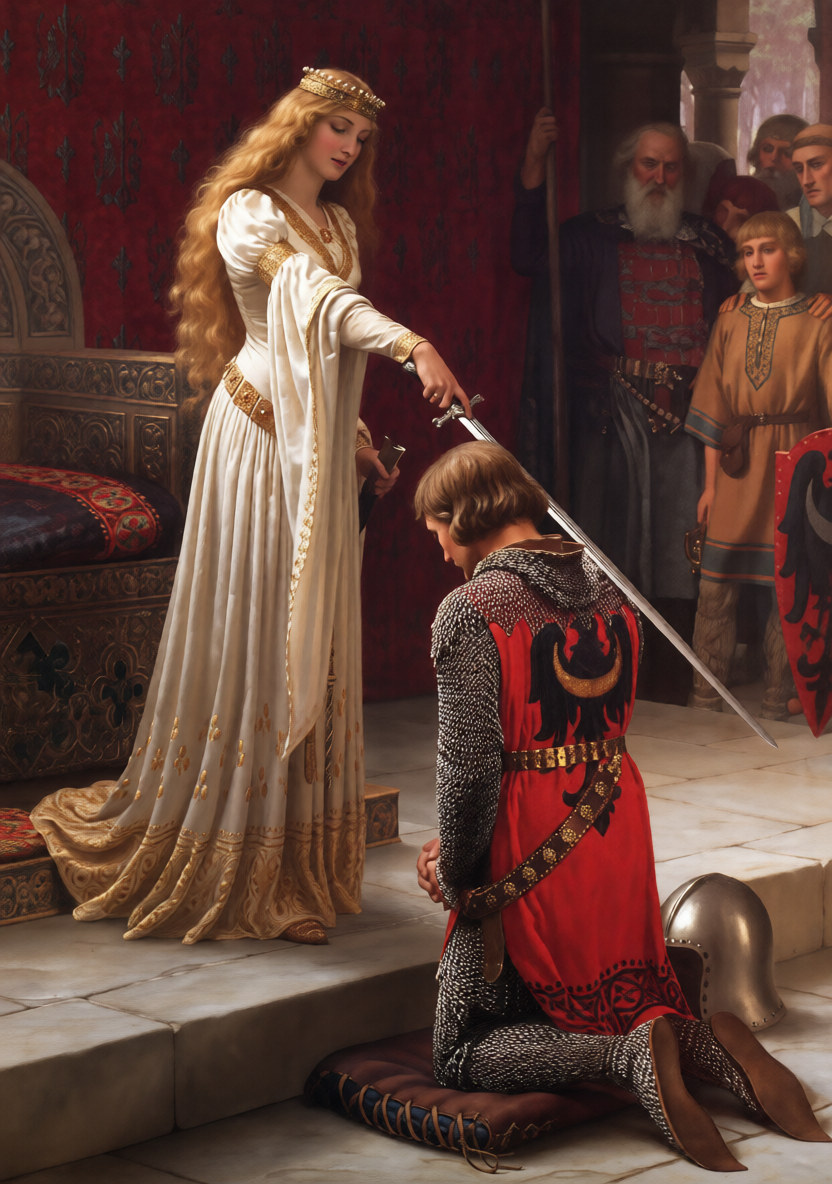
EXTRACTS FROM “ROMANCE” BY ACTON GRISCOM
IN “THE THEOSOPHICAL QUARTERLY” OCTOBER 1920
What is Romance? Not, what is a romance, but what is Romance itself?
Romance is a light of eternity irradiating the unexplained events familiar to our everyday experience and consciousness.
It is the antidote to scientific or prosaic realism. It does not lead to idealism, the opposite to realism; it reveals truth. It sees things as they are sub specie eternitatis [i.e. “from the perspective of eternity,” or “under their eternal aspect”], bathed in the rosy glow of divine illumination. It brings to our eyes, holden by false material lights and blinded by passion and desire, the vision of nature and of life more nearly as they are. Romance is the sparkling of the diamond-truth.
Therefore Romance itself exists. It is in, and of, reality; inherent in life as a radiance, as the essential poetry and joy and mystery of a divinely ordered activity. Romance is nature’s charm; “that light whose smile kindles the universe.” When Romance itself is seen or felt or apprehended in any way, then we have come upon eternal life. For true life is a romance; and so life, seen truly, is romantic. Romance, therefore, is at once a way of understanding the interplay of the love and mystery and beauty and joy of things, and a new quality that springs from their union and harmony. Until life is seen as radiant immortality, in terms of love and mystery and beauty and joy, it is not really seen at all. “Remember, moreover, that only to those who are deaf is life a cry; it is a song: and if this be true of life in general, it is also true of life in particular, of your life and of theirs.” [“Light on The Path”] Life seen in such terms is Romance; to see the Song of Life is Romance.
The so-called Romantic schools of art – poets, painters, sculptors, musicians – felt or saw or heard, something of real life, of immortal life.
It is, perhaps, because there is “a Presence which is not to be put by,” a centre of immortal life, of reality, in most of us – because most men and women have experienced moments when the veils of their own self-deception melted away before the radiance of some inner divine fire of love or religion or passionate endeavour, that so many crave Romance.
People speak wistfully of such moments; they cherish and reverence the ideals, the “dreams,” of youth; so few, alas, dare to hope for their return. But Romance has been, it is, known; the imagination has been stirred; and imagination, the pioneer of the will, creates a fairy-land of mystery, of beauty, of happiness, of things as they ought to be, “moving about in worlds not realized.”
It is for men, not merely to dream romances. but to create them, to live them.
The light by which we see the world comes out from our own souls. It may be the light of hell; it is more often the grey light of earth; it can be the light of heaven. “’Tis the good reader that makes the good book,” says Emerson; and again, “The world is enlarged for us, not by new objects, but by finding more affinities and potencies in those we have.” It is this which the child does instinctively. He is the prince he dreams, he walks past bowing courtiers, through embattled castles; he fights unnumbered hosts of giants and wild beasts; he lives adventures in a world of gold and azure and loveliness. He fits all he knows of life into his dream, and this world of his creation is truer to him than everyday life. “We live among gods of our own creation.” Wordsworth is right; heaven is near, is reached, by such creative imagination, heaven does often lie “about us in our infancy.”
When their best efforts fall short of realization, when their words, their pictures, their music are but faint echoes, “shadowy recollections,” then we, the earthbound, say that they romance, and the dictionaries use such words as “extravagant” and “fanciful.” But though we must recognize the fact that there are degrees of Romance, degrees of vision, of understanding, and inevitable distortion, yet in all Romance worthy the name is a vista to a larger truth. A single flash bespeaks the diamond. Hence the universal popularity of novels, of plays, of romans d’aventures [i.e. adventure novels/fantasies], of operas, and of landscapes, which, in one sense, have no basis whatever in the plain facts of life, but which hint that excitement is a perversion of that intense yearning of the heart for God which will carry a man through the fiery trial; that passions both good and evil are, after all, revelations of how high pitched and vibrant immortal life really is; that adventure is fulfilled only in the final Quest of the Holy of Holies; that operas remind us of a time “when the morning stars sang together” [Job 38:7]; and that Nature is the vesture of God, which only the pure in heart may hope to see truly.
For the moment we are not concerned with the technicalities of an art, of how such effects are produced; nor of the fact that “realist” schools, so called, are seeking the same revelation by another method. The realist will meet Romance before his goal is attained. But Romance makes a contribution all its own, because it reveals itself. Deny its existence, and you rob yourself of the best of life — of all the plus qualities, of spices, and of sugar coating. Accept it, and you are in touch with a mystery. For Romance is pre-eminently a quality of the heart, and so leads us to the heart of life.
From the foregoing, it will perhaps be divined that the Gods, the Masters, live lives of the truest Romance. And it is my belief that, as in heaven the everyday life of a Master is one long, thrilling, adventurous Romance, so on earth the greatest Romances ever enacted have had something of the life of the Masters in them. For it is immortal life that is the home of Romance, and there must be the touch of immortality to create Romance.
It becomes, therefore, of special significance to discover that Romance, both as a technical word in the history of literature, and as an intellectual conception, seems specifically restricted to the Christian era. For this would suggest that the incarnation of the Master Christ infused the necessary consciousness into mankind to conceive of Romance. He, so to speak, brought the consciousness of Romance with him, when he came. Romance existed before, but men did not see it, their capacity to appreciate it lay dormant within them, not yet awakened by cyclic evolution. Only those who had risen above the world and claimed their immortality, had any conception of life as romantic. The Romance of Christ’s life and nature, his presence in men’s hearts, awoke the higher, the new consciousness in them. A new light had come into the world, all life and nature were filled with a new radiance. “Every good gift and every perfect gift is from above, and cometh down from the Father of lights, with whom is no variableness, neither shadow of turning.” [James 1:17]
It is a fact that the word Romance itself first appears applied to the language of Gaul or France, as it developed from the Roman or Latin language at the close of the “dark ages.” Coincident with this “Romance” language, appeared a body of literature, the first truly romantic literature to exist; which literature, because it was written in this Romance language, came to be called “Romance.” So the special language, and the special literature appeared approximately together. The gradual development of romance literature, embodying certain new ideas, formulated a new conception, that of Romance itself, or the romantic, with which everyone is to-day familiar, but which, before A. D. 1000, was not sufficiently present in the minds of men to produce literature. It can be seen, however, in the lives and words of early Christian soldiers and saints. There is no equivalent that we can discover in any pre-Christian language, within the historic period, for the word, or for the idea, romance. Romance appears specifically to be a development of Christian civilization, and I should go further and say that it is characteristically Christian.
This is so clearly recognized an historic fact that Webster defines Romance as “Pertaining or appropriate to the style of the Christian and popular literature of the Middle Ages, as opposed to the classical antique.” The Romans, the Greeks, the Semitic races, probably even the Chinese, Persians, and Hindus, had no conception of life such as is conveyed to us by the adjective romantic. We, looking back on events in Greek life, for example, as it is depicted in their literature, call this and another incident romantic, or a romance. Perhaps the loves of Hero and Leander might serve as an excellent illustration. The Christian world conceives this story as filled with romantic beauty; but we read into it the feelings and understanding of our own hearts. The original poem of Musaeus – whether he be the chosen disciple and spiritual son of Orpheus (about 1400 B.C.) as Virgil and Suidas celebrate, or a fourth century poet of the same name – the poem itself does not contain or set forth our ideas. It is, even in translation, an exquisite poem, full of lyric beauty; of rare simplicity, and portraying high passion and a noble virility. But both Hero and Leander are children.
It is delightful to see two doves billing and cooing. The doves, perhaps, might be said to know what they are doing, in a way. Sweethearts of five and four are also aware, in a sense, of what they are doing. But though many of the romantic elements are present, true Romance is lacking, because the self-consciousness of the individuals is incomplete. It is grown men and women who see Romance in the little loves of children, not the children themselves. Romance, if it reveal immortal life, must be mature, must have the self-consciousness of the heart to be complete. The loves of Hero and Leander might have been mature, their ultimate experience was certainly maturing, but the Greek poem which is our source, does not so render them.
The Greeks found beauty in nature; they did not find love. Cupid could teach love, but Cupid never gave his heart to men. Aucassin finds love, finds romance, in the song of birds, in the scent of flowers. He has felt, he is conscious of that “Sacred Heart,” which is ever on his lips, even in this early poem. “Nicolette searched his hurt, and perceived that the shoulder was out of joint. She handled it so deftly with her white hands, and used such skilful surgery, that by the grace of God (who loveth all true lovers) the shoulder came back to its place.”
God was in his world, not as thundering Jove on Mount Olympus, but as Father, interested in and loving his children. The incarnation of the Son of God, an incarnation motived by pure love of God and men, brought love, a new love, into the world. And as the heart is the centre of love-consciousness, so the world to-day has had a heart infused into it. The gods, the Masters, no longer are felt to stand above or apart from the world of nature and of men, but are immanent in them; their celestial radiance shines upon them, as
“. . . that sustaining Love
Which, through the web of being blindly wove
By man and beast and earth and air and sea,
Burns bright or dim, as each are mirrors of
That fire for which all thirst.”
A Romance is not the word which we should use naturally about the life of Christ. Yet, if we examine that life in terms of Romance, each and all of the elements are present, proving to us that it is, what it must be, the greatest example of Romance “come true” that the earth has so far seen.
Mr. George Saintsbury has analysed the elements of Romance, from the literary point of view, in so acute and able a manner, that we shall take over his terms almost bodily; laying, however, a somewhat different stress upon certain of those elements which do not much concern him in a strictly literary essay, but which have a special interest for us. He suggests that Romance comprises, in order, “war, love, and religion; the typical rather than individual character; . . . the admixture of the marvellous, not merely though mainly as part of the religious element; the presence of the chivalrous idea;” and, together with “adventure,” “the world-old motive of the quest.”
Each and all of these elements will be seen to have their ultimate source in spiritual life, in the life of the disciple, and of the Master. It cannot be found anywhere else – there is no final explanation of the raison d’e’tre for war, for love, for religion, for chivalry, outside the fullness of immortal, spiritual life. There has been no greater single fight than that waged in the temple at Jerusalem and on Calvary. There has been no greater adventure than the quest of a whole world of hearts, nor one inspired by a greater love. Nor has there ever been a finer consideration of the feelings of others, a more superb self-restraint, a more absolute loyalty, greater self-sacrifice, more magnificent heroism – in a word, such ideal chivalry, as that portrayed in the Gospel narratives.
It was the incarnation of Christ which, endowing us with heart, made such things part of our human consciousness, made us self-conscious of them, not merely as isolated virtues, but as a unity, as an individual perfection necessary to establish the ideal man, and the ideal state of society. Christ added to the very trees and flowers a magic they had not possessed before; and I am convinced if we could hear the way birds sang 100 B.C. we should inevitably discern that their song to-day had deepened in quality, springing more from the heart and appealing more to the heart. Must not the incarnation of every Avatar as set forth in theosophic teaching, bring with it a new, individual gift from the Lodge for the whole manifested universe? This new consciousness of the heart then, may be regarded as the distinguishing mark of the whole cycle of Christianity, which the classical age had never known. In its realization, the literature, the art, of our world, entered upon a new cycle, a new phase, the cycle of the heart, and of the self-consciousness, the maturity, which comes when we awake to the realization of love.
Romance is, therefore, for us, an achievement of Christianity. Mr. Saintsbury, striving to distinguish between all the adventure and story telling of the Ancients, and the Romances of Christianity, notes that “two things were still wanting which were all-powerful in the romances proper — Chivalry and Religion.”
There is no literature, outside specific scriptural writing, that expresses the religious-mindedness of man so completely as Romance-literature – which puts Christianity as the basis of its whole structure – and that depends so completely upon a strictly religious interpretation of life, upon so high a moral ethic. Mr. Saintsbury emphasizes “The singular purity of the romances as a whole”; and he says, “In a very wide reading of romance the present writer does not remember more than two or three passages of romance proper (that is to say before the later part of the 15th century) which could be called obscene by any fair judge.” Illicit love, as we now judge such things, is freely portrayed, but “it is never spoken of lightly and is always punished; nor are the pictures of it ever coarsely drawn.”
Together with its elevated tone, Romance literature portrays chivalry; and as a consequence, the world to-day conceives of Romance as imbued with the chivalric ideal. Romance appeals to the hero, and to the heroic; another clue as to its acting as a guide to the inner world; because, contained within the Greek traditions (cf., for example, Hesiod, Works and Days, Works, II. 187-224) were echoes, and more than echoes, of the Third Race, when the Nirmanakayas reappeared “as Kings, Rishis and heroes,” as Madame Blavatsky tells us in the Secret Doctrine. The memory, and almost the deification, of heroes, from Greek and also Scandinavian sources, persisted into the period of the Middle Ages when Romance literature appeared. So we find included the whole cycle of “quest” romances, depicting more or less vaguely and generally the initiations of the knight or “hero.”
The chivalric ideal, the Quest, the exaltation of women, the consecration of life to a cause, as that of religion, or of the church, or of a lady, or of honour — these things are the outward expression of Romance, are the efforts made by mankind to bring Romance out of the land of dreams, into everyday life. And we miss the import of these phases of human endeavour if we fail to discern that they carry with them the vitality of spiritual life. It is the genius of great minds to have visualized them; it is the rarer genius of great men actually to have lived them. For Romance has “come true,” and some day we shall all live our perfect Romance.
~ * ~
Acton Griscom (1891–1961) was an American Theosophist and a son of Clement Acton Griscom, Jr. and Genevieve Ludlow Griscom, who were close friends and colleagues of William Q. Judge. After Judge’s death and the difficulties with Katherine Tingley, Clement and Genevieve played a leading role in the reformation of the original Theosophical Society, headquartered in New York. Genevieve, who mostly wrote under the pseudonym of Cavé, was a direct disciple of the Master Hilarion, and became the esoteric heart of the Society.
Influenced by the new appreciation for Christ and Christianity gained by the Theosophists of this Society, Acton became ordained as a priest in the Episcopal Church, the American equivalent and counterpart of the Church of England. As Rev. Acton Griscom, he had a ministerial role at the Chapel of the Comforter, an Anglo-Catholic Episcopal church in New York which was under the direction and leadership of Theosophists.
In 1929, he published the lengthy and scholarly book “The Historia Regum Britanniae of Geoffrey of Monmouth with contributions to the study of its place in early British history,” which dealt with the historicity of King Arthur.
The Arthurian myths and legends are a prime and prominent example of the Romance-literature which Griscom’s above article is extolling. The Arthurian saga was particularly valued by members of The Theosophical Society headquartered in New York, and its mystical, esoteric, and symbolic qualities especially appreciated by those who were also members of its esoteric group, the Order of the Living Christ. This Theosophical Society no longer exists but can be explored in some depth in our article The Forgotten Theosophical Society. Acton Griscom was also particularly interested in Joan of Arc – as indeed was the Society at large – whose short but famous life could be described as a veritable historical embodiment of the type of Romance which the article is talking about.
~ * ~
In the above article, we saw it repeatedly suggested that “the incarnation of every Avatar as set forth in theosophic teaching, brings with it a new, individual gift from the Lodge for the whole manifested universe [or perhaps “the whole world” would be more accurate?]” and infuses a new consciousness into the existing human consciousness; people’s awareness, perceptions, and way of thinking . . . not only through the message that is given but through the immense and tremendously powerful spiritual energy that surely cannot help but be released into the world whenever the Divine Logos specially takes on human form and manifests in activity in this physical world. Granted, neither H. P. Blavatsky or William Q. Judge say any of this but it seems a natural and reasonable deduction and assumption to make if one reflects on the subject.
If we look at the teachings conventionally attributed to three great Avataric figures in the canonical scriptures, what do we see with regard to the focus they gave to the different aspects and applications of Love?
Krishna (in India, traditionally said to be approx. 5,000 years ago) – Love toward God (“upwards”) – No attention given to loving one’s neighbour, practising radical acceptance and forgiveness, etc., nor any particular focus on the love of God for man. These are surely implicit but Krishna is almost entirely silent about them.
Buddha (in India, approx. 2,500 years ago) – Meditating on and cultivating the feeling of love and compassion (“inwards”) – Love toward God and love from God are both dismissed as false teachings, for Buddhism is strictly nontheistic and denies that there is a God. Practically extending compassion to all beings forms an important part of the teaching but the focus is given almost wholly to the internal cultivation of a compassionate mind.
Christ (in Israel and Palestine, approx. 2,000 years ago) – The love and care of God toward man (“downwards”). Unconditional love toward others; practically and actually loving one’s neighbour as oneself (“outwards”) – There is also attention given to loving God with one’s whole being but in practice this occupies far less space and focus in the Gospels than the outwards and downwards aspects.
~ * ~
Many students of Theosophy may argue, based on H. P. Blavatsky’s writings, that what we call “God” is really an impersonal Principle, only associated with Love in a purely abstract sense, and that the notion of the Divine having love and care towards us must be erroneous and, at best, a severely exoteric compromise for the benefit of the unphilosophical masses.
To this, we would quote and point out the following:
“There will be objection at once, by some, to the use of the personal pronoun [for God, i.e. “He,” “Him,” “His” etc.]. They will argue rightly that the Absolute can
not be limited, and that personality implies limitation. On the other hand, to deny personality to the Absolute also imputes limitation. We use the impersonal pronoun [i.e. “it,” “that” etc.] for inanimate objects and babies. . . . it would be wise to mean something more when we speak of God than what we think we mean when we speak of the Absolute [i.e. because “absolute” is, properly speaking, a quality, a linguistic and philosophical category and adjective, whereas the term “God” denotes a LIVING REALITY so profound, transcendent, and supreme, that philosophical logic and intellectual reasoning can never suffice to adequately define and categorise “it”; only a Mystic can have direct experiential knowledge of God, and none have reported that their experience was of an impersonal, attributeless, “blank” force or law or energy devoid of characteristics.]” (R., “How Do We Think of God?” “The Theosophical Quarterly” Vol. 12, p. 136)
We all recognise that pure, unconditional, universal, and self-sacrificing love among human beings is the highest quality and characteristic there is and that it is truly sublime and wondrous. To insist, as most of our fellow HPB students do, based on intellectual reasoning and mundane logic, that God is literally incapable of this and is beyond all possibility of feeling and expressing love for His myriad offshoots, fragments, or sparks, other than as a purely homogeneous, abstract, impersonal, undeveloped type of unconditioned, unmanifest, unrelational “proto-love” – is to make man fundamentally superior to God (or the Infinite), and God (or the Infinite) vastly inferior to man! Jesus clearly taught otherwise.
On this site, we suggest that God is not actually impersonal but ineffable, meaning not possible of fitting neatly into any boxes, categories, definitions, or classifications – whether religious, Theosophical, or otherwise – which our minds may come up with. If God is GOD, surely this must be so?
~ * ~
“God so loved the world . . .” (Jesus, John 3:16)
“And one of the scribes came up and heard them disputing with one another, and seeing that he answered them well, asked him, “Which commandment is the first of all?” Jesus answered, “The first is, ‘Hear, O Israel: The Lord our God, the Lord is one; and you shall love the Lord your God with all your heart, and with all your soul, and with all your mind, and with all your strength.’ The second is this, ‘You shall love your neighbour as yourself.’ There is no other commandment greater than these.” And the scribe said to him, “You are right, Teacher; you have truly said that he is one, and there is no other but he; and to love him with all the heart, and with all the understanding, and with all the strength, and to love one’s neighbour as oneself, is much more than all whole burnt offerings and sacrifices.” And when Jesus saw that he answered wisely, he said to him, “You are not far from the kingdom of God.”” (Mark 12:28-34)
“As the Father has loved me, so have I loved you; abide in my love. If you keep my commandments, you will abide in my love, just as I have kept my Father’s commandments and abide in his love. These things I have spoken to you, that my joy may be in you, and that your joy may be full. This is my commandment, that you love one another as I have loved you. Greater love has no man than this, that a man lay down his life for his friends. You are my friends if you do what I command you. No longer do I call you servants, for the servant does not know what his master is doing; but I have called you friends, for all that I have heard from my Father I have made known to you. . . . This I command you, to love one another.” (Jesus, John 15:9-17)
“Owe no one anything, except to love one another; for he who loves his neighbour has fulfilled the law. The commandments, “You shall not commit adultery, You shall not kill, You shall not steal, You shall not covet,” and any other commandment, are summed up in this sentence, “You shall love your neighbour as yourself.” Love does no wrong to a neighbour; therefore love is the fulfilling of the law.” (St. Paul, Romans 13:8-10)
“Beloved, let us love one another; for love is of God, and he who loves is born of God and knows God. He who does not love does not know God; for God is love. . . . No man has ever seen God; if we love one another, God abides in us and his love is perfected in us. . . . God is love, and he who abides in love abides in God, and God abides in him. . . . There is no fear in love, but perfect love casts out fear. For fear has to do with punishment, and he who fears is not perfected in love. We love, because he first loved us. If any one says, “I love God,” and hates his brother, he is a liar; for he who does not love his brother whom he has seen, cannot love God whom he has not seen. And this commandment we have from him, that he who loves God should love his brother also.” (St. John, 1 John 4:7-21)
~ * ~
This article may have raised more questions about various things. Please make use of the site search function (the magnifying glass symbol at the top of the page) and visit the Articles page to see the complete list of over 400 articles covering all aspects of Theosophy and the Theosophical Movement. For a number of articles relating to the work and thought of the so-called Griscom/Hargrove/Johnston Theosophical Society, please see The Forgotten Theosophical Society, Occultism and Mysticism, The Master Who Stands At The Head of Your Ray, The Egyptian Lodge and the Secret Wisdom, Chelaship, Meditation, and The Master (by Cavé), Cavé’s Assistance on The Path to The Master, Two Little-Known Letters from The Master Hilarion, and Theosophy is ONE with the Christianity of Christ.
~ BlavatskyTheosophy.com ~
 T H E O S O P H Y