
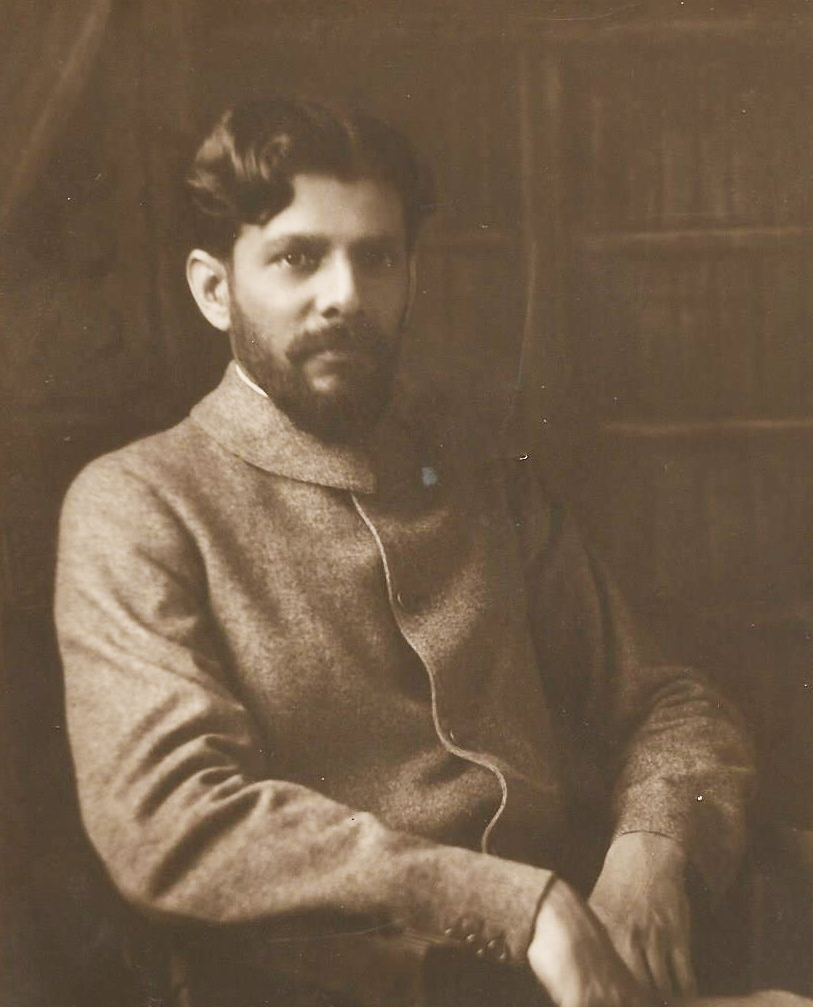
The influential Indian Theosophist B. P. Wadia (1881-1958) used the mantramic phrase “accuracy in space, punctuality in time, purity in causation” many times. Numerous articles on the practical applications of this triad of principles appeared in magazines he edited in connection with the United Lodge of Theosophists in India, such as “The Theosophical Movement” and “The Aryan Path.” The expression is still sometimes referred to today by some associates of the ULT.
Incidentally, Theosophy’s use of the word “Aryan” pre-dates and has no connection with 20th century European race ideology; the Sanskrit word literally means “noble” and in Victorian times was generally used as a synonym for “Indian,” since ancient India was known as Aryavarta. The term is still used in its original meaning by Indians today, even though to most of the world it has understandably taken on a very negative connotation.
It is not known when or how Wadia first formulated the phrase “accuracy in space, punctuality in time, purity in causation” but it appears in his article “The Search for The Master” (a large part of which can be read in one of our articles here) which pre-dates his time in the ULT. That article was first published in a 1922 pamphlet titled “The Inner Ruler” by a New York Theosophical group with unofficial links to “The Theosophical Society – Adyar,” just a very short time before Wadia’s high profile public resignation from the Society (when he declared “The Theosophical Society is disloyal to Theosophy”) and his joining the United Lodge of Theosophists, which also took place in 1922.
In that article he said: “In physical-plane life, faculty is required to do the Masters’ work well. The disciple must gain accuracy as far as space is concerned, punctuality with reference to time, purity with regard to causes. That is what the Master wants in terms of space, time, and causality.”
Whilst many spiritual seekers and aspirants recognise the importance and necessity of purity or at least of doing and being good and creating only beneficial causes in the world, most view things such as accuracy and punctuality as not particularly important, especially in relation to the spiritual life and spiritual progress.
Some forms of spirituality lead people to conclude that if one is genuinely attuned to the spiritual or the divine, things like punctuality, timekeeping, accuracy, and attention to detail, become irrelevant, unimportant, and things to be forgotten about and discarded, due to their seeming to tie one down to this physical, material plane which is ultimately illusory.
While it is of course true that one should not become obsessive, excessive, or overly fastidious about such matters as these, Wadia shows how extremely important they actually are and how accuracy, punctuality, and purity, or inaccuracy, lateness, and impurity, are really just the exterior effects of inner attitudes and states of mind. Those inner attitudes which result in carelessness, non-concentration, lack of clear thought and perception, failure to assume due responsibility, and inconvenience or even suffering to others, can hardly be considered “spiritual” or examples of the right kind of detachment!
We do not expect this pragmatic approach to be very popular with many spiritual seekers today but we trust that students of Theosophy will gain some inspiration, practical help, and motivation for self-improvement in both outer and inner life, from the following excerpts from articles believed to have been written by B. P. Wadia.
~ * ~
“Accuracy, Punctuality, Purity”
“The Theosophical Movement” December 1946
On what lines shall we begin acting from within? By thinking of the laws of the Universe and acting in harmony with them, and since the Universe is run on geometrical and mathematical lines, we have been given three rules of conduct: Accuracy in Space, Punctuality in Time, Purity in Causation.
Accuracy in Space. This has to be first learned from within. It is not the endeavour to be “accurate” as the world understands it, not the effort to put things straight and in their right places that really makes for accuracy. Forethought and planning and imagination have to be used first, watchfulness employed to see if the physical-plane results are what we planned, and all has to be planned as impersonally as a mathematician sets about his problems. Behind every action is a thought. Think accurately and actions will be accurate. It is in the little things that we see our lack of thinking accurately. Little acts of carelessness, of inaccuracy – how these mount up and become an avalanche destroying us just at the moment when accuracy would have saved us! Little mistakes of adding up, of typing, do not matter as mistakes, but if the attitude to them is that they do not matter, inaccuracy becomes the attitude underlying all life. Take the slightly careless driver. He can extricate himself ninety-nine times, but the hundredth time comes, and harm is done. Perhaps the plane on which most harm is done by inaccuracy is the plane of speech, as has been pointed out. Little do we realize that in trying to develop accuracy, i.e., the right attitude to the importance of all things in life, we are training ourselves and developing one of the most important of our powers! Even to give the right thing at the right place and to the right person implies thought. Further still, the very atoms of the body have to be trained to follow a noetic instead of a psychic impulse. Accuracy goes very deep into our natures, and only if we are accurate can we be trusted. The vice of inaccuracy is rooted in carelessness which in turn is rooted in the irresponsibility of the one who feels that nothing really matters.
Punctuality in Time. This implies also the power of judgment, or reasoning, or forethought. Watchfulness, as a constant mental factor, will help us more than trying to get up at the same hour or to catch a train. These things will come of themselves if watchfulness is ever-present. Even the Spiritual Guides of humanity watch for the right time for Their efforts. We learn from Isis [Unveiled] (I. 219), “Everything in this world has its time, and truth, however based upon unimpeachable evidence, will not root or grow, unless, like a plant, it is thrown into soil in its proper season.” Forethought is essential, judgment is essential, both grow out of patience, and that grows out of reliance on the Law. In our planning we must form clear images, accurate in detail, and learn to image them forth when the season is ripe. Punctuality on this plane will result in punctuality on the physical plane. To refer again to one who can be trusted – and what higher praise can be given to anyone? – such an one can be relied upon partly because he is always in time.
Purity in Causation. The soul of all our actions will be harmonious if we remember our Divine Heritage and always plan and act for and as the Self. Impurity is any tinge of self; purity is impersonality, with its roots in the One SELF. “Leave nothing of myself in me,” said Plotinus. This will of ours which has to control all things has first to be lost as far as we are concerned, as it has to be merged in the greater Will. Given the freedom of choice, which is man’s, Arjuna finally says: “I will do Thy bidding.” With purity of heart and mind comes the realization that life is a Song, a Harmony, and Man a part of that Harmony. “Not my will, but Thine, be done,” the Christian says, and this surrender must be no hardship but a joy. When, finally, the student has become the Master, “All Nature thrills with joyous awe and feels subdued.”
“Compassion is no attribute. It is the Law of LAWS – eternal Harmony, Alaya’s SELF; a shoreless universal essence, the light of everlasting right, and fitness of all things, the law of Love eternal.” [“The Voice of The Silence”]
~ * ~
“Three Rules for Daily Practice”
“The Aryan Path” April 1932
[From a lecture to a non-Theosophical audience on the subject of living the higher life:]
Our circumstances can be and should be changed and the measure of the change is the measure of human evolution. Take your destiny in your own hands and do not be fooled by appearance or by priest-craft and say “fate.” Man is the maker of his destiny. This will lose much of its difficulty if we can see that there is an educative value inherent in all our circumstances.
The higher life demands a change in inner attitude: man himself has fashioned in the past his present environment, and his future growth depends upon his right endeavour to live not as a body, not even as a mind, but as a Soul. The teaching of the Gita is that even the most sinful of men can cross the ocean of evil in the bark of spiritual endeavour. That is the teaching of the Buddha, who promised the boon of Nirvana to Upali, the barber. That is the teaching of Jesus who referred to the kingdom of Heaven as being within us.
The change in inner attitude results in our perception that we are, within ourselves, Souls, capable of willing, of thinking, of feeling; that as Souls we are in the body and possess a mind so that unlike beasts we may ascertain the real value, i.e. the educative value of all things and all people who surround us. . . .
So begin and change your inner attitude, but do so knowingly, deliberately, self-consciously. See what each event, each object in the environment, each person you contact has to teach you. We require true humility, not mock modesty, to live the higher life. A man who says, “I am humble,” betrays himself of the sin of subtle pride. Fix your mental attention on the Soul within and see with the Soul’s eye the value of each thing and every being in silent humility. . . .
The whole of the manifested universe is a triple expression of Motion, Space, and Time. Motion is causal and Time and its myriads of objects are effects in Space. We might say that Motion produces Time in Space. But let us not go into metaphysics! And yet it is necessary to get this fundamental of metaphysics that every thing and therefore every man in the universe is affected by Motion, Space and Time, and our environment is nothing else but an expression or a manifestation of Space, Time, and Motion or Causation. Therefore we find that the law of the higher life in reference to outer things, events and circumstances is summed up in three Aphorisms and these are: Purity in Causation, Accuracy in Space, and Punctuality in Time. We might say these three are all the Law and the Prophets any one needs to lead a spiritual life, a simple life, a higher life.
Learn the three aphorisms: Purity in Causation. Accuracy in Space. Punctuality in Time. Apply them to your own office work, if you please, and convince yourself that the higher life is highly practical. If Soul life makes you sentimental, dreamy so that you are inaccurate, unpunctual so that you are selfish, and egotistic till you are impure, beware of that Soul life! Much passes off as spirituality in this country, and we have to remember always that he who draws attention to oneself is unspiritual. To be egotistic of one’s own riches is unspiritual, but also it is unspiritual to be proud of sack-cloth and ashes! The truly spiritual man must be inconspicuous, must appear as nothing in the eyes of men.
Be pure in all you cause, i.e. in all you say and do, in all you feel and think. Four-fold is the world for every Soul. Each one of us moves in four spheres: of thought, of feeling, of speech and of deeds. Apply your trinity to these four things. Be pure and accurate and punctual in your thoughts, in your feelings, in your speech, and finally in your actions.
There is a very simple method (all spiritual things are simple because they are straightforward) which is sometimes called the law of elimination. This law eliminates difficulties, pitfalls and obstacles. What is that law? It revolves round the word “Necessity.” Don’t do that which is unnecessary; don’t say that which is unnecessary, ah! this we find difficult; don’t feel, nor think, what is unnecessary. The higher life is the simple life because things are simplified. Note, please, it is not simple living as it is commonly understood; there is a different kind of simplicity, that of necessity. That which is necessary for life must be retained and necessities of different people are different.
Apply this law of elimination and watch and be attentive not to indulge in unnecessary things; always and always ask of yourself, “is it necessary to do this, to go to this place or that, to say and speak thus, to feel or think in such a manner?” This will greatly help each one of us to be pure in our motives, to be accurate in the execution of our duties, to be punctual in all our tasks.
To sum up then. First the inner change of attitude which enables us to perceive that each man is a Soul, and is here in the school of life, to learn from his environment which he must improve by evaluating properly all men and beasts and things.
To bring about this change a man must convince himself of the power of his own Soul, and then as a Soul he must handle the affairs of his life, endeavouring to do all things with a pure motive, with a thoughtful punctuality and with deliberate accuracy. The marks of the spiritual man are that he does only that which is necessary and does it with a pure motive, correctly, in due place and due time.
Many are the difficulties to be encountered and many too the helps to be obtained, but unless a man starts right, he will go wrong a long, long way. The immediate step in front of us is the looking within to find the captain of the sea of life, and then to steer our vessel with the accurate compass, with the punctual chronometer, but above all with that motive of unselfish good will and desire to serve the passengers, our fellowmen, by taking our own ship to the Haven of Beauty and Virtue, where the Immortals eternally live to bless and to guide the divine Souls of mortal men.
~ * ~
This article may have raised more questions about various things. Please make use of the site search function (the magnifying glass symbol at the top of the page) and visit the Articles page to see the complete list of over 300 articles covering all aspects of Theosophy and the Theosophical Movement.
Some articles closely related to this one are: The Occult Life of B. P. Wadia, Space, Motion, Duration, Matter, Living Consciously, The Raja Yoga of Theosophy, Daily Self-Study and Self-Examination, Helpful Hints for Spiritual Progress, and Making Theosophy Living, Practical & Transformative.
~ BlavatskyTheosophy.com ~
 T H E O S O P H Y