
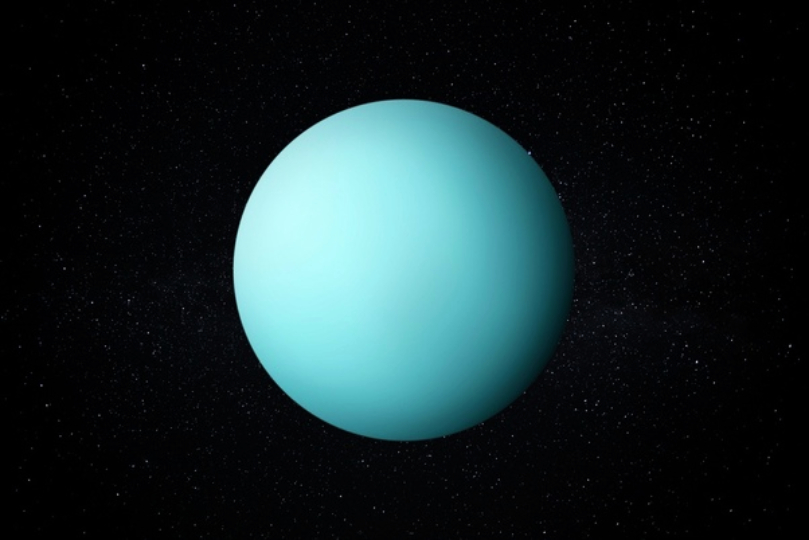
H. P. Blavatsky’s writings are ambiguous – probably deliberately so – about the planet Uranus, which was discovered by astronomers in 1781.
She explains that the seven sacred planets which bear a particular special connection with our Earth and humanity are Mercury, Venus, Jupiter, Mars, Saturn, and two others which were traditionally referred to as the Sun and Moon, but these latter two – one of which is a star rather than a planet and the other of which is a dead planet – were merely exoteric substitutes for two “mystery planets” whose identities were not permitted to be revealed historically.
In “The Secret Doctrine” Vol. 1, p. 575, she says that neither Uranus nor Neptune were these “mystery planets” and adds that they are the “gods and guardians” of other planets but not of Earth.
But on p. 99-100 of the same volume, she had quite strongly indicated that Uranus is the “sun substitute.” There, she quotes approvingly the French Freemason Jean-Marie Ragon, who stated that the day of the week we call “Sun-day” should actually be “Uranus-day.”
In “Transactions of The Blavatsky Lodge” (p. 48) she speaks of Vulcan – a planet between Mercury and the Sun and which some Victorian astronomers thought they had briefly discovered, until they could no longer find it – as the “sun substitute.”
In “The Secret Doctrine Dialogues” p. 96-97 (only published for the first time in 2014) she strongly implies that Uranus is the “moon substitute.”
So we are now seeing quite clearly, if it was not already obvious from one’s in depth study, that dogmatically insisting on the unquestionable truth of what HPB says in one place is unwise, since on numerous subjects she says something different, even contradictory, in another place.
Unfortunately, many take this as a sign that “HPB didn’t really know what she was talking about” or “HPB was unfit for the job,” but we take it as a reminder that many subjects are still too esoteric and potent to be more than fleetingly and very cautiously hinted at by those who possess true knowledge regarding them, and that this would have been the case even more so during the 19th century than today. The most important and practically relevant of her teachings are consistent throughout, however. Knowledge of the esoteric nature and role of Uranus is definitely interesting, inspiring, and mind-expanding, but it is far from being a crucial or essential thing for humanity, or even all Theosophists, to know about.
But there is a significant and revealing statement about Uranus found in HPB’s posthumously published article “Pagan Sidereal Worship, or Astrology.” There she states:
“We may, and shall be told, no doubt, that Uranus was unknown to the ancients, and that they were forced to reckon the sun amongst the planets and as their chief. How does anyone know? Uranus is a modern name; but one thing is certain: the ancients had a planet, “a mystery planet,” that they never named and that the highest Astronomus, the Hierophant, alone could “confabulate with.” But this seventh planet was not the sun, but the hidden Divine Hierophant, who was said to have a crown, and to embrace within its wheel “seventy-seven smaller wheels.””
~ * ~
This article may have raised more questions about various things. Please make use of the site search function (the magnifying glass symbol at the top of the page) and visit the Articles page to see the complete list of over 400 articles covering all aspects of Theosophy and the Theosophical Movement.
~ BlavatskyTheosophy.com ~
“The visible planet is the physical body of the sidereal being the Atma or Spirit of which is the Angel, or Rishi, or Dhyan-Chohan, or Deva, or whatever we call it. This belief . . . is thoroughly occult. It is a tenet of the Secret Doctrine . . . pure and simple.” (H. P. Blavatsky, “Star-Angel-Worship in The Roman Catholic Church”)
 T H E O S O P H Y