
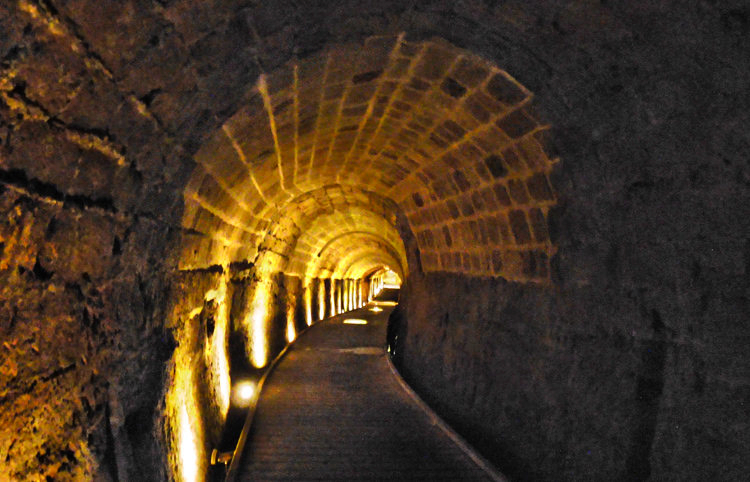
“Certain ascetics in the trans-Himalaya regions who live in deep underground caves, are called “Spirits of the Earth.” Lha, “Spirit” or Divine Being, is the name generally given to great adepts in Thibet, as the name of Mahatma, “Great Soul,” is given to the same Initiates in India.” (H. P. Blavatsky, Miscellaneous Notes, “Lucifer” magazine, June 1888)
“. . . occult science has its own methods of research as fixed and arbitrary as the methods of its antithesis physical science are in their way. If the latter has its dicta so also has the former; and he who would cross the boundary of the unseen world can no more prescribe how he will proceed than the traveller who tries to penetrate to the inner subterranean recesses of L’Hassa [i.e. Lhasa, the capital of Tibet] — the blessed, could show the way to his guide.” (Master K.H., “The Mahatma Letters” p. 6)
“Moreover in all the large and wealthy lamasaries [i.e. Tibetan Buddhist monasteries], there are subterranean crypts and cave-libraries, cut in the rock, whenever the gonpa and the lhakhang are situated in the mountains. Beyond the Western Tsay-dam, in the solitary passes of Kuen-lun [i.e. the northern edge of the Tibetan Plateau, but HPB in a footnote says she’s actually referring to the Karakoram Mountains, which are a Trans-Himalayan mountain range, straddling India (specifically the Ladakh area), Tibet (now technically a part of China), and to a lesser extent a few other countries], there are several such hiding-places. Along the ridge of Altyn-Toga [i.e. presumably the Altyn-Tagh, a mountain range in China, a large part of which is within Xinjiang, the Uygur Autonomous Region], whose soil no European foot has ever trodden so far, there exists a certain hamlet, lost in a deep gorge. It is a small cluster of houses, a hamlet rather than a monastery, with a poor-looking temple in it, with one old lama, a hermit, living near by to watch it. Pilgrims say that the subterranean galleries and halls under it contain a collection of books, the number of which, according to the accounts given, is too large to find room even in the British Museum. . . . According to the same tradition the now desolate regions of the waterless land of Tarim [i.e. the Tarim Basin, which includes the Taklamakan Desert, in the just-mentioned Uygur region; the Taklamakan adjoins the Gobi Desert] — a true wilderness in the heart of Turkestan [i.e. an old and nowadays unused name for a large area of Central Asia] — were in the days of old covered with flourishing and wealthy cities. At present, hardly a few verdant oases relieve its dead solitude. One such, sprung on the sepulchre of a vast city swallowed by and buried under the sandy soil of the desert, belongs to no one, but is often visited by Mongolians and Buddhists. The same tradition speaks of immense subterranean abodes, of large corridors filled with tiles and cylinders. It may be an idle rumour, and it may be an actual fact. . . . Among these verdant oases there are some which are entirely inaccessible even to the native profane traveller. Hurricanes may “tear up the sands and sweep whole plains away,” they are powerless to destroy that which is beyond their reach. Built deep in the bowels of the earth, the subterranean stores are secure; and as their entrances are concealed in such oases, there is little fear that anyone should discover them, even should several armies invade the sandy wastes . . .” (HPB, “The Secret Doctrine” Vol. 1, Introductory, p. xxiv, xxxii)
“Tradition says, and the records of the Great Book [i.e. the Secret Book of Dzyan, as confirmed by HPB in “The Secret Doctrine” when quoting this passage] explain, that long before the days of Ad-am, and his inquisitive wife, He-va, where now are found but salt lakes and desolate barren deserts, there was a vast inland sea, which extended over Middle Asia, north of the proud Himalayan range, and its western prolongation. An island, which for its unparalleled beauty had no rival in the world, was inhabited by the last remnant of the race which preceded ours. This race could live with equal ease in water, air, or fire, for it had an unlimited control over the elements. These were the “Sons of God”; not those who saw the daughters of men, but the real Elohim, though in the Oriental Kabala they have another name [i.e. in “The Secret Doctrine” that other name is given as the “Sons of Will and Yoga” or “Sons of the Fire-Mist,” who are said to be synonymous with the Seven Kumaras, although this name should not necessarily be taken to refer to only seven individual beings]. It was they who imparted Nature’s most weird secrets to men, and revealed to them the ineffable, and now lost “word.”
“The hierophants of all the Sacerdotal Colleges were aware of the existence of this island, . . . There was no communication with the fair island by sea, but subterranean passages known only to the chiefs, communicated with it in all directions. Tradition points to many of the majestic ruins of India, Ellora, Elephanta, and the caverns of Ajunta (Chandor range), which belonged once to those colleges, and with which were connected such subterranean ways.” (HPB, “Isis Unveiled” Vol. 1, p. 589-590)
“Why, then, could not Ellora, Elephanta, Karli, and Ajunta have been built on subterranean labyrinths and passages, as claimed? Of course we do not allude to the caves which are known to every European, whether de visu or through hearsay, notwithstanding their enormous antiquity, though that is so disputed by modern archæology. But it is a fact, known to the Initiated Brahmins of India and especially to Yogis, that there is not a cave-temple in the country but has its subterranean passages running in every direction, and that those underground caves and endless corridors have in their turn their caves and corridors.” (HPB, “The Secret Doctrine” Vol. 2, p. 221)
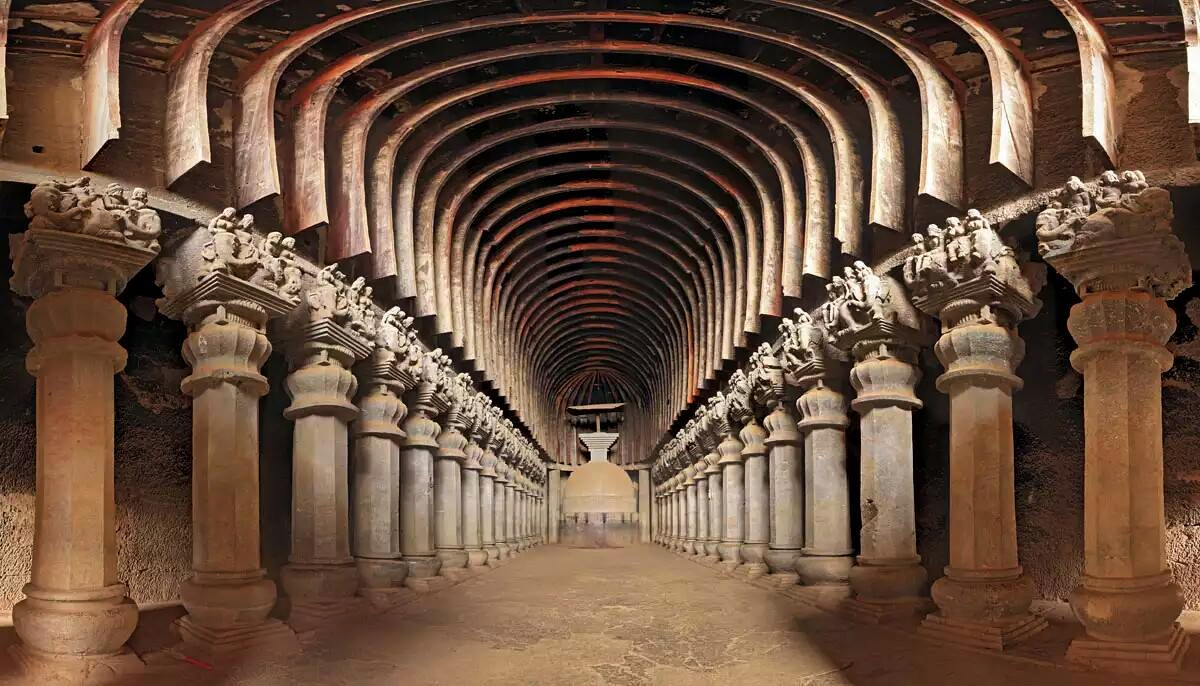
“But behind this veil of Cosmic and Astrological symbols, there were the Occult mysteries of Anthropography and the primeval genesis of man. And in this, no knowledge of symbols — or even the key to the post-diluvian symbolical language of the Jews — will, or can help, save only with reference to that which was laid down in national scriptures for exoteric uses; the sum of which, however cleverly veiled, was only the smallest portion of the real primitive history of each people, often relating, moreover, — as in the Hebrew Scriptures — merely to the terrestrial human, not divine life of that nation. That psychic and spiritual element belonged to MYSTERY and INITIATION. There were things never recorded in scrolls, but, as in Central Asia, on rocks and in subterranean crypts.” (HPB, “The Secret Doctrine” Vol. 1, p. 229)
“The civilization of the Atlanteans was greater even than that of the Egyptians. It is their degenerate descendants, the nation of Plato’s Atlantis, which built the first Pyramids in the country, and that certainly before the advent of the “Eastern Æthiopians,” as Herodotus calls the Egyptians. This may be well inferred from the statement made by Ammianus Marcellinus, who says of the Pyramids that “there are also subterranean passages and winding retreats, which, it is said, men skilful in the ancient mysteries, by means of which they divined the coming of a flood, constructed in different places lest the memory of all their sacred ceremonies should be lost.”
“These men who “divined the coming of floods” were not Egyptians, who never had any, except the periodical rising of the Nile. Who were they? The last remnants of the Atlanteans [i.e. whose island was destroyed and submerged by flood], we maintain.” (HPB, “The Secret Doctrine” Vol. 2, p. 429)
“The ruins which cover both Americas, and are found on many West Indian islands, are all attributed to the submerged Atlantians. As well as the hierophants of the old world, which in the days of Atlantis was almost connected with the new one by land, the magicians of the now submerged country had a network of subterranean passages running in all directions.” (HPB, “Isis Unveiled” Vol. 1, p. 595)
“An Eastern artist has attempted to give pictorial expression to the kabalistic doctrine of the cycles. The picture covers a whole inner wall of a subterranean temple in the neighborhood of a great Buddhistic pagoda, and is strikingly suggestive. Let us attempt to convey some idea of the design, as we recall it.
“Imagine a given point in space as the primordial one; then with compasses draw a circle around this point; where the beginning and the end unite together, emanation and reabsorption meet. The circle itself is composed of innumerable smaller circles, like the rings of a bracelet, and each of these minor rings forms the belt of the goddess which represents that sphere. As the curve of the arc approaches the ultimate point of the semi-circle — the nadir of the grand cycle — at which is placed our planet by the mystical painter, the face of each successive goddess becomes more dark and hideous than European imagination is able to conceive. Every belt is covered with the representations of plants, animals, and human beings, belonging to the fauna, flora, and anthropology of that particular sphere. There is a certain distance between each of the spheres, purposely marked; for, after the accomplishment of the circles through various transmigrations, the soul is allowed a time of temporary nirvana, during which space of time the atma loses all remembrance of past sorrows. The intermediate ethereal space is filled with strange beings. Those between the highest ether and the earth below are the creatures of a “middle nature”; nature-spirits, or, as the kabalists term it sometimes, the elementary [i.e. properly speaking, the elementals; these two similar terms, which have quite different meanings, were not always clearly distinguished during the early days when HPB wrote “Isis Unveiled”].
“This picture is either a copy of the one described to posterity by Berosus, the priest of the temple of Belus, at Babylon, or the original. We leave it to the shrewdness of the modern archæologist to decide. But the wall is covered with precisely such creatures as described by the semi-demon, or half-god, Oannes, the Chaldean man-fish, ” . . . hideous beings, which were produced of a two-fold principle” — the astral light and the grosser matter.” (HPB, “Isis Unveiled” Vol. 1, p. 348-349)
“Druzes, in Mount Lebanon, . . . if a stranger ask for admission to a “Thursday” meeting he will never be refused. Only, if he is a Christian, the okhal will open a Bible and read from it; and if a Mahometan, he will hear a few chapters of the Koran, and the ceremony will end with this. They will wait until he is gone, and then, shutting well the doors of their convent, take to their own rites and books, passing for this purpose into their subterranean sanctuaries.” (HPB, “Isis Unveiled” Vol. 2, p. 315)
“In Japan and Siam [i.e. Thailand] there are two orders of priests, of which one are public, and deal with the people, the other strictly private. The latter are never seen; their existence is known but to very few natives, never to foreigners. Their powers are never displayed in public, nor ever at all except on rare occasions of the utmost importance, at which times the ceremonies are performed in subterranean or otherwise inaccessible temples, and in the presence of a chosen few whose heads answer for their secrecy. Among such occasions are deaths in the Royal family, or those of high dignitaries affiliated with the Order.” (HPB, “Isis Unveiled” Vol. 2, p. 602)
“And yet there are widespread traditions of the existence of certain subterranean, and immense galleries, in the neighborhood of Ishmonia [Note: It is not clear where Ishmonia is, aside from it being in an Arabic country; it could potentially take its name from the Phoenician god Eshmun] — the “petrified City,” in which are stored numberless manuscripts and rolls. For no amount of money would the Arabs go near it. At night, they say, from the crevices of the desolate ruins, sunk deep in the unwatered sands of the desert, stream the rays from lights carried to and fro in the galleries by no human hands.” (HPB, “Isis Unveiled” Vol. 2, p. 29)
The next quote is excerpted from the series “A Hindu Chela’s Diary,” based on letters from Damodar K. Mavalankar to William Q. Judge. A year after Damodar (a chela/disciple of the Master K.H.) went to live in-person with the Trans-Himalayan Masters, Judge adapted and anonymised many of the experiences Damodar had shared with him, for the benefit of his magazine readers. Like the account that follows, the vast majority of the Diary is set in India. At the time of these experiences, Damodar (a young and devoted Indian man) was living and working at the Theosophical Society headquarters in India, where H. P. Blavatsky was also then based:
“Very wearying indeed in a bodily sense was the work of last week and especially of last evening, and upon laying down on my mat last night after continuing work far into the night I fell quickly sound asleep. I had been sleeping some hour or two when with a start I awoke to find myself in perfect solitude and only the horrid howling of the jackals in the jungle to disturb me. The moon was brightly shining and I walked over to the window of this European modeled house, threw it open and looked out. Finding that sleep had departed, I began again on those palm leaves. Just after I had begun, a tap arrested my attention and I opened the door. Overjoyed was I then to see Kunala [i.e. a pseudonym which was used for H. P. Blavatsky in this article, which was published while she was still alive] standing there, once more unexpected.
“‘Put on your turban and come with me,’ he [i.e. “Kunala” or HPB, who is portrayed here as male] said and turned away.
“Thrusting my feet into my sandals, and catching up my turban, I hurried after him, afraid that the master would get beyond me, and I remain unfortunate at losing some golden opportunity.
“He walked out into the jungle and turned into an unfrequented path. The jackals seemed to recede into the distance; now and then in the mango trees overhead, the flying foxes rustled here and there, while I could distinctly hear the singular creeping noise made by a startled snake as it drew itself hurriedly away over the leaves. Fear was not in my breast for master was in front. He at last came to a spot that seemed bare of trees, and bending down, seemed to press his hand into the grass. I then saw that a trap door or entrance to a stairway very curiously contrived, was there. Stairs went down into the earth. He went down and I could but follow. The door closed behind me, yet it was not dark. Plenty of light was there, but where it came from I cared not then nor can I now, tell. It reminded me of our old weird tales told us in youth of pilgrims going down to the land of the Devas where, although no sun was seen, there was plenty of light.
“At the bottom of the stairs was a passage. Here I saw people but they did not speak to me and appeared not to even see me although their eyes were directed at me. Kunala said nothing but walked on to the end, where there was a room in which were many men looking as grand as he does but two more awful, one of whom sat at the extreme end.”
Later, on a small and seemingly deserted island just off the shore of Sri Lanka, Damodar met in the garden of a well-hidden house “another friend of Kunala with the same expression of the eyes as he has. I also recognized him as one of those who was in the room underground.” (published in four parts in “The Path” magazine, 1886)
“. . . the denials of the whole world will not blow sufficiently to extinguish the perpetually-burning lamps in certain of the subterranean crypts of India, Thibet, and Japan.” (HPB, “Isis Unveiled” Vol. 1, p. 225)
“And this is the true meaning of the Verse in the [secret, esoteric] COMMENTARY which says:
“The GREAT DRAGON has respect but for the ‘SERPENTS’ of WISDOM, the Serpents whose holes are now under the triangular stones,” i.e., “the Pyramids, at the four corners of the world.”
“. . . This tells us clearly that which is mentioned more than once elsewhere in the Commentaries; namely, that the Adepts or “Wise” men [i.e. who were symbolically called “serpents,” since in ancient times this was a universal symbol for spiritual wisdom, as seen even in Jesus’ instruction to “Be wise as serpents” and also in the Genesis account of the serpent in the Garden of Eden, if one knows how to read it allegorically, as was originally intended] of the three Races (the Third, Fourth and the Fifth) dwelt in subterranean habitats, generally under some kind of pyramidal structure, if not actually under a pyramid. For such “pyramids” existed in the four corners of the world and were never the monopoly of the land of the Pharaohs, though until found scattered all over the two Americas, under and over ground, beneath and amidst virgin forests, as in plain and vale, they were supposed to be the exclusive property of Egypt. . . .
“But the “Serpents of Wisdom” have preserved their records well, and the history of the human evolution is traced in heaven as it is traced on underground walls.” (H. P. Blavatsky, “The Secret Doctrine” Vol. 2, p. 351-352)
~ * ~
This article may have raised more questions about various things. Please make use of the site search function (the magnifying glass symbol at the top of the page) and visit the Articles page to see the complete list of over 400 articles covering all aspects of Theosophy and the Theosophical Movement. Some articles closely related to this one include Blavatsky on Shambhala, The Occult Importance of Central Asia, Mount Kailash and The Teachers of Buddha, The Masters and Madame Blavatsky, and Masters of Wisdom: Outwardly Mortal, Inwardly Immortal.
~ BlavatskyTheosophy.com ~
 T H E O S O P H Y