
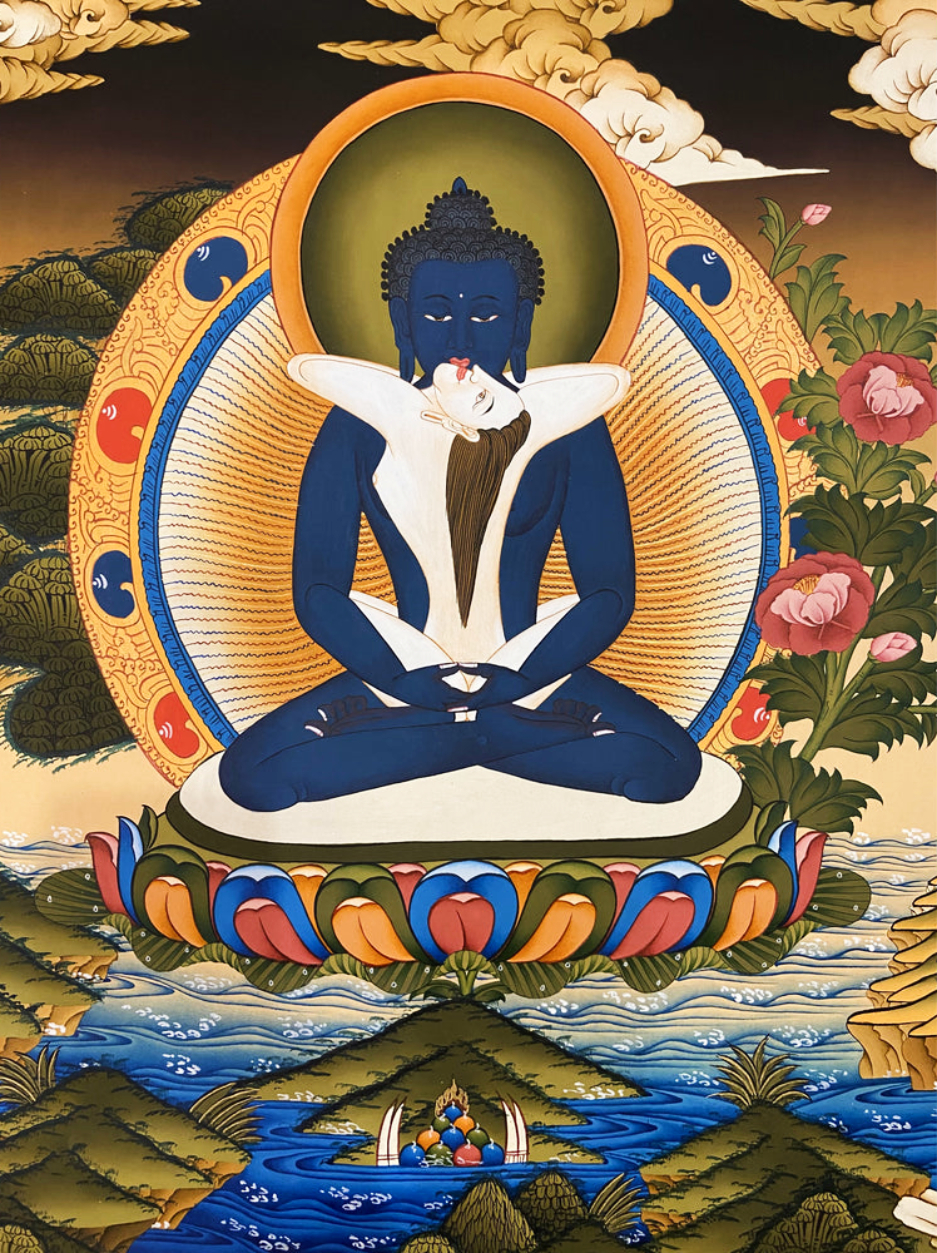
INTRODUCTION – THE GELUG ATTITUDE TOWARDS SEXUAL TANTRA – OUTER,
INNER, AND SECRET – LAMA GOVINDA, THE MASTER MORYA, AND B. P. WADIA ON
THE PURELY SYMBOLIC NATURE OF TANTRIC LANGUAGE AND IMAGERY – THE
DALAI LAMA’S BROTHER ON THE PURE TANTRA OF TSONG-KHA-PA AND ATISHA –
THE MAHASIDDHAS – PADMASAMBHAVA AND THE “RED HATS” – MULTIPLE
SIMULTANEOUS INCARNATIONS – A FEW WORDS OF CONCLUSION
“The true Raja Yogins . . . are, moreover, profoundly versed in the doctrines of the Tantras – termed devilish by those who either do not understand them or reject their tenets with some preconceived object.” (H. P. Blavatsky, “The Yoga Philosophy,” “A Modern Panarion” p. 338-339)
“Some of the “White” Tantras, especially the one treated upon in the present article [Note: This was in reference to the Mahanirvana Tantra of Hinduism], contain extremely important information for Occultists.” (H. P. Blavatsky, Footnote to “The Tantras”)
“As there are both magic (pure psychic science) and sorcery (its impure counterpart) so there are what are known as the “White” and “Black” Tantras. The one is an exposition, very clear and exceedingly valuable, of occultism in its noblest features, the other a devil’s chap-book of wicked instructions to the would-be wizard and sorcerer.” (H. P. Blavatsky, Note to “A Description of The Tantrik Mystic Rites”)
“Sexual rites and magical powers – the worst form of black magic or sorcery.” (H. P. Blavatsky, “The Theosophical Glossary” p. 319, Entry for “Tantra”)
“In course of time as the Truth becomes realized, the situation is rendered quite clear to the Yogi and he is placed beyond the criticism of any ordinary man. The Mahanirvana Tantra says: . . . “For one, walking beyond the three gunas – Satva, Rajas and Tamas – what duty or what restriction is there?” . . . This does not mean that a Mahatma can or will ever neglect the laws of morality, but that he, having unified his individual nature with Great Nature herself, is constitutionally incapable of violating any one of the laws of nature, and no man can constitute himself a judge of the conduct of the Great One without knowing the laws of all the planes of Nature’s activity.” (Mohini M. Chatterjee, “Morality and Pantheism,” “Five Years of Theosophy” p. 218)
INTRODUCTION
“Tantra,” an ancient Sanskrit word, is not a bad word in itself and merely means “continuum” or “expansion.” It can largely be looked upon as a synonym for practical occultism.
Even if a teaching or system does not expressly call itself tantric, if it deals with all or most of such subjects as (1) the occult constitution of the human being and the cosmos, (2) the correspondences or metaphysical links that exist between the various forces of Nature, (3) parts of the body and their occult correspondences and connections to higher energies or higher planes, (4) the esoteric side of colours, sounds, and sacred words or mantras, (5) Kundalini and subtle energies and energy channels in the spine and body, (6) chakras, (7) recognition and reverence in one way or another of Shakti or the feminine, or of the importance of bringing masculine and feminine polarities into union – then it is the very definition and epitome of what tantra actually is. We could add to this an emphasis on the necessity and sacredness of initiations and keeping certain teachings and details secret, although this characteristic is not exclusively tantric. The associated feature of actual transference of force and influence from Guru to disciple is, however.
The average person in the West today associates the word “tantra” solely with notions of “sacred sex” and thinks its purpose and reason is sensual pleasure and enjoyment. There is actually a huge difference between what most Westerners think of as sexual tantra and what the sexual tantra found in some forms of Hindu and Tibetan Buddhist tantric practice actually is.
The average Westerner cannot really be blamed for their ignorance about tantra, for who is teaching them otherwise? Not Theosophists, most of whom – even in 2025 – are just as ignorant on the subject, or only a fraction less so, than those whose understanding they could help to illuminate.
Aside from the “Theosophical Glossary” quote, the passages with which we opened this article have never been noticed by even the majority of longtime or lifelong students of the original Theosophical teachings, most of whom are mistakenly convinced that “Blavatsky said tantra is bad, tantra is all black magic, we should warn against anything tantric, Tsong-Kha-Pa was against tantra, and the Gelugpas which he founded are a non-tantric form of Tibetan Buddhism” etc.
This confusion is largely due to the peculiar reluctance of many modern Blavatsky students to do any research or exploration for themselves into the world’s religions and philosophies, even though she herself always emphasised this as the second main objective for which the Theosophical Movement was founded, the first being Universal Brotherhood. But it is of course also due to not having made as deep or extensive or attentive a study of HPB’s writings as they may have thought.
Theosophists sometimes speak of the Book or rather Books of Kiu-Te or Khiu-Ti, having seen HPB and her Teachers – the Masters of Wisdom, “our living, human Mahatmas” – refer to them, but probably very few realise that the term “Kiu-Te” (or “rgyud sde” in Wylie transliteration and nowadays generally written as “gyud” phonetically) is simply the Tibetan translation of the Sanskrit word “Tantra.” The Books of Kiu-Te are therefore literally the Books of Tantra.
Tantra is not always something sexual. HPB states that there is such a thing as “white tantra” which is of the nature of white magic, and such a thing as “black tantra” which is the opposite.
The introduction into it of selfish motives, sexual practices, and immorality, makes it black tantra. But it can exist perfectly well and happily in its pure form, as white tantra. Sexual tantra and sexual magic are stated by HPB to be the worst form of black magic or sorcery; not its only form but its worst form.
Many people understandably ask why that is the case. Theosophy maintains that the sex function is “the gift of divine wisdom,” a “divine gift,” and a “holy mystery” (see Theosophy on Sex and Sexuality) and that on the perennial principle of “as above, so below” or “on Earth as it is in Heaven,” that generative, creative power and organ(s) in the human body is in some way a reflection in miniature of the great cosmic or universal generative forces that brought the whole of manifestation into being. And not only is it a reflection but there is also an actual occult connection between the microcosmic and macrocosmic. Thus the sexual parts and faculties of our body are so inherently sacred and holy that they are not to be abused in any way . . . and attempting to take advantage of the sacredness with which they are imbued, for our own spiritual benefit, gaining spiritual powers, or even enlightenment is considered one of the worst things that can be done, from the metaphysical perspective. Besides which, it will not truly work, and the karmic kickback, whether in this or a future life, will be great.
HPB’s comments regarding tantra are almost entirely about Hindu tantra. Tibetan Buddhist tantra was hardly ever mentioned by her by name but, as will be evident by the end of the article and also from other articles on this site, numerous teachings and details show clearly that she and her Adept-Teachers were extremely familiar and closely involved – both theoretically and practically – with the most esoteric, pure, and profound teachings of Buddhist tantra. Considering that they were (and are) advanced practical occultists who belong to what they variously call the Trans-Himalayan and Tibetan Brotherhood or Esoteric School, how could they not be?
Tibetan Buddhism is a form of Mahayana Buddhism but it is also more than that, which is why it’s usually called Vajrayana Buddhism. Vajrayana, practically speaking, is Tantric Mahayana or Esoteric Mahayana. The term “Hinayana,” meaning “small vehicle,” “lesser vehicle,” or “lesser way,” is applied by Mahayanists to what now exists as Theravada Buddhism (often called Southern Buddhism by HPB and others in the Victorian era), while “Mahayana” means “great vehicle,” “greater vehicle,” or “great way,” and “Vajrayana” is translated “diamond vehicle,” “the diamond way,” or “the diamond path,” “diamond road,” etc. Vajrayana began in India among Indian Buddhists but was later almost wholly exported to Tibet. HPB never uses the term “Vajrayana” although she must have known it. She often uses the term “Northern Buddhism” for Tibetan Buddhism, although sometimes she means by it Mahayana Buddhism in general.
The Buddhism of Tibet has two aspects to it: the Sutra teachings and the Tantra teachings, which are also known respectively as the Sutrayana or Paramitayana or Bodhisattvayana and the Tantrayana or Mantrayana, sometimes referred to as “Secret Mantra.” Tibetan Buddhism as a whole is termed Vajrayana but it is specifically the Tantrayana/Mantrayana that makes it Vajrayana.
In the Gelug school of Tibetan Buddhism founded by the Theosophically revered Tsong-Kha-Pa at the start of the 15th century, it is always maintained that the spiritual aspirant must become properly developed and established in the Bodhisattva Ideal and the Bodhisattva Path of developing bodhichitta (the selfless aspiration to attain enlightenment solely to benefit and help all living beings) and perpetually practising the Paramitas (the “glorious virtues” or “transcendental perfections”) – in other words, the Sutrayana – before entering upon training and practice in Tantra.
Vajrayana, particularly its tantric aspect, is what the world knows of today as “Esoteric Buddhism.” For most people familiar with Buddhism, the phrase “Esoteric Buddhism” (often used in Theosophical literature and also the title of a book by A. P. Sinnett systematising teachings received in letters from HPB’s Teachers Morya and Koot Hoomi or Kuthumi) is a synonym for Vajrayana Buddhism. But the Esoteric Buddhism of the Trans-Himalayan Brotherhood is something more profoundly esoteric and secret than what one can now readily find and access in the publicly known Vajrayana, although it is indeed directly connected with the latter.
In the article Kalachakra and Theosophy we wrote:
“The real Kalachakra [Tantra] system and teachings are closely connected with the Masters and Initiates of the Trans-Himalayan Brotherhood and Esoteric School and vice versa. They were also historically considered the speciality of the Panchen Lama of [the Gelugpa] Tashilhumpo Monastery, Shigatse, with which H. P. Blavatsky and her Adept-Teachers were closely connected.
“In “The Mystery of Buddha,” which was initially intended to be published as part of “The Secret Doctrine,” HPB specifically states and explains that “What is given here is taken from the secret portions of Dus Kyi Khorlo (Kala Chakra, in Sanskrit, or the “Wheel of Time,” or duration).”
“Again, in “A Few More Misconceptions Corrected,” she talks about the Kalachakra, called “Dus Kyi Khorlo” in Tibetan, saying:
“. . . the “Dus-kyi Khorlo,” or Tibetan Mysticism. A system as old as man, known in India and practised before Europe had become a continent, “was first known,” we are told [i.e. by the Orientalists and academics], only nine or ten centuries ago. The text of its books in its present form may have “originated” even later, for there are numerous such texts that have been tampered with by sects to suit the fancies of each [Note: This point is important and should help us avoid the mistake of equating the now publicly known Kalachakra Tantra of Tibetan Buddhism with the real thing, although there must inevitably be multiple commonalities]. But who has read the original book on Dus-Kyi Khorlo [i.e. Kalachakra], re-written by Tsong-Kha-pa, with his Commentaries? . . . this grand Reformer burnt every book on Sorcery on which he could lay his hands in 1387 . . . he has left a whole library of his own works – not a tenth part of which has ever been made known.”
“Saying that the Kalachakra is “a system as old as man” seems equivalent to saying that the real Gupta Vidya or Secret Doctrine is the real Kalachakra.”
At Tashilhumpo or Tashilhunpo Monastery in Tibet, historically the seat of the Panchen Lama reincarnation lineage (the Panchen Lamas being the second most important figures in the Gelug or Gelugpa branch of Tibetan Buddhism, the Dalai Lamas being considered the highest, although HPB says that from the perspective of esoteric authority and importance the Panchen Lamas are the highest), there was for centuries a general tantric college for Gelug Lamas, much like there is or was at many Tibetan monasteries, but also a Kalachakra college or school, to which only a very small number of select Lamas were admitted. In the whole vast arena of Tibetan Buddhism, it is only really the Gelugpas and the much smaller and far less influential Jonangpas who pay much attention to the Kalachakra Tantra, and even among the Gelugpas many favour other systems of Gelug tantra, numerous of which were also taught at Tashilhunpo and elsewhere.
This was all going on while H. P. Blavatsky was in Tibet and visiting Tashilhunpo with some of the Masters, and it continued up until the Chinese invasion and virtual destruction of the country in the 1950s. It seems plausible that the Kalachakra school at Tashilhunpo just spoken of, presided over by the Panchen Lamas, who were considered the leading expert on the esotericism of the Kalachakra Tantra, may be the same as “the Secret School near Shigatse, attached to the private retreat of the Panchen Lama” which HPB stated in her article “Tsong-Kha-Pa – Lohans in China” was founded by Tsong-Kha-Pa himself.
In her article “Practical Occultism” HPB translates twelve rules for instructors of chelas in the Tibetan Brotherhood. One speaks of the teacher or Guru imparting to his disciple “the good (holy) words of LAMRIN.” HPB comments: “”Lamrin” is a work of practical instructions, by Tson-kha-pa, in two portions, one for ecclesiastical and exoteric purposes, the other for esoteric use.”
The Lam Rim or Lam Rim Chen Mo – “The Great Treatise on The Stages of The Path to Enlightenment” – is Tsong-Kha-Pa’s most well known work and is nowadays published in English and easily accessible to everyone. It’s possible that by the “portion for esoteric use” she actually means the Ngak Rim Chen Mo, Tsong-Kha-Pa’s other main work, “The Great Exposition of Secret Mantra,” also now published in English. The Lam Rim is the fullest embodiment of his Sutra teachings and the Ngak Rim of his Tantra teachings. It is very likely, however, that what is publicly accessible is not the most truly esoteric and complete versions of these works. HPB’s wording may also mean that there is an exoteric Lam Rim and an esoteric, secret Lam Rim.
So let us, as Theosophists, not demonise the word “tantra,” lest we shut ourselves off from esoteric truth through a misguided and fearful closed-mindedness and give a bizarrely puritanical impression of Theosophy to others, particularly Indians and Tibetans as well as the ever-growing number of Westerners who have made themselves more familiar with Indian and Tibetan religious philosophy than are most Theosophists in the present day.
What we should be focusing on in this regard is the distinction between white and black tantra, which is something most people, especially in the West, are unfortunately currently unaware of. And this brings us on at last to the proper beginnings of this present article, in which we will see exactly what the position of the Gelugpas – and their leading figurehead, the 14th Dalai Lama – is today with regard to sexual tantra. It is not exactly what we as students of Theosophy would expect but the information below is as accurate as we have been able to gather and can also be investigated independently by any reader so inclined.
THE GELUG ATTITUDE TOWARDS SEXUAL TANTRA
The following points sum up concisely the actual position and attitude of the Gelug school or sect towards sexual tantra.
(1) Sexual tantra is strictly forbidden to Gelugpa Lamas and monks. This dates back to Tsong-Kha-Pa’s requirement of celibacy and chastity under all circumstances for ordained members of his Order. This is one of the ways in which the Gelug school is unique within Tibetan Buddhism.
(2) Sexual tantra is, however, not condemned or warned against by the Gelugpas. They do not express an issue with those of the other schools or traditions of Tibetan Buddhism – i.e. Nyingma, Kagyu, Sakya, and Jonang – practising or promoting it, and in most cases genuinely respect the others’ right to do as they wish.
(This, and #3 below, will certainly be the most objectionable to students of Theosophy. Some will say and think “Tsong-Kha-Pa could never have inculcated or endorsed such attitudes.” If we believe HPB and the Masters to be reliable sources, it indeed seems extremely unlikely that he would have done so, since his views as to what constitutes black magic would presumably have been the same as the Trans-Himalayan Brotherhood. It is quite possible though that #2 may actually have its origins with Tsong-Kha-Pa, for his own teachers and gurus belonged to those other schools of Tibetan Buddhism, in which sexual tantra and other dark elements had become welcome and accepted. While Tsong-Kha-Pa himself did not welcome and tolerate such things for his monks or for himself, he did make the practice of “devotion to the Guru” the essential foundation of his teaching and system. As expressed in his “The Foundation of All Good Qualities”: “The foundation of all good qualities is the kind and perfect, pure Guru; Correct devotion to him is the root of the path. By clearly seeing this and applying great effort, Please bless me to rely upon him with great respect.” For Gelugpas and all other Tibetan Buddhists, to criticise or depreciate any of one’s gurus and spiritual teachers, or to condemn or demean any organisation or group that they choose to be involved with, is a terrible act with severe karmic consequences. Tsong-Kha-Pa himself affirmed this. We may be wrong but it therefore seems to us fairly plausible that Tsong-Kha-Pa may have refrained from direct denunciation of sexual tantra in other schools, due to his revered teachers having chosen to be and remain part of those schools.)
(3) The Gelugpas also have no problem with Gelugpa lay practitioners engaging in certain types of sexual tantra, provided they have received the necessary prior instructions and empowerments (initiations) and are doing it with legitimately pure and selfless motives, rather than for pleasure or from lust and desire. Lay practitioners are not bound by Tsong-Kha-Pa’s strict monastic code of conduct, hence it is deemed alright for them.
(This is undeniably completely opposed to the position of HPB and her Teachers. But it is with regard to this #3 that the Dalai Lama has made statements in some of his bestselling books such as “A practitioner who has firm compassion and wisdom can make use of sexual intercourse in the spiritual path as a technique for strongly focusing consciousness and manifesting the fundamental innate mind of clear light. Its purpose is to actualize and prolong the deeper levels of mind in order to put their power to use in strengthening the realization of emptiness. . . . How does sexual intercourse help in the path? Since the potential of grosser levels of mind is very limited, but the deeper, more subtle levels are much more powerful, developed practitioners need to access these subtler levels of mind. . . . Due to this, sex is utilized. Through special techniques of concentration during orgasm competent practitioners can prolong very deep, subtle, and powerful states and put them to use to realize emptiness. However, if you engage in sexual intercourse within an ordinary mental context, there is no benefit.” (“Mind of Clear Light: And Living a Better Life” p. 176-179) And “The same is true for sexual yoga; trainees who are capable of using the bliss arising from the desire involved in gazing, smiling, holding hands, or union must perform the appropriate deity yoga; they could not be imagining themselves as Shakyamuni, a monk. For Buddhists, sexual intercourse can be used in the spiritual path because it causes a strong focusing of consciousness if the practitioner has firm compassion and wisdom. Its purpose is to manifest and prolong the deeper levels of mind, in order to put their power to use in strengthening the realization of emptiness. Otherwise, mere intercourse has nothing to do with spiritual cultivation. When a person has achieved a high level of practice in motivation and wisdom, even the joining of the two sex organs, or so-called intercourse, does not detract from the maintenance of that person’s pure behavior. Yogis who have achieved a high level of the path and are fully qualified can engage in sexual activity, and a monastic with this ability can maintain all the precepts.” (“How To Practise: The Way to a Meaningful Life”) In other books he emphasises that only a very small number of advanced, pure-minded, and well-disciplined lay-practitioners and Lamas “ought” to engage in “sexual yoga” and related exercises and indeed in the above quotes he stipulates the preliminary requirement of having “firm compassion and wisdom” and having “achieved a high level of the path and are fully qualified.” But no “monastic” of the Gelug Order is permitted by Tsong-Kha-Pa’s ordinances to engage in such things and from the Theosophical perspective no-one – monk, layperson, or otherwise – should be attempting such sexual yoga. It is a dragging down, to the physical, sensual, bodily plane, of the ideal of real tantra, the sexual aspects of the symbolism, imagery, and language of which are intended to be just that: symbolic.)
(4) Gelug Lamas who may strongly feel the need or wish to practise sexual elements of tantra are ordinarily required to renounce their vows and life as a monk and re-become a lay person. We say “ordinarily” because historically there have been a very few for whom exceptions were made by very senior Lamas. This is extremely rare but has happened.
(5) The general Gelugpa attitude towards their Lamas practising sexual tantra can be seen in recent times by the 14th Dalai Lama’s complete rejection and shunning of Michael Roach after learning that he had a tantric consort. Roach behaved in ways that would have been perfectly acceptable and even celebrated if he were a Nyingmapa Lama but it was deemed totally unacceptable as a Gelugpa, in accordance with the ordinances of Tsong-Kha-Pa. The 14th Dalai Lama has also mentioned how his predecessor, the 13th Dalai Lama, expelled hundreds of Lamas after learning of their engaging in sexual tantra.
(6) But there are a comparatively very small number of Gelugpa Lamas today – primarily, it seems, among Western Lamas – who openly speak of their involvement with sexual tantra and who have recruited female pupils as their tantric consort(s). Since the Office of the Dalai Lama cannot be policing everyone, one can only assume that if people were to directly bring it to their attention, these individuals would essentially be expelled.
(7) Considering that true tantra is by definition something highly esoteric, the Gelugpa position on the whole is that tantric terminology was never supposed to be taken literally and exoterically but rather symbolically and esoterically. We say “on the whole” because there are some Gelugpa Lamas who imply that it’s merely a matter of personal choice and preference as to whether one takes it literally or not. But it is widely accepted that ancient tantric texts are written in “twilight language,” a type of esoteric language in which very little truly means what it appears to mean, the deeper, more mystical and originally intended meaning usually only being possible to those who possess the “key” in the form of commentaries that decipher the code language. In the Kalachakra Tantra, for example, which is most focused on by the Gelugpas, every symbol or concept is said to possess an outer, an inner, and a secret meaning. If one takes the central Kalachakra subject of Shambhala, the outer meaning relates to the physical location and details regarding Shambhala existing as an actual physical location on this Earth, the inner meaning of such details relates to states of consciousness and occult centres of energy belonging to the human being and also to the planet, while the secret meaning of this or other tantric symbols is publicly unknown, since it is usually only transmitted orally to those who senior Gurus consider ready and worthy and who have undergone all the necessary arduous training and higher initiations. While Shambhala is itself not a sexual symbol in its “dead letter” or at any other level, the above applies to all the sexual language and imagery of the tantra texts too.
OUTER, INNER, AND SECRET
This widespread Tibetan tantric division into outer, inner, and secret applies to biographies of prominent Lamas and yogis too; most celebrated and influential Tibetan Buddhist figures have an outer biography, an inner biography, and a secret biography. The outer biography is often the only one readily available to the general public. As far as we are aware, no such secret biographies have ever been released to the public, for the few who possess or have access to them treat their vows of initiation too seriously to “leak” sacred things to the uninitiated “profane.” Besides which, it is said that the secret biographies are written in such an impenetrable code language that one could never hope to understand it anyway, without having the associated “commentary” as a key.
One may recall HPB’s many mentions of secret or esoteric “commentaries” in “The Secret Doctrine,” some of which she provides brief translated excerpts from. This is very Tibetan.
HPB herself also makes mention of the secret biographies of certain great Teachers, including the Buddha himself but also many non-Buddhist sages who were sufficiently linked with the Brotherhood of Shambhala to have been lastingly honoured and revered by the Esoteric Buddhist Initiates, and she had some degree of access to these records:
“As a supplement to the Commentaries there are many secret folios on the lives of the Buddhas and Bodhisattvas, and among these there is one on Prince Gautama [i.e. Gautama Buddha, the historical Buddha of 2,600 years ago] and another on His reincarnation in Tsong-Kha-pa [Note: That Tsong-Kha-Pa was an incarnation of Buddha himself was a secret teaching, which has never been disclosed or even hinted at by any Gelugpa or other Lamas, but which HPB made public to the world, albeit saying very little indeed on the matter. He is generally believed by Gelugpas to have been in some way an emanation of the Bodhisattva Manjushri, who he described as his main inspirer.]. This great Tibetan Reformer of the fourteenth century said to be a direct incarnation of Amita [i.e. Amitabha] Buddha is the founder of the secret School near Tji-gad-je [i.e. Shigatse in Tibet] attached to the private retreat of the Teshu Lama [i.e. Panchen Lama, often referred to in HPB’s time as the Tashi Lama or other variants of this, due to his monastery being Tashilhumpo].” (“Amita Buddha, Kwan-Shai-Yin and Kwan-Yin — What the “Book of Dzyan” and the Lamaseries of Tsong-Kha-Pa Say”)
“Tsong-Kha-pa . . . was an incarnation of Amita Buddha Himself. The records preserved in the Gon-pa, the chief Lamasery of Tda-shi-Hlumpo [i.e. Tashilhumpo or Tashilhunpo Monastery in Shigatse, Tibet, historically the seat of the Panchen Lama], show that Sang-gyas [i.e. the Tibetan name for Buddha] left the regions of the “Western Paradise” [i.e. a Buddhist name for a particular celestial realm – the “Pure Land” of Amitabha Buddha – but said by HPB to often mean Shambhala] to incarnate Himself in Tsong-Kha-pa, in consequence of the great degradation into which His secret doctrines had fallen [in Tibet].” (“Tsong-Kha-Pa – Lohans in China”)
And in “The Secret Books of “Lam-Rin” and Dzyan” she says regarding the Books of Gyud (usually written Kiu-te or Kiu-ti by HPB), which means Books of Tantra, Gyud or Kiu-te simply being the Tibetan translation of the Sanskrit word “tantra”:
“Thirty-five volumes of Kiu-te for exoteric purposes and the use of the laymen may be found in the possession of the Tibetan Gelugpa Lamas [Note: And the Lamas of all other Tibetan Buddhist sects too; not only the Gelugpas], in the library of any monastery; and also fourteen books of Commentaries and Annotations on the same by the initiated Teachers. Strictly speaking those thirty-five books ought to be termed “The Popularized Version” of the Secret Doctrine, full of myths, blinds, and errors; the fourteen volumes of Commentaries, on the other hand – with their translations, annotations, and an ample glossary of occult terms, worked out from one small archaic folio the Book of the Secret Wisdom of the World contain a digest of all the Occult Sciences. These it appears, are kept secret and apart in the charge of the Teshu Lama [i.e. Panchen Lama] of Tji-gad-je [i.e. Shigatse]. The Books of Kiu-te are comparatively modern, having been edited within the last millennium, whereas the earliest volumes of the Commentaries are of untold antiquity, some fragments of the original cylinders having been preserved. With the exception that they explain and correct some of the too fabulous, and to every appearance grossly exaggerated accounts in the Books of Kiu-te – properly so called – the Commentaries have little to do with these. They stand in relation to them as the Chaldæo-Jewish Kabalah stands to the Mosaic Books. . . . No student unless very advanced would be benefited by the perusal of those exoteric volumes. They must be read with a key to their meaning and that key can only be found in the Commentaries.”
In HPB’s article “Tibetan Teachings” she quotes “the venerable Chohan-Lama” of Tibet – who she describes as the guardian or custodian of the esoteric and secret libraries of both the Panchen Lamas and Dalai Lamas, “no one in Tibet” being “more deeply versed in the science of esoteric and exoteric Buddhism” than this Chohan-Lama (some suspect him to be the same as the venerable Chohan spoken of in “The Mahatma Letters” and elsewhere, i.e. the Maha Chohan, chief of the Trans-Himalayan Brotherhood and Esoteric School, and Guru of the Master M., Master K.H., and many others) and who says – in the 1880s – regarding the vast canon of Tibetan Buddhist scriptures, which include the abovementioned Tantras or “Books of Kiu-te” but also contain a great deal more, and only a very very small amount of which has been translated into English as of 2025:
“Could they even by chance have seen them, I can assure the theosophists that the contents of these volumes could never be understood by anyone who had not been given the key to their peculiar character, and to their hidden meaning.
“Every description of localities is figurative in our system; every name and word is purposely veiled; and a student, before he is given any further instruction, has to study the mode of deciphering, and then of comprehending and learning the equivalent secret term or synonym for nearly every word of our religious language. The Egyptian enchorial or hieratic system is child’s play to the deciphering of our sacred puzzles. Even in those volumes to which the masses have access, every sentence has a dual meaning, one intended for the unlearned, and the other for those who have received the key to the records.
“Our world-honoured Tsong-kha-pa closing his fifth Damngag reminds us that ‘every sacred truth, which the ignorant are unable to comprehend under its true light, ought to be hidden within a triple casket concealing itself as the tortoise conceals his head within his shell; ought to show her face but to those who are desirous of obtaining the condition of Anuttara Samyak Sambodhi [i.e. synonymous with ultimate bodhichitta; see The Essence of Buddhism]‘ – the most merciful and enlightened heart.
“There is a dual meaning, then, even in the canon thrown open to the people, and, quite recently, to Western scholars. . . . [These records] contain no fiction, but simply information for future generations, who may, by that time, have obtained the key to the right reading of them.”
LAMA GOVINDA, THE MASTER MORYA, AND B. P. WADIA ON THE PURELY SYMBOLIC NATURE OF TANTRIC LANGUAGE AND IMAGERY
Lama Anagarika Govinda, one of the most widely respected Gelug Lamas of the 20th century, wrote:
“Among all the aspects of Buddhism, its Tantric teachings have until now been the most neglected and misunderstood. The reason for this was the fact that these scriptures cannot be understood merely philologically, but only from the point of view of yogic experience, which cannot be learned from books, Moreover, those books, from which information was sought, were written in a peculiar idiom, a language of symbols and secret conventions which in Sanskit was called Sandhyabhasa, literally “twilight language”, because of the double meaning which underlay its words.
“This symbolic language . . . had its origin mainly in the fact that the ordinary language is not able to express the highest experiences of the mind. The indescribable, which is experienced by Sadhaka, the true devotee, can only be hinted at by symbols, similes and paradoxes. . . .
“The Buddhist [wants] the realization of the “uncreated, unformed” state of sunyata, from which all creation proceeds, or which is prior to and beyond all creation (if one may put the inexpressible into human language). The becoming conscious of this sunyata is prajna or highest knowledge. The realization of this highest knowledge in life is enlightenment, i.e. if prajna or sunyata, the passive, all embracing female principle, from which everything proceeds and into which everything recedes, is united with the dynamic male principle of active universal love and compassion, which represents the means for the realization of prajna and sunyata, then perfect Buddahood is attained.
“The process of enlightenment is therefore represented by the most obvious, the most human and at the same time the most universal symbol imaginable: the union of male and female in the ecstasy of love, in which the active element (upaya) is represented as a male, the passive (prajna) by a female figure. . . . In Buddhist symbolism. The Knower (Buddha) becomes one with his knowledge (prajna), just as man and wife become one in the embrace of love . . . The Dhyani-Buddhas (i. e., the ideal Buddhas visualized in meditation) and the Dhyani-Bodhisattvas, as embodiments of the active urge of enlightenment which finds its expression in upaya, the all-embracing love and compassion, are therefore represented in the embrace of their prajna, symbolized by a female deity, the embodiment of highest knowledge. . . .
“The Vajrayana . . . used a particular form of symbology, in which very often the highest was clothed in the form of the lowest, the most sacred in the form of the most profane. the transcendent in the form of the most earthly, and deepest knowledge in the form of the most grotesque paradoxes. It was not only a language for initiates, but a kind of shock therapy, which had become necessary on account of the over-intellectualization of the religious and philosophical life of those times. Though the polarity of male and female principles is recognized in the Tantras of the Vajrayana and is an important feature of its symbolism, it is raised upon a plane which is as far away from the sphere of mere sexuality as the mathematical juxtaposition of positive and negative signs . . .
“In Tibet the male and female Dhyani Buddhas and Bodhisattvas are regarded as little as “sexual beings” as in certain schools of Japan; and to the Tibetan even their aspect of union is indissolubly associated with the highest spiritual reality in the process of enlightenment, so that associations with the realm of physical sexuality are completely ignored [Note: This is not the case with many non-Gelugpas though, as already mentioned, and such symbolic imagery and language is taken in its dead letter even by some Gelugpa Lamas.] We must not forget that the figural representation of these symbols are not looked upon as portraying human beings, but as embodying the experiences and visions of meditation. In such a state, however, there is nothing more that could be called ‘sexual’, there is only the super-individual polarity of all life, which rules all mental and physical activities, and which is transcended only in the ultimate state of integration, in the realization of sunyata. . . .
“If in one of the most controversial passages of Anangavajra’s it is said that all women should be enjoyed by the sadhaka in order to experience the mahamudra; it is clear that this can not be understood in the physical sense, but that it can only be applied to that highest form of love which is not restricted to a single object and which is able to see all ‘female’ qualities, whether in ourselves or in others, as those of the Divine Mother. Another passage, which by its very grotesqueness proves that it is meant to be a paradox and is not to be taken literally states that “the sadhaka who has sexual intercourse with his mother, his sister, his daughter, and his sister’s daughter, will easily succeed in his striving for the ultimate goal.”
“To take expressions like ‘mother’, ‘sister’, ‘daughter’ or ‘sister’s daughter’ literally in this connection is as senseless as taking literally the well-known Dhammapada verse (No. 294), which says that, after having killed father and mother and two Ksattriya kings, and destroyed a Kingdom with all its inhabitants, the Brahmana remains free from sin. Here ‘father and mother’ stands for ‘egoism and craving,’ the ‘two kings’ for the erroneous views of annihilation or eternal existence, ‘the kingdom and its inhabitants’ for ‘the twelve spheres of consciousness’ and the Brahmana for the liberated monk.
“To maintain that Tantric Buddhists actually encouraged incest and licentiousness is as ridiculous as accusing the Theravadins of condoning matricide and patricide and similar heinous crimes [i.e. since the Dhammapada is primarily a Theravada scripture]. If we only take the trouble to investigate the living tradition of the Tantras in their genuine, unadulterated forms, as they existed still in our days in thousands of monasteries and hermitages of Tibet, where the ideals of sense-control and renunciation were held in the highest esteem, then only can werealize how ill-founded and worthless are the current theories which try to drag the Tantras into the realm of sensuality. From the point of view of the Tibetan Tantric tradition, the above mentioned passages can only be meaningful in the context of yoga terminology.
“‘All women in the world’ signifies all the elements which make up the female principles of our psycho-physical personality which, as the Buddha says, represents what is called ‘the world’. To these principles correspond, on the opposite side, an equal number of male principles. Four of the female principles form a special group. representing the vital forces of the Great Elements, Earth, Water, Fire, Air and their corresponding psychic centres or planes of consciousness within the human body. In each of them the union of male and female principles must take place, before the fifth and highest stage is reached. If the expressions ‘mother’, ‘sister’, ‘daughter’, etc. are applied to the forces of these fundamental qualities of the mahabhutas, the meaning of the symbolism becomes clear. In other words, instead of seeking union with a woman outside ourselves, we have to seek it within ourselves (“in our own family”) by the union of our male and female qualities in the process of meditation.” (from the article “Principles of Buddhist Tantrism”)
And now let us compare the above with something written by the Master Morya, Guru of H. P. Blavatsky, in a letter to A. P. Sinnett in 1882:
“In Cosmogony and the work of nature the positive and the negative or the active and passive forces correspond to the male and female principles. Your spiritual efflux [i.e. outflowing of spiritual force] comes not from “behind the veil” but is the male seed falling into the veil of cosmic matter. The active is attracted by the passive principle and the Great Nag, the Serpent emblem of the Eternity, attracts its tail to its mouth forming thereby a circle (cycles in the eternity) in that incessant pursuit of the negative by the positive. Hence the emblem of the lingam [i.e. a phallic-shaped religious object used in Hinduism to represent Shiva; it is often interlinked with the round symbol of the yoni; in its entry in “The Theosophical Glossary” HPB defends it as being a pure and spiritual symbol and says that the “gross and immodest” ideas often associated with this ancient symbol originated with Westerners] the phallus [i.e. image or representation of an erect penis] and the {k}teis [i.e. originally mistranscribed in the book as “eteis” but corrected in later reprints; it is the Greek word κτείς, meaning a vagina and equivalent to the Sanskrit “yoni”]. The one and chief attribute of the universal spiritual principle – the unconscious but ever active life-giver – is to expand and shed; that of the universal material principle to gather in and fecundate. Unconscious and non-existing when separated, they become consciousness and life when brought together.” (“The Mahatma Letters” p. 71)
So here we see the Mahatma M. both endorsing and explaining the overtly sexual symbols and imagery encountered in Hindu and Buddhist tantra and presenting them very clearly as being symbolic and having metaphorical, metaphysical, and allegorical significance, and not mentioning anything about them being intended to be taken in a literal and physiological sense. No genuine and decent esotericist would ever done so, for to take sacred spiritual symbols literally and physically is an act of ignorant or foolish exotericism. And thus the Master explains such symbols in the same way as highly respected Gelugpas do, such as Lama Govinda above and, as we’ll read in a moment, the present Dalai Lama’s brother.
There is therefore nothing inherently “wrong” or “bad” or “dark” or of the nature of black magic in such symbolism and allegory, whether in religious artwork, mystical poems, esoteric tantric instructions, or biographies of great tantric Lamas written in occult code. That many people – including some in the Gelugpas – do take them literally is not the fault of the symbols themselves, nor of their ancient creators and formulators.
And as shown in the above quote, the Master also saw fit to add in some other sexual symbolism of his own accord, namely describing the individual’s spiritual force as “the male seed,” i.e. semen. B. P. Wadia, for whom there is good evidence of being a chela (disciple) of the Master K.H., writes that “Virya [i.e. undaunted spiritual energy and effort, the fifth of the seven Paramitas in “The Voice of The Silence”] is called the semen of the Soul.” (“Studies in The Voice of The Silence” p. 18) By whom is it so called? He does not say but as the Virya Paramita is a purely Buddhist expression, it can only be from an esoteric-tantric Buddhist source . . . perhaps the Master K.H. himself, or some other high Initiate of the Trans-Himalayan Esoteric School? Importantly, Wadia immediately adds that this “semen of the Soul” “is activated by spiritual celibacy – Brahmacharya of the mind.”
The Masters constantly emphasised the need – especially in practical occultism – for utmost purity of thought. The fact that They nonetheless choose to use and endorse such language and imagery should show us that these words and symbols have no degrading, carnalising, or lust-producing effect in themselves. They will only have this effect when the one who reads the words or sees the statues and artwork has not yet purified his or her own mind . . . hence one more good reason why the Masters’ School forbids any training and exercise of practical occultism before one has thoroughly purified and mastered oneself and become chaste and celibate, not only in conduct but in consciousness. Otherwise one becomes a black magician waiting to happen.
Prudishness is not purity. It is often a manifestation of poorly repressed impurity, when not simply sheer hypocrisy. It should be apparent to us now that the Masters are not prudes but take everything in Nature at its right and proper value.
THE DALAI LAMA’S BROTHER ON THE PURE TANTRA OF TSONG-KHA-PA AND ATISHA
The above is also echoed by the present Dalai Lama’s older brother, who directly stated (in his 1968 book “Tibet: An Account of the History, The Religion & The People of Tibet”) that Tsong-Kha-Pa was not in favour or support of sexual tantric practice and taught and inculcated for the Gelugpas a non-sexual, non-sensual system of occult development. Thubten Jigme Norbu (the Dalai Lama’s brother) explained regarding Tsong-Kha-Pa:
“He took the old Gods and demons, images and paintings of which filled the temples and monasteries of the day and nearly all of which had non-Buddhist origins, and he taught the symbolic meaning of each. . . . the Tantric symbols and practices were transmuted for use simply as symbols “with a view to right understanding” on higher planes of mentation. In this way the symbol of sexual union was emphatically declared to be a symbol of the union of knowledge and activity, leading to the right application of knowledge, or power. It in no way licensed sexual activity as a practice leading to spiritual advancement, as some of the old sects now taught. . . . The use of liquor and narcotics was equally forbidden to all Gelukpa, and once again Tsong Khapa saw that it was best to stress the symbolic meaning of intoxication and of meat eating – another practice which some old sects said had spiritual power. To simply deny them . . . would only achieve a limited end within his own following. By offering a symbolic interpretation he hoped to be able to slowly introduce reform into the other sects.”
What Tsong-Kha-Pa taught in this regard is still classed as tantra but it was pure tantra or what H. P. Blavatsky calls “white tantra.”
Tsong-Kha-Pa is often said by the Gelugpas to have combined and united the two aspects of Sutra and Tantra in the most perfect and excellent way, but, unlike the older schools of Tibetan Buddhism, he always emphasised the need to have thoroughly mastered the Sutrayana – i.e. the ethics, virtues, wisdom, and boundless compassion of the Bodhisattva Path – before embarking upon the Tantrayana. Customarily, Gelug monks were only permitted to engage with tantra after being approved and permitted by their instructors.
“Lam Rim” (literally “Stages of The Path”) was not exactly Tsong-Kha-Pa’s own discovery or innovation, although there is of course much that is “his” in his most celebrated work “Lam Rim Chen Mo.” But after Gautama Buddha himself, the 10th century Indian Buddhist teacher Atisha – founder of the Kadampa tradition or school, from which Tsong-Kha-Pa would eventually derive the name “New Kadampa” as a synonym for the Gelugpas – was the primary influence on Tsong-Kha-Pa’s thought, ideas, and teaching. Atisha spent the latter part of his life in Tibet and described his graduated teachings as “Lam Rim.”
Thubten Jigme Norbu explains that much like Tsong-Kha-Pa himself, his predecessor Atisha “saw the terrible state of degeneration that had come about through a misunderstanding of the tantras, but he refused to give in to those who counseled that they should be abolished. He set about teaching the tantras as only a philosopher of his stature could, elevating them to the highest spiritual level, removing them from any but symbolic connection with physical action. He himself, however, advised that only two of the four tantric initiations should generally be considered since the other two could mislead the aspirant. . . . At the same time that he supported the tantras, however, Atisha also taught the pure Theg Chen [i.e. Mind Training] doctrine, free of all tantric elements. One of his greatest contributions to Tibetan Buddhist literature is a discourse in pure Theg Chen tradition upon the different goals that man may set for himself and their relative value. . . . Here he clearly said that the tantras should only be followed by those who had passed through the previous stages of ethical (Theg Men) and philosophical reflection (Theg Chen), and that the actual practice of tantra was a purely spiritual affair, in no way calling for a female counterpart or the use of intoxicants, and in no way permissible for the selfish goal of self-advancement.”
An online article titled “The Gelug Tradition” by Miranda Adams says:
“Often portrayed as quite conservative both doctrinally and politically, there survives in the Gelug tradition a serious tension between the inclusion [and rejection] of officially proscribed teachings. The 5th Dalai Lama famously repressed the Jonang tradition and forcibly converted a number of Jonang, Kagyu, and Nyingma monasteries. Nevertheless many Dalai Lamas and other prominent Gelug hierarchs have engaged in non-Gelug teachings and practices. This has led to a backlash from more conservative members of the tradition, most visibly in the controversy over the deity Dorje Shugden (rdo rje shugs ldan). This Gelug protector deity is embraced by many Gelug followers, said to be charged with keeping the tradition pure (that is, purging the Gelug of those who embrace other, primarily Nyingma, teachings). Seen by many as an attack on the Dalai Lamas from within the tradition, worship of this deity is discouraged by the current Dalai Lama, who, since going into exile and taking on the role of leader of the Tibetan people, has embraced an ecumenical position unacceptable to more conservative-minded Gelug hierarchs.”
This touches upon the Dorje Shugden controversy which has proved very divisive and schismatic within the Gelugpas since the last few decades of the 20th century and has caused the Gelug tradition to be very fractured, with some now rejecting the present Dalai Lama as a spiritual authority. The New Kadampa Tradition founded by Geshe Kelsang Gyatso is the most famous example of this. A few years ago, however, the Reuters news agency provided compelling evidence that the Western Shugden Society, spearheaded by Geshe Kelsang Gyatso and leading NKT members, along with their colleagues in India, were knowingly on the payroll and under the direction of the Chinese government, who were particularly involved with their aggressive public protests and campaigns of harassment and defamation against the Dalai Lama. As soon as Reuters went public with this carefully gathered information, the Western Shugden Society ceased all its activities and soon thereafter legally dissolved itself, without any explanation or statement, an action which seems very much like an admission of guilt.
We will not explore the Dorje Shugden controversy here but quote the above because the Dalai Lama’s great openness to and acceptance of all forms or schools of Tibetan Buddhism may be seen by some Theosophists as one sign of his having distanced himself from what appears to be the position of the Masters of the Trans-Himalayan Brotherhood.
In the 1970s, the Dalai Lama issued a statement that “the teachings of these schools can be used without any contradiction whether one practices the way of the Sutra or that of the Tantra, or with both together. Though there are many schools of Buddhist thought in Tibet, the differences between them are only superficial, and there is no schism within the system as is to be found in Christianity.” One might ask why, if this is true, Tsong-Kha-Pa even bothered to establish the Gelugpas in the first place! Why go to the tremendous effort and labour of establishing a new system and emphasising how it differs from the others if “the differences between them are only superficial”? It is widely believed that such statements as these from the Dalai Lama are intended to counteract the problems of extreme sectarianism, which has been prevalent in Tibet for centuries.
Nonetheless, all biographical accounts of the life and spiritual journey of Tsong-Kha-Pa himself – including accounts from his own personal disciples – show that prior to establishing the Gelugpas he studied seriously, respectfully, and at length, with advanced Lamas from various other Tibetan Buddhist schools, including the Nyingmapas that had been founded by Padmasambhava and which is often viewed as akin to the polar opposite of the Gelugpa approach and attitude to things. His main inspiration was seemingly always the original Kadampa tradition established by Atisha but he apparently did not confine himself to that in either his studies or his meditative and tantric practices.
Some Gelug Lamas have suggested that actual physical sexual activities or experiences may sometimes be used as a type of initiatory test, i.e. the need to be sure that the aspiring Bodhisattva has truly and fully overcome all sexual desire. For the protection of oneself and others, it is not enough to merely think that one has become impervious to experiences that in the ordinary person would provoke lustful thoughts and physiological sexual responses; it has to be definitively proven to the initiating Gurus.
In her posthumously published “Preliminary Survey” HPB refers to how “the Egyptian hierophant evoked and guided Chemnu, the “lovely spectre,” the female Frankenstein-creation of old, raised for the torture and test of the soul-power of the candidate for initiation, simultaneously with the last agonising cry of his terrestrial human nature.” In another such article, “The Origin of Magic,” she refers again to Chemnu, under the more accepted spelling of Khoemnu: “. . . the Mystery Goddess Khoemnu or Khoemnis; the deity that was created by the ardent fancy of the neophyte, who was thus tantalised during his “twelve labours” of probation before his final initiation. Her male counterpart is Khem . . . the Egyptian phallic God of the Mysteries.”
It has also been suggested that mentions in tantra texts of meat, alcohol, tobacco, and a romantic partner etc. being permissible to the tantric initiate can sometimes be applied in a legitimate non-symbolic way, i.e. that exceptions to the standard Gelug code of conduct can sometimes be made for a Bodhisattva engaged in stressful and wearying work in the world on behalf of humanity, the requirement being that such things are not indulged in from personal desire or irresponsible craving, nor treated as something occult or sacred, but simply utilised to help make one’s selfless task and compassionate labours a little more bearable.
This could potentially relate to why H. P. Blavatsky was permitted by her Adept-Teachers to smoke and to eat meat or to Count St. Germain reportedly eating some meat and drinking wine or to some historical Adepts getting married. There is also clear evidence of some of HPB’s Teachers – the Masters of Wisdom – smoking, such as repeated mentions of the Master M. smoking a pipe. Smoking is considered reprehensible and sinful in all of Tibetan Buddhism, including among the Gelugpas, but although affiliated in some way with the Gelugpas, HPB’s Teachers were not monks or Lamas and They were described as ultimately transcending all boundaries and divisions of sect.
HPB noted regarding the Masters that “it is rarely that these great Men are found in Lamaseries, unless on a short visit.” (“The Secret Books of “Lam-Rin” and Dzyan”)
HPB once wrote in a letter to Franz Hartmann that although some of the Masters of the Trans-Himalayan Brotherhood are – or were – seen regularly in the company of the Panchen Lama of Tashilhumpo monastery, Shigatse, They nonetheless “remain unknown in their true character even to the average lamas – who are ignorant fools mostly.” We suspect that most of the Lamas and monks would have viewed and spoken of the Masters as yogis and siddhas, who typically have long hair and beards (the former of which was forbidden by Tsong-Kha-Pa for Gelug Lamas and monks and the latter of which only rarely encountered) and live in isolated areas in the mountains and who sometimes accept Lamas as disciples. They would be correct up to a certain point but would not have suspected that these Yogi-Siddhas possessed far higher siddhis (powers) and knowledge and were engaged in a vastly further-reaching work – a worldwide one, spanning centuries and millennia – than the “average” Yogi or Siddha living in the Tibetan or Trans-Himalayan mountains and caves.
THE MAHASIDDHAS
The most famous group of Siddhas known to the world at large is the 84 Mahasiddhas (Great Siddhas), several of whom were women, whose name has been translated as “great accomplished ones.” They were masters of various aspects of Buddhist tantra who lived in India at different points between the 2nd and 12th centuries C.E./A.D.
A few may have been legendary figures but most seem historically well attested to. One was a teacher or guru of Nagarjuna (one of the most important figures in the development of Mahayana Buddhism, who is held in high regard by HPB) while another was a disciple of Nagarjuna. Shantideva, the author of the celebrated Bodhicharyavatara or “Way of the Bodhisattva” (which is a Sutrayana rather than Tantrayana text) is counted among the Mahasiddhas. Many of them had a great influence – usually an indirect one, occurring years or generations after their own lifetime – on the development of tantra in Tibetan Buddhism. Thus some are viewed as “grandfathers” of various Vajrayana lineages and schools in Tibet.
The “Six Yogas of Naropa,” which became a fundamental feature of all forms of Tibetan Buddhist tantra, including Tsong-Kha-Pa’s tantric teachings, originated with the Mahasiddha Tilopa. Writings of numerous of the Mahasiddhas became part of the official Tibetan Buddhist scriptural canon.
One of the main characteristics of these Mahasiddhas was their unconventionality, which took various forms, and has sometimes been popularly labelled as “crazy wisdom” or the actions of “holy madmen.” In some cases, what is said about the Mahasiddhas’ conduct would equate to black magic – if it were meant to be taken literally. In many cases, these legends were probably never intended to be taken literally, since, as we have shown very clearly, real tantra is by definition something symbolic, esoteric, and deeply metaphysical.
Take, for example, the stories about one Mahasiddha wearing a robe of human flesh; another working in a brothel by night and grinding sesame seeds by day; another decapitating herself, after twelve years of esoteric training, with a sword (sometimes referred to as the sword of pure awareness) and then singing from her newly decapitated head a song of devotion and gratitude to her guru; another who was swallowed by a fish, whereupon he discovered his guru while in the fish’s belly, received initiation, and remained inside the fish for twelve years before emerging to teach humanity; or another who dispensed pills of “third eye vision” and eye-salve of omniscience; another who developed a large horn growing out of the top of his head; another who had only two teeth (the tooth of wisdom and the tooth of method or skilful means); one whose frequent sexual union with a pure young woman enabled him to fly through the sky; or another who insisted on having at every meal 84 main courses, 12 deserts, and 5 kinds of beverages.
The obvious mystical symbolism in all these examples should be readily obvious to serious students of the original Theosophical teachings, even if a few of them are not so easy to interpret or decipher. The tragedy is that the majority of people, even in the 21st century – ranging from Theosophists to Western scholars and academics to Western Buddhists to Tibetan Buddhist monks and Lamas (particularly in the non-Gelug or “red hat” schools) – either take all such details literally or believe that they were intended to be taken literally, when they very clearly weren’t.
Incidentally, the “one whose frequent sexual union with a pure young woman enabled him to fly through the sky” is very reminiscent of the story of Simon Magus or Simon the Magician, the 1st century Jewish-Christian occultist, who is spoken of in the Book of Acts in the Christian New Testament and elsewhere. H. P. Blavatsky states that “Acts” misrepresents and distorts his character but she credits his ability to ascend some distance into the air, via practical esoteric knowledge and developed inner faculties.
She also defends him against the claims made by his ecclesiastical enemies that his powers were due to frequent sexual union with a woman, possibly a prostitute, who was his “consort.” HPB maintains that such details are purely esoteric and symbolic and that the woman in question was no-one or nothing other than Buddhi/Wisdom/Sophia, with whom his Manas/Mind/Consciousness had become merged and united, making him an Adept.
This may remind the reader of what was quoted earlier from Lama Govinda about the union of male and female in Tibetan Buddhist tantra actually referring to the union of upaya (method, skilful means, largely synonymous with karuna or compassion, which is “active” and thus considered the masculine polarity) with prajna (wisdom, synonymous in this context with shunyata, the clear light of pure emptiness or voidness, which is “passive” and considered the feminine polarity).
As for this “woman” being a prostitute, prostitutes also feature and end up playing important spiritual roles in the legends of a number of the Mahasiddhas. One can see this as generally referring symbolically to the degradation and perversion to which Wisdom or Truth has often been subjected to and sullied by in this world, and the raising it back to its proper, original state by enlightened Adepts and Bodhisattvas.
“From Marcus, the Gnostic, down to the last mystic student of the Kabala and Occultism, that which they called their “Bride” was “Occult Truth,” personified as a naked maiden, otherwise called Sophia or Wisdom. . . . Sophia descends as a “bride” to the Adepts, from the higher regions of spirit . . . the naked truth is that . . . unnatural sexual unions, between the living man and the beauteous beings of the Elemental world, arise from the abnormal surexcitation of the nervous system and animal passions, through the unclean imagination of the “sensitive.” In the Kabalistic world, these “celestial” brides and bridegrooms have always been called by the harsh names of Succubi and Incubi; . . . Amiable hysteriacs and certain religious ecstatics may give free run to their diseased fancy, and construct [“spiritual brides” to have actual sexual relations with] out of the opalescent aura of their brains; but all the same they are but unconscious sorcerers: they enjoy lustful animal feelings by working black magic upon themselves.” (H. P. Blavatsky, Notes from “Lucifer,” “Theosophical Articles and Notes” p. 199-200)
Skulls, skeletons, blood, severed body parts, and corpses feature in the stories of numerous Mahasiddhas and indeed in tantric imagery and artwork in general, both Buddhist and Hindu. It is understandable why many people, especially Westerners, find this disturbing, frightening, or intimidating at first.
But the main intended aim of it is to help people overcome all fears related to death, dying, and decay, and also to illustrate that the gods, goddesses, gurus etc. who are pictured in company with such items are themselves powerful embodiments of such total fearlessness and transcendence. Death and decay are an inseparable and inevitable component of life and must not be hidden away from or avoided, since they will come to each person before long, just as they have come to us throughout every single one of our previous embodiments.
The impermanence of everything is one of the most central and fundamental principles of Buddhism. Buddha taught that unless one accepts and cheerfully embraces it, one is just prolonging one’s suffering. Similarly, Tsong-Kha-Pa famously encouraged people to seriously remind themselves every day “I may die today.”
It is especially incumbent on those who wish to become true and potent helpers and servers of humanity – i.e. Bodhisattvas – to eliminate and conquer all fear of death and suffering, as well as fear in general. And Tibetan Buddhist tantra is specifically aimed at helping aspiring Bodhisattvas to practically become such.
The specific term “Mahasiddhas” was never used in any context by HPB or her Adept-Teachers, so it is not possible to know for sure what they thought about them. But the term “Siddhas” is used several times, in both “The Mahatma Letters” and “The Secret Doctrine,” and the Masters of the Trans-Himalayan or Tibetan Brotherhood identify Themselves as Siddhas and as a type of “holy madmen,” although it is very safe to say that in Their case this does not mean anything resembling the degraded sensual notions of “crazy wisdom” that are popular today.
“Our own ways and manners are, perchance, as quaint and as uncouth – nay more so. Subba Rao is right; he who knows aught of the ways of the Siddhas shall concur with the views expressed on the third page of his incomplete letter: many of us would be mistaken for Madmen, by you English gentlemen. But he, who would become a son of Wisdom can always see beneath the rugged surface. . . . our ways are the ways of “madmen” . . . . .” (Master K.H., “The Mahatma Letters” p. 278)
“He who joins our Society gains no siddhis by that act, nor is there any certainty that he will even see the phenomena, let alone meet with an adept. Some have enjoyed both those opportunities and so the possibility of the phenomena and the existence of “Siddhas” do not rest upon our unverified assertions.” (H. P. Blavatsky, “Misconceptions about The Theosophical Society”)
“The Pleiades (Krittika) are the nurses of Karttikeya, the God of War (Mars of the Western Pagans), who is called the Commander of the celestial armies – or rather of the Siddhas (translated Yogis in heaven, and holy sages on the earth) – “Siddha-sena,” which would make Karttikeya identical with Michael, the “leader of the celestial hosts” and, like himself, a virgin Kumara. Verily he is the “Guha,” the mysterious one, as much so as are the Saptarshis and the Krittika (seven Rishis and the Pleiades), for the interpretation of all these combined, reveal to the adept the greatest mysteries of occult nature.” (HPB, “The Secret Doctrine” Vol. 2, p. 549)
“The “sevenfold classification” in the esoteric system has never been claimed (to the writer’s knowledge) by any one belonging to it, as “the peculiar property of the Trans-Himalayan esoteric doctrine”; but only as having survived in that old school alone. It is no more the property of the trans, than it is of the cis-Himalayan esoteric doctrine, but is simply the common inheritance of all such schools, left to the sages of the Fifth Root Race by the great Siddhas of the Fourth. . . . According to Svetasvatara-Upanishad (357) the Siddhas are those who are possessed from birth of superhuman powers, as also of “knowledge and indifference to the world.” According to the Occult teachings, however, Siddhas are the Nirmanakayas or the “spirits” (in the sense of an individual, or conscious spirit) of great sages from spheres on a higher plane than our own, who voluntarily incarnate in mortal bodies in order to help the human race in its upward progress. Hence their innate knowledge, wisdom and powers.” (HPB, “The Secret Doctrine” Vol. 2, p. 636)
PADMASAMBHAVA AND THE “RED HATS”
What should the attitude of students of Theosophy be towards the famous and colourful Padmasambhava, whose most famous written work is the Bardo Thodol, popularly known as the Tibetan Book of the Dead? Let’s explore this subject, for any examination of Tibetan Buddhism is incomplete without it.
(1) Tsong-Kha-Pa and his disciples made no secret of the fact that his various teachers were “red hat” Lamas, of the Nyingmapa, Kagyupa, and Sakyapa schools, and nor could they have been otherwise; they could not have been Gelugpas seeing as he was the one who established the Gelugpas, and only did so after having spent years receiving esoteric instruction, transmission, and initiations from some of the most respected members of all the existing schools of Tibetan Buddhism. He always honoured and praised his Nyingma (and other) teachers, as “devotion to the Guru” was the oft-repeated foundation of his system; there is no known historical record of him or his immediate disciples expressing a negative view of Padmasambhava (literally “the lotus-born,” also popularly known as Guru Rimpoche or Guru Rinpoche). Tsong-Kha-Pa was famously an eclectic synthesiser of knowledge and although his main inspiration was Atisha’s Kadampa tradition, which he revived and regenerated in the form of the Gelug school, he never drew set boundaries as to where to derive inspiration and wisdom from.
Similarly, many Dalai Lamas and Panchen Lamas throughout the centuries have had Nyingmapa Lamas among their teachers and Gurus, both exoteric and esoteric. The Second Dalai Lama claimed that Tsong-Kha-Pa had in previous lifetimes been Atisha and Padmasambhava (who did in fact prophesy in some detail the birth and mission of Tsong-Kha-Pa 600+ years in advance) and many Gelugpas have believed this since. The difficulty with such claims is that most of us have no way to be able to investigate or verify them.
(2) Some of the most noble and insightful Gelugpa Lamas of the 20th century, and probably others before, have maintained that although the Nyingmapas founded by Padmasambhava ended up embracing sexual tantra and other unsavoury practices, there is no solid evidence that Padmasambhava himself did so. Tantra and its texts were originally intended to be interpreted and understood symbolically and esoterically, not literally and physically. Dealing with highly esoteric matters and processes, they use a lot of code language, in which spiritual things are often described in mundane language or with carnal/sensual imagery.
In her “Theosophical Glossary” entry for “Dugpas,” H. P. Blavatsky’s wording implies that Tibetan Buddhism became to a large extent degraded and corrupted sometime between its establishment and the time of Tsong-Kha-Pa. The insinuation is that when Buddhism was established in Tibet around the 8th century C.E./A.D. – and which was due very largely and indispensably to Padmasambhava, as no-one has ever denied – it was not problematic. In fact, HPB confirms more specifically elsewhere that this was the case, saying “Between the ninth and tenth centuries . . . in those days, the pure religion of Sakya Muni had already commenced degenerating into that Lamaism, or rather fetichism, against which four centuries later, Tsong-kha-pa arose with all his might.” (“Reincarnations in Tibet”)
(3) It seems undeniable, due to historical evidence, that Padmasambhava frequently travelled with one or sometimes two women, possibly more – the most well known being Yeshe Tsogyal – and many have described them as his “tantric consorts,” the implication being that he engaged in sexual tantra with them. But as mentioned in #2, there is no solid evidence of the latter, and respected Gelugpas maintain that he counted women among his closest disciples but point out that many male spiritual teachers have done so, most notably Jesus with Mary Magdalene, and that it is only in later times that people started claiming a sensual or sexual element to what could well have been a pure and chaste spiritual relationship.
Most of Padmasambhava’s supporters today will claim that he promoted sexual tantra but then there are some Tibetan Buddhists who also claim that Tsong-Kha-Pa endorsed it. Theosophists do not usually give credence to the latter claim, so why give credence to the former when there is insufficient evidence for both? As explained already in this article, there is an outer, an inner, and a secret meaning to the life story of every significant tantric Buddhist Lama and Guru, Padmasambhava and Tsong-Kha-Pa included. HPB once wrote that learned male alchemists of ancient times often found it indispensable to have a woman or wife as their spiritual partner, in order to help bring about occult results that a male constitution was incapable of. She did not really elaborate on this, nor say who or where these alchemists were, but she speaks of it approvingly, adding that those who may have interpreted this spiritual principle of uniting male and female energies for magical “operations” as a bodily union, i.e. sexual union, would be practising black magic instead of white.
(4) H. P. Blavatsky never expresses any view or opinion about Padmasambhava, positive or negative. The only time he is mentioned in her writings is within a passage she quotes from someone else. The quote is not specifically about him but he is mentioned in passing in it as a “master of enchantments.” HPB’s comment on the quote doesn’t touch on that point but only says that the passage in general is rather misleading and ill-informed.
In “The Way of The White Clouds,” Gelug Lama Anagarika Govinda writes of “the tremendous impact that Padmasambhava had on the Tibetan mind. He certainly was one of the most powerful personalities of Buddhist history. . . . if modern historians try to dismiss Padmasambhava as a ‘sorcerer and a charlatan’ or as a ‘black magician,’ they only show their complete ignorance of human psychology in general and of religious symbolism in particular.” Padmasambhava was undoubtedly a magician and an extremely powerful one, almost unrivalled in his era. Being labelled a “master of enchantments” by European Christian writers is not necessarily an insult; many viewed and still view HPB herself – another undoubted magician in the true sense of the word, which is simply a synonym for “practical occultist” – as exactly that.
(5) Everyone of whatever Buddhist school or tradition has always acknowledged that, according to history, the establishment of Buddhism in Tibet was greatly hindered by the disruptive and violent actions of what we would Theosophically call elementals and elementaries, who felt threatened by the prospect of the Tibetans becoming Buddhist and were opposed to Buddhism in general, and that Buddhism would not have been established there had the renowned magician and yogi Padmasambhava not been called for from his native India, whereupon he set to work subduing and subjugating as many of these entities as possible, when not able to dissipate or disintegrate them, and in many cases turned them to good use by offering them roles as “worldly Dharma protectors” of Buddhism in Tibet, which they would be required to commit to by oath and face punishment if the oath were broken.
It seems that most of such entities have continued to perform their role ever since, the most notable example being the spirit known as Dorje Drakden, whose routine periodical possession of a successive line of Nechung oracles has played an important role in the Gelug tradition for centuries, often being consulted by the Dalai Lamas, not as an infallible, all-wise, high spiritual entity, but as a non-physical being whose very job is to look out for the welfare of Tibet’s religion and politics. The 1997 film “Kundun” shows the Nechung oracle providing guidance and warning to the young Dalai Lama about the need to flee Tibet and to not be so trusting of the Chinese as he initially was.
As said, all agree that Padmasambhava could and did play an absolutely essential role in the beginnings of Tibetan Buddhism. But in recent times, some have claimed that the Nyingma (literally “ancient” or “the old ones”) form of Tibetan Buddhism which he inculcated, and which was the first school of Buddhism in Tibet, is little more than the indigenous and anti-Buddhistic Bon or Bhon religion, with a thin veneer of Buddhism laid over it. HPB was repeatedly clear that most of the time when speaking of “the Dugpas” or “Brothers of the Shadow,” she meant the Bons, although in one place she also identifies the Nyingmapas with the Dugpas. But, very importantly, she clarifies in her article “Elementals” that the vast majority of the adherents of such traditions – and she says this about the vast majority of Jesuits within the Roman Catholic Church too – are perfectly good and decent people and that it is usually only a comparatively small group of the priestly elite which in such cases constitutes the dark and dangerous element.
However, even if it is true that the Nyingmapas today often have an inordinate amount in common with the Bons, history tells us that in Padmasambhava’s time this was not exactly so, for “Padmasambhava, himself a great master of this secret science [i.e. of accessing and utilising the hidden forces of man and Nature through internal yoga], made wise use of it and thus fought the Bon shamans, who tried to prevent the spread of Buddhism in Tibet with their own weapons.” (“The Way of The White Clouds”)
(6) The last section of our article The Dalai Lama, Theosophy & The Gelugpa Tradition is titled “DUGPAS AND GELUGPAS” and the following is quoted from it:
“When Tsong-Kha-Pa established the Gelugpas and inculcated their usage of yellow hats and caps, he made visually clear that there was indeed a significant distinction between his group and the older and already established branches of Tibetan Buddhism, such as the Nyingmapas, Kagyupas, and Sakyapas, all of which used and still use red hats. The Bhons or Bons . . . also use red hats. . . .
But there are a few important things to be aware of . . . The Gelugpas themselves also sometimes wear red ceremonial hats and apparently have done so since soon after, or even during, the time of Tsong-Kha-Pa, so it would be mistaken to form the assumption that “Red hat in Tibetan Buddhism = bad.” . . .
“In a “Mahatma Letter” to A. P. Sinnett, the Master K.H. speaks of having recently been “in the neighbourhood of Pari-Jong, at the gun-pa of a friend, and was very busy with important affairs. . . . I was just crossing the large inner courtyard of the monastery; bent upon listening to the voice of Lama Tondhub Gyatcho.” Pari-Jong, nowadays standardised in spelling as Paro Dzong, is an area of Bhutan, and its monastery is Rinpung Dzong Monastery, also known simply as Paro Dzong Monastery. This is, and has always been, a Drukpa–Kagyu monastery. . . . HPB has associated the Drukpas with the Dugpas, although she never implies them to be synonymous. The fact that the Master K.H., so closely associated with the Panchen Lama and the inner side of the Gelugpas, would visit a Drukpa-Kagyu “Red Hat” monastery and count a Lama there as his friend, indicates that there was never such a complete and unequivocally sectarian distinction in the minds of the Masters and HPB between the Gelugpas and all the other forms of Tibetan Buddhism as one might initially assume. . . .
“One almost entirely unknown group within the Gelugpas is the Kuthumpas, literally “followers of Kuthumi” or Koothoomi, i.e. of the Master K.H. Long believed to have been merely a “theosophical invention,” the Kuthumpas surfaced publicly in the early 2000s, in France and online, but after a few years disappeared again from public view and all public knowledge, with the exception of certain areas of the Trans-Himalayan region such as Ladakh, Lahaul, and Spiti, where their existence has never been a secret, even if not especially well known. The Kuthumpa website, which now no longer exists, seems to have gone unnoticed by most Theosophists, but, relevant to this present article, it showed that (a) The Kuthumpas are indeed affiliated with the Gelugpas and express reverence and respect towards the Dalai Lama, and (b) Rather than viewing all other branches of Tibetan Buddhism as inherently bad or untouchable, they were endeavouring to raise funds for the reconstruction of the “monastère de TAYUL (lahaul-ladakh),” i.e. the Tayul Monastery in the Lahaul–Ladakh area of the Trans-Himalayan region. And this Tayul Gompa or Monastery belongs to the Drukpa–Kagyu lineage or school of Tibetan Buddhism which we have mentioned; it houses one of the world’s largest statues of Padmasambhava, the founder of the Nyingmapas, . . .
“All this should show us that as students of Theosophy who do not yet have the full and broad vantage-point of the Masters of Wisdom, we are in no position to condemn or denounce even the “Red Hats,” let alone the Dalai Lama (who can deny the huge amount of good he has done for a huge amount of people, nor the tremendous pressure of trying to hold together a nation-in-exile?) and nor should we desire or seek to engage in condemnation and denunciation. We can of course critically point out, in a constructive and helpful manner, those things that are clearly and undoubtedly wrong and which are of a questionable or harmful nature and we have done some of that . . . And non-condemnation of the “Red Hat” sects does not equate to an approval or friendly tolerance of true Dugpas or black magicians . . . besides which, the simple fact of being a Gelugpa is in itself no guarantee against being or becoming a Dugpa. Similarly, a Theosophist by name is not necessarily a Theosophist by nature!”
(7) To conclude this section on Padmasambhava: Please note that we are not saying Theosophists should start actively revering or promoting Padmasambhava. Without being a true Initiate, one cannot definitively know for sure whether he was actually a white magician, black magician, or something in between, i.e. a grey magician. But what we have tried to point out is that there are as valid – if not much more valid reasons – for supposing, if one is willing to look into the matter with a genuinely open mind, that he was in reality a white magician and a noble adept, than condemning and denouncing him as the opposite (as we ourselves have unadvisedly done in the past) when it’s possible that may be absolutely unwarranted. We have learnt in regard to many things over the years that it is always better not to be hasty, rash, or presumptuous.
The following are a few quotes from Russian Theosophist and famous artist Nicholas Roerich’s “Altai–Himalaya – A Travel Diary”:
“Even the physical world of Tantrik teaching, which has been so degraded in modern understanding, must be conceived sublimely. The teacher, Padma Sambhava, would not have proclaimed only a physical teaching. . . . No matter how clouded is his teaching now, its foundation stills gleams through. . . . Of course, the teacher, Tsong-kha-pa, is still nearer. He rose beyond the confines of magic.”
“Twelve hundred years after Buddha, the teacher Padma Sambhava brought the teachings of the Blessed One closer to men. At the birth of Padma Sambhava all the skies were aglow and the shepherds saw miraculous tokens. The eight-year-old Teacher was manifested to the world in the Lotus flower. Padma Sambhava did not die but departed to teach new countries. Had he not done so the world would be threatened with disaster. In the cave Kandro Sampo, not far from Tashiding, near a certain hot spring, dwelt Padma Sambhava himself. A certain giant, thinking to penetrate across to Tibet, attempted to build a passage into the Sacred Land. The Blessed Teacher rose up and growing great in height struck the bold venturer. Thus was the giant destroyed. And now in the cave is the image of Padma Sambhava and behind it is a stone door. It is known that behind this door the Teacher hid sacred mysteries for the future. But the dates for their revelation have not yet come.”
“Many times the teaching of Buddha was purified, but it was again quickly covered with the soot of prejudices. Its vitality was disfigured into a heap of treatises and of metaphysical nomenclature. Why, then, be astonished if there still remain erect the walls of the monastery of Lamayuru, stronghold of the faith of Bon-po with its Shaman invocations, founded long before the birth of Buddha?
“Nevertheless this brought about a healthy realization: they became accustomed to purify the teachings. Of course it was not the heralded synods in Rajagriha, Vaisali and Patna which brought back the teachings to their original simplicity of the community. But strong-spirited individual teachers sincerely tried to reveal again the beautiful image of the teaching: Atisha, defeating convention, wrestled with the somber survival of the sorcery of Bon-po. Ashvagosha, the creator of the entire Mahayana of the north, applied the form of dramatic productions for the sake of conviction and visualization. The bold Nagarjuna reaped wisdom on Lake Yum Tso from his discourses with Nagi, “King of Serpents.” The Tibetan Orpheus, Milarepa, surrounded by animals, hearkened to the prophetic voices of the mountains. Padma Sambhava conquered the forces of nature – powerful figure, distorted by the conventions of the Red Caps. The clear and active Tsong-kha-pa was beloved of the entire north as founder of the Yellow Caps. And many others – solitary figures – who understood the predicted evolution and purged the gospel of Buddha from the dust of conventional forms. Their works, again, were covered by the musty layer of mechanical ritual. The conventional mind of the “man of everyday,” though he accepted the teaching of Buddha, tried to clothe it with his own prejudiced understanding.”
We do not know how relevant this is but both Lama Govinda and Nicholas Roerich had close contact with the famed Gelugpa Lama known as Domo Geshe Rinpoche, who was one of the most esoterically advanced, noble, and pure Lamas of Tibetan Buddhism in the whole 20th century. Govinda was a direct chela or disciple of his (as recounted in “The Way of The White Clouds”) while Nicholas and Helena Roerich had numerous conversations of esoteric significance with Domo Geshe. The latter also presided over Nicholas Roerich’s mysterious ordination as a Gelugpa Lama, a role which he never actually acted in. It is possible, therefore, that their both having a positive view of Padmasambhava and saying that he has been misrepresented and misinterpreted, is due to insights shared with them by Domo Geshe Rinpoche, who is known to have revered Padmasambhava and to have installed a special statue of him in his main monastery, Dungkar Gompa in the Chumbi or Domo valley of southern Tibet.
Domo Geshe Rinpoche also spent much time at the Yiga Chöling Gelug monastery in Ghoom or Ghum, near Darjeeling, India, and became responsible for this monastery, from which H. P. Blavatsky had written letters while staying there in the autumn of 1882, en route to spend several days with the Masters M. and K.H. and some of Their chelas who were in nearby Sikkim. It was also this same Domo Geshe Rinpoche who in the early 1920s officially inducted English Theosophists Alice Leighton Cleather (one of HPB’s closest esoteric pupils during her last years in London) and Basil Crump, along with Cleather’s son Graham and possibly their colleague Christobel Davey, into the Gelugpas, after which they were recognised as Gelug lay-disciples. The Cleathers and Crump lived some of the time in Darjeeling, as also did the Roerichs. Cleather and Crump would go on to form a close connection with the 9th Panchen Lama, who amongst other things encouraged them to republish HPB’s “The Voice of The Silence.”
“After the Tséwang, Phiyang Lama continued his daily instructions and finally crowned them by giving us in short succession two esoteric initiations which completed the circle (maṇḍala) of our previous initiations and introduced us to many new aspects of meditative practice, belonging to the most ancient tradition of Tibetan Buddhism as preserved by the Nyingmapas (lit.: ‘The Old Ones’). Thus we began to understand the various esoteric aspects of Padmasambhava, which have created such a sorry confusion among Western scholars, who neither understood the symbolic language of Padmasambhava’s Biography nor that of his teachings, and who mixed up descriptions of mystic experience with historical facts and legendary accretions. . . . His name, ‘Lotus-born,’ [i.e. the literal meaning of “Padma-sambhava”] indicates his spiritual birth from the ‘lotus’ or one of the psychic centres [i.e. chakras, which are often symbolically called lotuses, especially in Indian tradition] in the movement of his enlightenment or in the process of his spiritual realisation, which has to be re-enacted by each of his devotees, i.e. by all who have been initiated into his teachings and his way of ultimate liberation. . . . Reformers like Atīśa, Tsongkhapa, and others never rejected the traditions of earlier sects, but tried to synthesise their teachings and only criticised the faults of those among their followers, who had fallen from the high standard of their own professed ideals, and insisted on a re-establishment of those standards and the personal integrity of every member of the clergy.” (Lama Anagarika Govinda, “The Way of The White Clouds”)
MULTIPLE SIMULTANEOUS INCARNATIONS
One of the most remarkable statements in the Theosophical literature regarding the powers and abilities or capabilities of Adept-Bodhisattvas is the following:
“. . . popular exoteric Lamaism . . . regards our “Byang-tzyoobs” and “Tchang-chubs” – the Brothers who pass from the body of one great Lama to that of another –as Lhas or disembodied Spirits. . . . The Tchang-chub [i.e. Jangchub, the Tibetan word for “Bodhisattva”] (an adept who has, by the power of his knowledge and Soul-enlightenment, become exempt from the curse of unconscious transmigration) – may, at his will and desire, and instead of reincarnating himself only after bodily death, do so, and repeatedly – during his life if he chooses. He holds the power of choosing for himself new bodies – whether on this or any other planet – while in possession of his old form, that he generally preserves for purposes of his own. Read the book of Khiu-tee [i.e. Kiu-te or, as it is written today, Gyud, the Tibetan word for “Tantra”; the Master does not specify which of the tantra scriptures he is referring to but we suspect, due to reasons gone into here, that it may be the purely secret and original Kalachakra] and you will find in it these laws. She [i.e. H. P. Blavatsky] might translate for you some paras as she knows them by rote. To her you may read the present.” (Master K.H., “The Mahatma Letters” p. 285)
If one studies this reflectively and carefully, it seems to shed some light – albeit in an extremely brief manner, as one would expect in regard to matters so sacred – on what at least some of the Lama reincarnation lineages, also known as Tulku lineages, in Tibetan Buddhism actually are.
The popular, exoteric belief is indeed, as the Master observes, that, for example, the successive Dalai Lamas are all incarnations or emanations in some way of Avalokiteshvara, the Bodhisattva of Compassion; the Panchen Lamas of Amitabha, the Buddha of Infinite Light, and so on, all referring to purely celestial, or disembodied, spiritual beings. But the Master says that in reality it is “the Brothers who pass from the body of one great Lama to that of another.” “The Brothers” was one of the original preferred terms of the Masters or Adepts for referring to Themselves, although later “Masters” and “Mahatmas” became more popular expressions. Whether it can justifiably be assumed that every Panchen Lama or every Dalai Lama etc. is always inwardly a Master of the Great Brotherhood is an open question and there seem valid reasons for assuming not, but we are in no position to say either way.
The fact that the Master K.H. then immediately goes on to talk about Bodhisattvic Adepts being able to have multiple simultaneous incarnations seems to indicate that he is suggesting that the “great Lamas” are but one of multiple embodiments engaged in by a Brother at that particular time period. In other words, one and the same great individuality may be incarnated for 70 years as a leading Lama in Tibet while at the same time incarnated in a far older body in some secluded area of the Trans-Himalayan region or elsewhere, living and working directly with other Masters of Wisdom, and could even also be incarnated in a completely different part of the world – or even “on any other planet“! – at the same time, etc., etc.
This could potentially explain why HPB refers to both the Panchen Lama as an incarnation of Amitabha Buddha (as is also exoterically believed) and the Maha Chohan, Chief of the Trans-Himalayan Brotherhood, as being Amitabha Buddha too. Both are spoken of with great reverence by HPB and the Masters and both are described as having authority and influence over the Masters. But as external personalities, they were clearly two different people in two different places, albeit both apparently Tibetan. In their particular case, one may recall HPB’s statement that “Amitabha is the inner “God” of Gautama . . . manifesting through him whenever this great Soul incarnates on earth as He did in Tzon-kha-pa . . . [who] was the Avatar of Amitabha, the celestial name of Gautama Buddha.” (“The Secret Doctrine” Vol. 1, p. 108) Amitabha is also suggested by HPB to be one of the many names applied to the Nameless One, the Maha-Guru, the Great Sacrifice, the Initiator of all Initiates, the Chief of the entire worldwide Great Brotherhood of Adepts. The Maha-Guru may or may not be the same outwardly as the Maha Chohan; it is not entirely clear from HPB’s writings.
One may well imagine that what is described in the above passage by the Master K.H. regarding multiple simultaneous incarnations of Bodhisattvas is a teaching so deeply esoteric that one would not find it publicly mentioned anywhere outside of a very few places in the Theosophical literature. But in fact, this aspect of it has become exoteric and well known over the course of the past 60+ years, i.e. since the Chinese invasion led many Tibetans – living in self-imposed isolation and geographical remoteness for millennia – to spread themselves and their teachings over other parts of the world, including here in the West.
Nowadays, one can readily find many Tibetan Buddhist Lamas and practitioners/students (Western included) of Tibetan Buddhism openly referring to and discussing this idea. They typically describe these multiple simultaneous embodiments as “emanations,” rather than incarnations: multiple emanations of one single mindstream. The Buddhist conception of “mindstream” or “mental continuum” is explained in the article The Essence of Buddhism.
Even mainstream Indian newspapers today sometimes carry articles on this very subject.
The present 14th Dalai Lama publicly stated in 2011 that he may “reincarnate” or “emanate” his successor while he himself is still alive, thus allowing him to identify and confirm his own successor before his own death, which would then frustrate China’s plans to interfere and disrupt matters, such as they have done by abducting – and possibly murdering – as a young child the latest Panchen Lama who was recognised as such by the Dalai Lama, and appointing their own China-supporting, China-directed, China-funded “Panchen Lama” to act as the Chinese government’s religious puppet within Tibet, which is today officially the Tibet Autonomous Region of China.
Interestingly, as well as the abducted young 11th Panchen Lama (missing since three days after the Dalai Lama’s official recognition of him in 1995) and the Chinese pretender to 11th Panchen Lama, there is currently a third Panchen Lama figure.
Born in Tibet in 1939, he was recognised in 1951 by the present Dalai Lama (then only 16 himself) as the reincarnation of the 9th Panchen Lama (who died in 1937) and thus as being himself the 10th Panchen Lama. Due to reasons that are very unclear and which have only been publicly explained as being “due to the political situation at that time,” the Dalai Lama’s opinion seemingly changed and another candidate was appointed as 10th Panchen Lama. The latter died in 1989 and it was his apparent reincarnation who was abducted by China in 1995. However, the originally identified 10th Panchen Lama is still alive and active and is nowadays the head of a Gelugpa monastery in the Republic of Ireland. He was given the title of Panchen Otrul Rinpoche and it has been suggested by the Dalai Lama that Panchen Otrul Rinpoche is a partial emanation of the being who was the 9th Panchen Lama but that the boy who ended up actually becoming 10th Panchen Lama was a more complete emanation.
Whether or not all of that is actually accurate, it is again an illustration of the tantric principle – first presented to the West a century ago in “The Mahatma Letters” – of advanced Bodhisattvas being able to have multiple simultaneous incarnations.
“Not only a Buddha, a Shankaracharya, or a Jesus can be said to animate several persons at one and the same time, but even the principles of a high Adept may be animating the outward tabernacles of common mortals.” (H. P. Blavatsky, “The Doctrine of Avataras”)
A FEW WORDS OF CONCLUSION
“[The Theosophical teaching, when derived directly from the initiated Adepts of the Trans-Himalayan Brotherhood is] an exposition of certain tenets of the secret doctrine of Tibetan Buddhism – that of the Arhats which, as our readers know, is but another name for the “World Religion” or Occult Doctrine underlying all the ancient faiths of mankind.” (H. P. Blavatsky, “Esoteric Buddhism”)
“I am a Thibetian [i.e. Tibetan] buddhist, you know, and pledged myself to keep certain things secret.” (H. P. Blavatsky, letter of 1876 to Dr. Alexander Wilder)
“The late Lama Kazi Dawa-Samdup [i.e. a respected Tibetan Buddhist Lama of the Kagyu sect or school] was of the opinion that, despite the adverse criticisms directed against H. P. Blavatsky’s works, there is adequate internal evidence in them of their author’s intimate acquaintance with the higher lamaistic teachings, into which she claimed to have been initiated.” (W. Y. Evans-Wentz, “The Tibetan Book of The Dead”)
“True, “Koot Hoomi” mentions Buddha. But it is not because the Brothers hold him in the light of God or even of “a God,” but simply because he is the Patron of the Tibetan Occultists, the greatest of the Illuminati and Adepts, self-initiated by his own Divine Spirit, or “God-Self,” into all the mysteries of the invisible universe.” (“Madame Blavatsky on The Himalayan Brothers”)
“In the letter enclosed he [i.e. A. O. Hume] says – we “may be tantrikists” (better ascertain the value of the compliment paid) . . .” (Master K.H., “The Mahatma Letters” p. 303)
Although we cannot know absolutely what the above phrasing is intended to imply, it seems very reasonable – in light of the mass of information presented over the course of this article – to assume, as other Theosophists have, that the Master is saying that Hume’s attempt to insult or at least severely depreciate the Masters by suggesting They are practitioners of tantra is in fact an unwitting compliment.
They are certainly not involved with black tantra but, as HPB repeatedly explained, there is both white tantra and black tantra. While the latter is synonymous with black magic or practical occultism of the worst kind, the former is white magic, pure practical occultism.
Vajrayana Buddhism – the esoteric or tantric Mahayana Buddhism of Tibet, Mongolia, Siberia (Asian Russia), Bhutan, Nepal, and surrounding areas, including “Little Tibet” or Trans-Himalayan India – has been the thriving seat and hotbed of both for well over 1,000 years.
~ * ~
This article may have raised more questions about various things. Please make use of the site search function (the magnifying glass symbol at the top of the page) and visit the Articles page to see the complete list of over 400 articles covering all aspects of Theosophy and the Theosophical Movement. You may like other articles listed under the heading “BUDDHISM AND TAOISM.”
One article that may help to elucidate some of the things you’ve just read is
~ BlavatskyTheosophy.com ~
“You are not now merely at the threshold of Tibet, but also of all the wisdom it contains. It rests with yourself how far you shall penetrate both, one day. May you deserve the blessings of our Chohans.”
(Master K.H., “Letters from The Masters of The Wisdom” First Series, p. 59)
 T H E O S O P H Y