
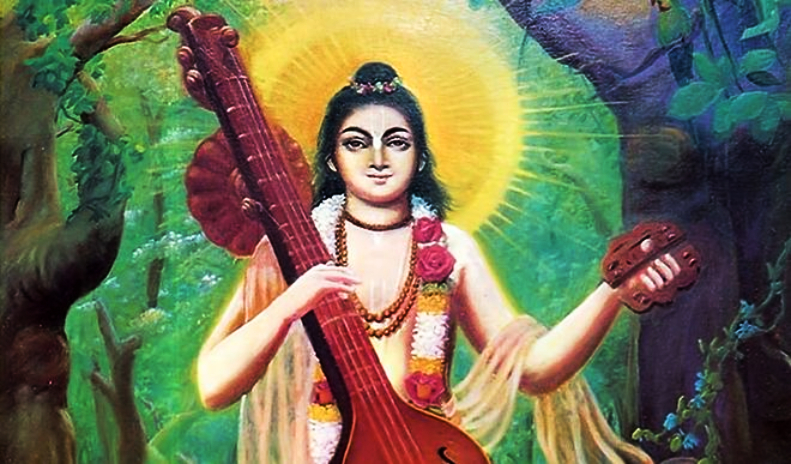
Narada (pronounced in Sanskrit “Naarada” and not “Naraada”) or Pesh-Hun (the equivalent Tibetan term) is mentioned numerous times by H. P. Blavatsky, mostly in “The Secret Doctrine.”
What she says about him may often seem mystifying, confusing, or like a riddle which cannot be solved. However, when one puts together everything she has said on this subject (or indeed any subject in Theosophy) and studies and contemplates on the matter as a whole, instead of just through isolated statements or fragments, a much more complete and comprehensible picture emerges. It is still, of course, only an extremely fragmentary picture, seeing as this subject is really too sacred and esoteric for a direct explanation in words, but it is valuable nonetheless, at least for serious students of Theosophy. This is what we have attempted to do below.
If one compares the following with what is provided in another article about the Maha-Guru or Great Sacrifice or Solitary Watcher or Initiator, the highest Guru of all Gurus, and the supreme great Head of the entire worldwide Brotherhood of Masters and Adepts, called the highest Being on Earth and in the Heavens, one may well deduce that Narada or Pesh-Hun is in reality another name for this equally mysterious “Wondrous Being,” “the “Nameless One” who has so many names.” Whether or not that is definitely the case is not in our power to say but it seems very reasonable and likely, as those who compare this article with the one just linked to will be able to attest for themselves. And if that is so, these statements from the writings of HPB will expand our perceptions and understanding of the role, activities, and function of the Maha-Guru.
In Hinduism, Narada is one of the seven Mind-Born Sons of Brahmā, i.e. a Manasaputra or Kumara. He is mentioned in various Hindu scriptures and is sometimes referred to as the Rishiraja, “the King of the Rishis” or “King of all Sages,” and spoken of as possessing all knowledge, wisdom, and insight.
Meanwhile, from the Esoteric Philosophy, Secret Doctrine, Occult Science, or sacred archaic Wisdom that has been partially presented to us as Theosophy, we can also discover that Narada –
* “is the Ruler of events during various Karmic cycles” (“The Theosophical Glossary” p. 224, Entry for “Narada”)
* is “the personification, in a certain sense, of the great human cycle” (“The Theosophical Glossary”)
* is “a Dhyan Chohan” (“The Theosophical Glossary”)
* “is the sole confidant and executor of the universal decrees of Karma and Adi-Budh [i.e. Adi-Buddhi or Adi-Buddha, Mahayana Buddhist terms for Primordial Wisdom and/or the Absolute]” (“The Secret Doctrine” Vol. 2, p. 48)
* is “a kind of active and ever incarnating logos, who leads and guides human affairs from the beginning to the end of the Kalpa.” (“The Secret Doctrine” Vol. 2, p. 48)
* “is the mysterious guiding intelligent power, which gives the impulse to, and regulates the impetus of cycles, kalpas and universal events.” (“The Secret Doctrine” Vol. 2, p. 48)
* is “the inspirer and the leader of the greatest heroes of this Manvantara.” (“The Secret Doctrine” Vol. 2, p. 48)
* is “he who has charge of our progress and national weal or woe. It is he who brings on wars and puts an end to them.” (“The Secret Doctrine” Vol. 2, p. 49)
* is “credited . . . in the old Stanzas [i.e. from the Secret Book of Dzyan, some of which are translated by HPB in “The Secret Doctrine”] . . . with having calculated and recorded all the astronomical and cosmic cycles to come, and with having taught the Science to the first gazers at the starry vault. . . . There is a work among the Secret Books, called the “Mirror of Futurity,” wherein all the Kalpas within Kalpas and cycles within the bosom of Sesha, or infinite Time, are recorded. This work is ascribed to Pesh-Hun Narada.” (“The Secret Doctrine” Vol. 2, p. 49)
* is “of all the Vedic Rishis . . . the most incomprehensible, because the most closely connected with the occult doctrines – especially with the secret cycles and Kalpas.” (“The Secret Doctrine” Vol. 2, p. 82)
* “is the Deva-Rishi of Occultism par excellence; and . . . the Occultist who does not ponder, analyse, and study Narada from his seven esoteric facets, will never be able to fathom certain anthropological, chronological, and even Cosmic Mysteries.” (“The Secret Doctrine” Vol. 2, p. 83)
* “is one of the Fires above-mentioned [i.e. probably a reference to the Three Fires spoken of in “The Secret Doctrine” and in Hindu Puranas, namely Fire by Friction or Pavamana, Solar Fire or Suchi, and Electric Fire or Pavaka]” (“The Secret Doctrine” Vol. 2, p. 83)
* “is an actor who appears in each of the successive acts (Root-Races) of the present Manvantaric drama, in the world allegories which strike the key-note of esotericism” (“The Secret Doctrine” Vol. 2, p. 83), “is found reborn in every cycle (or race)” (“The Secret Doctrine” Vol. 2, p. 323)
* “is the leader [i.e. as portrayed in Hinduism] of the Gandharvas, the celestial singers and musicians; esoterically, the reason for it is explained by the fact that the latter (the Gandharvas) are “the instructors of men in the secret sciences.” It is they, who “loving the women of the Earth,” disclosed to them the mysteries of creation; or, as in the Veda – the “heavenly Gandharva” is a deity who knew and revealed the secrets of heaven and divine truths, in general. . . . their leader, Narada, while refusing to procreate, leads men to become gods.” (“The Secret Doctrine” Vol. 2, p. 584)
~ * ~
“Daksha cursed him for his interference with his 5,000 and 10,000 sons, whom he persuaded to remain Yogins and celibates, to be reborn time after time on this earth (Mahâbhârata). But this is an allegory.” (“The Theosophical Glossary” p. 224, Entry for “Narada”)
“It has already been hinted that of all the incomprehensible characters in the Mahabhârata and the Purânas, Narada . . . is the most mysterious. . . . Narada is here, there, and everywhere; and yet, none of the Purânas gives the true characteristics of this great enemy of physical procreation [i.e. which is how he is portrayed in some of the Puranas].” (“The Secret Doctrine” Vol. 2, p. 47-48)
“Even Sir W. Jones was strongly impressed with this mysterious character from what he gathered in his Sanskrit Studies. He compares him to Hermes and Mercury, and calls him “the eloquent messenger of the gods” (see Asiat. Res. I. p. 264). All this led the late Dr. Kenealy (“Book of God”), on the ground that the Hindus believe him to be a great Rishi, “who is for ever wandering about the earth, giving good counsel,” to see in him one of his twelve Messiahs. He was, perhaps, not so far off the real track as some imagine.
“What Narada really is, cannot be explained in print; nor would the modern generations of the profane gather much from the information.” (“The Secret Doctrine” Vol. 2, p. 48)
“The hidden symbolism of Nārada – the great Rishi and the author of some of the Rig-Vaidic hymns, who incarnated again later on during Krishna’s time – has never been understood. Yet, in connection with the Occult Sciences, Nārada, the son of Brahmā, is one of the most prominent characters; he is directly connected in his first incarnation with the “Builders” – hence with the seven “Rectors” of the Christian Church, who “helped God in the work of creation.” . . . Nārada is one of the seven Rishis, the “mind-born sons” of Brahmā. The fact of his having been during his incarnation a high Initiate – he, like Orpheus, being the founder of the Mysteries – is corroborated, and made evident by his history. The Mahābhārata states that Nārada, having frustrated the scheme formed for peopling the universe, in order to remain true to his vow of chastity, was cursed by Daksha, and sentenced to be born once more. Again, when born during Krishna’s time, he is accused of calling his father Brahmā “a false teacher,” because the latter advised him to get married, and he refused to do so. This shows him to have been an Initiate, going against the orthodox worship and religion. It is curious to find this Rishi and leader among the “Builders” and the “Heavenly Host” as the prototype of the Christian “leader” of the same “Host” – the Archangel Mikael. Both are the male “Virgins,” and both are the only ones among their respective “Hosts” who refuse to create. Nārada is said to have dissuaded the Hari-ashvas, the five thousand sons of Daksha, begotten by him for the purpose of peopling the Earth, from producing offspring. Since then the Hari-ashvas have “dispersed themselves through the regions, and have never returned.” The Initiates are, perhaps, the incarnations of these Hari-ashvas?” (HPB, “Traces of The Mysteries” posthumously published; for more on the Archangel Michael as a later version of Sanat Sujata “the chief of the Kumaras,” please see Understanding The Seven Kumaras)
~ * ~
This article may have raised more questions about various things. Please make use of the site search function (the magnifying glass symbol at the top of the page) and visit the Articles page to see the complete list of over 400 articles covering all aspects of Theosophy and the Theosophical Movement. Two articles linked to above (The Great Sacrifice: The Maha-Guru, The Silent Watcher, The Initiator and Understanding The Seven Kumaras) may be found particularly helpful, as might A Beginner’s Guide To Studying “The Secret Doctrine”, Who Wrote “The Secret Doctrine”?, and How To Successfully Study The Teachings of H. P. Blavatsky.
~ BlavatskyTheosophy.com ~
 T H E O S O P H Y