

FROM THE WRITINGS OF H. P. BLAVATSKY
“In view of this, Gautama Buddha, after his initiation into the mysteries by the old Brahman, His Guru, renouncing gods, Devas and personal deity, feeling that the path to salvation lay not in vainglorious dogmas, and the recognition of a deity outside of oneself, renounced every form of theism and – became Buddha, the one enlightened.” (Footnotes to “The Philosophy of Spirit”)
“Udra Ramaputra . . . A Brahman ascetic, who was for some years the Guru of Gautama Buddha.” (“The Theosophical Glossary” p. 351)
This name is more typically written as Uddaka Ramaputta or Udraka Ramaputra; he is mentioned in several Buddhist scriptures.
“It is clear that Gautama-Buddha, the son of the King of Kapilavastu, and the descendant of the first Sakya, through his father, who was of the Kshatriya, or warrior-caste, did not invent his philosophy. Philanthropist by nature, his ideas were developed and matured while under the tuition of Tir-thankara, the famous guru of the Jaina sect.” (“Isis Unveiled” Vol. 2, p. 322)
This is presumably referring to Mahavira, the last Tirthankara recognised by Jainism and who was a contemporary of Buddha, 2,600 years ago.
“The old Brāhmanical secret Schools in the Himālayas . . . the parent of all others, had been established beyond the Himālayas [Note: The phrase “beyond the Himalayas” is used repeatedly by HPB and refers to either the Trans-Himalayan region once known as “Little Tibet,” or to Tibet itself, or both.] for ages before the appearance of Sākyamuni [i.e. Shakyamuni being a name of Gautama Buddha]. Gautama was a pupil of this; and it was with them, those Indian Sages, that He had learned the truths of the Sunyata, the emptiness and impermanence of every terrestrial, evanescent thing, and the mysteries of Prajña-Pāramitā, or “knowledge across the River,” which finally lands the “Perfect One” in the regions of the One Reality. But His Arhats [i.e. his leading disciples] were not Himself. Some of them were ambitious, and they modified certain teachings after the great councils, and it is on account of these “heretics” that the Mother-School [i.e. that most ancient parent of all Esoteric Schools, based “beyond the Himalayas”] at first refused to allow them to blend their schools, when persecution began driving away the Esoteric Brotherhood [of the Buddhists] from India. But when finally most of them submitted to the guidance and control of the chief Āshramas, then the Yogacharyā of Āryāsanga was merged into the oldest Lodge. For it is there from time immemorial that has lain concealed the final hope and light of the world, the salvation of mankind.” (“A Few More Misconceptions Corrected”)
The following passages shed a little more light on the above:
“But three or four centuries after [Buddha’s] separation from this earthly coil, when Asoka [i.e. Ashoka Morya or Maurya, the Buddhist emperor of India, who died in 232 B.C.E.], the great supporter of our religion, had left the world, the Arhat initiates, owing to the secret but steady opposition of the Brâhmans to their system, had to drop out of the country one by one and seek safety beyond the Himâlayas. Thus, though popular Buddhism did not spread in Tibet before the seventh century, the Buddhist initiates of the mysteries and esoteric system of the Âryan Twice-born, leaving their motherland, India, sought refuge with the pre-Buddhistic ascetics; those who had the Good Doctrine, even before the days of Shakya-Muni. These ascetics had dwelt beyond the Himâlayan ranges from time immemorial. They are the direct successors of those Âryan sages who, instead of accompanying their Brâhman brothers in the pre-historical emigration from Lake Mânasasarovara [i.e. the famous lake – nowadays typically written as Manasarovar – near Mount Kailash in Tibet; the most ancient Hindu scripture called the Rig Veda is “recorded in Occultism as having been delivered by great sages on Lake Man(a)saravara beyond the Himalayas, dozens of thousands of years ago,” writes HPB in “The Theosophical Glossary”] across the Snowy Range [i.e. the Himalayas] into the hot plains of the Seven Rivers [i.e. India], had preferred to remain in their inaccessible and unknown fastnesses. No wonder, indeed, if the Âryan esoteric doctrine and our Arhat doctrines are found to be almost identical. Truth, like the sun over our heads, is one; but it seems as if this eternal truism must be constantly reiterated to make the dark, as much as the white, people remember it. Only that truth may be kept pure and unpolluted by human exaggerations – its very votaries betimes seeking to adapt it, to pervert and disfigure its fair face to their own selfish ends – it has to be hidden far away from the eye of the profane.” (The “Venerable Chohan-Lama,” quoted by HPB in “Tibetan Teachings”)
“There is generally a hopeless confusion about Eastern dates among European scholars, but nowhere is this so great as in the case of Tibetan Buddhism. Thus, while some, correctly enough, accept the seventh century as the date of the introduction of Buddhism, there are others – such as Lassen and Koeppung, for instance – who show on good authority, the one, the construction of a Buddhist monastery on the slopes of the Kailāsa Range [i.e. the mountain range whose most prominent peak is Mount Kailash] so far back as the year 137 B. C. [i.e. probably an example of what is described at the start of the preceding quote], and the other, Buddhism established in and north of the Punjab, as early as the year 292 B. C. The difference though trifling – only just one thousand years – is nevertheless puzzling. But even this is easily explained on Esoteric grounds. Buddhism – the veiled Esotericism of Buddha – was established and took root in the seventh century of the Christian era; while true Esoteric Buddhism, or the kernel, the very spirit of Tathāgata’s doctrines, was brought to the place of its birth, the cradle of humanity, by the chosen Arhats of Buddha, who were sent [i.e. by Buddha himself, during his lifetime, around 2,600 years ago] to find for it a secure refuge, as
“The Sage had perceived the dangers ever since he had entered upon Thonglam (“the Path of seeing,” or clairvoyance).”
“Amidst populations deeply steeped in Sorcery the attempt proved a failure; and it was not until the School of the “Doctrine of the Heart” had merged with its predecessor, established ages earlier on the slope facing Western Tibet, that Buddhism was finally engrafted, with its two distinct Schools – the Esoteric and the exoteric divisions – in the land of the Bon-pa [i.e. adherents of Bon or Bhon, the indigenous religion of Tibet].” (“A Few More Misconceptions Corrected”)
If we put together some key statements from the above three excerpts, a clearer picture might emerge:
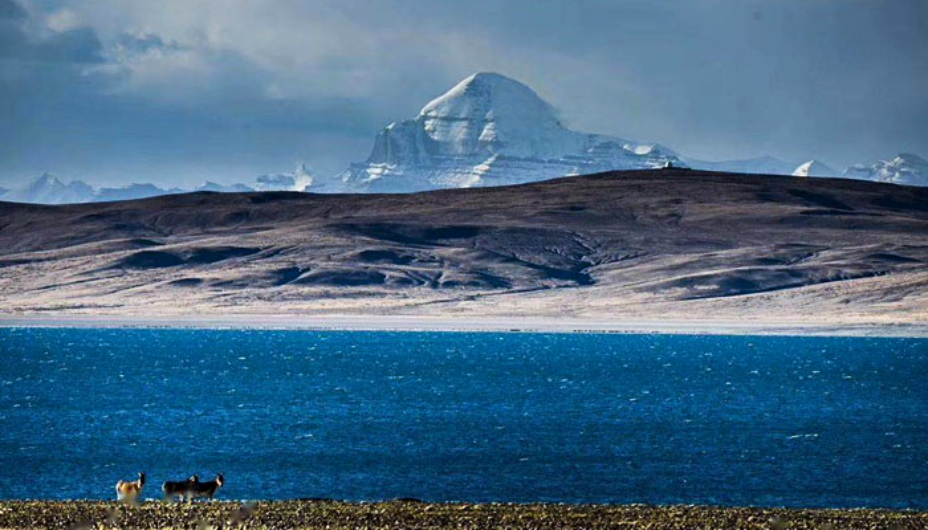
“The oldest Lodge . . . the parent of all [Esoteric Schools], had been established beyond the Himālayas for ages before the appearance of [Gautama Buddha] . . . the Mother-School . . . the pre-Buddhistic ascetics; . . . These ascetics had dwelt beyond the Himâlayan ranges from time immemorial. . . . Lake Mânasasarovara [near Mount Kailash in Tibet] . . . the chief Ashrams . . . the Yogacharyā of Āryāsanga [referring to the original and historically unknown Aryasanga, who HPB calls an Arhat and direct disciple of Buddha and the founder of the first and still secret Yogacharya School; see The REAL Esoteric Buddhism for more] was merged into the oldest Lodge . . . the School of the “Doctrine of the Heart” had merged with its predecessor, established ages earlier on the slope facing Western Tibet [i.e. another reference to Mount Kailash, as it is that highly revered and sacred mountain which faces Western Tibet and which has ever been forbidden to climb] . . . it is there from time immemorial that has lain concealed the final hope and light of the world, the salvation of mankind.”
This sounds exactly like what we are reading about is actually referring to Shambhala. In the Blavatsky on Shambhala compilation, we included her mention of “Arghya Varsha – “the land of libations” – . . . the mystery name of that region which extends from Kailas mountain [i.e. Mount Kailash in Tibet] nearly to the Schamo Desert [i.e. the Gobi Desert, partly in Mongolia and partly in China] – from within which the Kalki Avatar is expected.” (“The Secret Doctrine” Vol. 2, p. 416) The article The Occult Importance of Central Asia will also shed light on these various matters, including the ancient historical link between the Himalayas, Central Asia, and the escaping survivors – of the early Fifth Root Race and latter Fourth Root Race – from the destruction of Atlantis.
In fact, HPB essentially affirms that what is referred to above is indeed Shambhala or Shamballa, as she immediately follows the sentence “For it is there from time immemorial that has lain concealed the final hope and light of the world, the salvation of mankind,” by saying:
“Many are the names of that School and land, the name of the latter being now regarded by the Orientalists as the mythic name of a fabulous country. It is from this mysterious land, nevertheless, that the Hindu expects his Kalki Avatara, the Buddhist his Maitreya, the Parsi his Sosiosh, and the Jew his Messiah, and so would the Christian expect thence his Christ – if he only knew of it. There, and there alone, reigns Paranishpanna (Gunggrub), the absolutely perfect comprehension of Being and Non-Being, the changeless true Existence in Spirit, even while the latter is seemingly still in the body, every inhabitant thereof being a Non-Ego because he has become the Perfect Ego. . . . Its “Perfect” Buddhas and Bodhisattvas may be on every nimble Buddhist tongue as celestial – therefore unreachable Beings, while these names may suggest and say nothing to the dull perceptions of the European profane. What matters it to Those who, being in this world, yet live outside and far beyond our illusive earth! . . . Thence emerge occasionally the Bodhisattvas in their Prul-pai-ku (or Nirmanakaya) body and, assuming an ordinary appearance, they teach men. There are conscious, as well as unconscious, incarnations.” (“A Few More Misconceptions Corrected”)
The ”Theosophical Glossary” entry for “Abhayagiri” (p. 2-3) also sounds like much the same thing as the above passages is being referred to, although in this case Sri Lanka is spoken of, rather than India:
“[At “Mount Fearless” in Sri Lanka was] a School called Abhayagiri Vâsinah, “School of the Secret Forest.” This philosophical school was regarded as heretical, as the ascetics studied the doctrines of both the “greater” and the “smaller” vehicles – or the Mahâyâna and the Hînayâna systems and Triyâna or the three successive degrees of Yoga [Note: “Triyana” refers here to the Hinayana, Mahayana, and Vajrayana systems of Buddhist teaching and practice; the historical existence of this Abhayagiri school is well attested to by all researchers and it is widely recognised that they studied and appreciated all three Buddhist systems, much to the displeasure of their fellow Buddhists.]; just as a certain Brotherhood does now beyond the Himalayas. This proves that the “disciples of Katyayana” were and are as unsectarian as their humble admirers the Theosophists are now. This was the most mystical of all the schools, and renowned for the number of Arhats it produced. The Brotherhood of Abhayagiri called themselves the disciples of Katyayana, the favourite Chela of Gautama, the Buddha. Tradition says that owing to bigoted intolerance and persecution, they left Ceylon [i.e. Sri Lanka] and passed beyond the Himalayas, where they have remained ever since.”
The Katyayana spoken of is described in Buddhism as one of Buddha’s ten main disciples but he is not described as being his most favourite or closest. Perhaps this “Glossary” entry indicates that the historically unknown Aryasanga who was – according to HPB and no-one else – an Arhat and direct disciple of Buddha, and the historically unknown Esoteric Yogacharya School which he founded, are better known to the world as Katyayana and the Abhayagiri School? If “the pre-Christian Aryasanga” and Katyayana are in reality synonymous, and the Esoteric Yogacharya School and Abhayagiri School are one and the same, this resolves what otherwise has remained since HPB’s time a great historical mystery and an apparent major discrepancy in her comments on early Buddhism. This may of course not be the case at all but it is certainly possible or even probable.
Neither HPB nor modern researchers believe that Katyayana himself directly founded Abhayagiri, since it postdates him, but he is said by some sources to have been the main originator of the Sthavira or Sthavirah school, of which Abhayagiri was an offshoot or subdivision a few centuries afterwards. Nevertheless, the implication seems to be that Katyayana’s esoteric teachings – which he would have derived from Gautama Buddha himself – were preserved by a group at Abhayagiri and that the members of this group (and probably others, in India itself) eventually felt it necessary to travel northwards, up to and beyond the Himalayas, perhaps to Mount Kailash itself and, merging with the One Parent School/Lodge/Brotherhood, re-established themselves there and have remained so ever since. We know this did not apply to all the monks and ascetics at Abhayagiri, since it remained an active monastic centre until just 800 years ago. Now partially restored, it is a UNESCO world heritage site and can be read about on Wikipedia here.
“True, “Koot Hoomi” mentions Buddha.But it is not because the Brothers hold him in the light of God or even of “a God,” but simply because he is the Patron of the Tibetan Occultists, the greatest of the Illuminati and Adepts, self-initiated by his own Divine Spirit, or “God-Self,” into all the mysteries of the invisible universe.” (“Madame Blavatsky on The Himalayan Brothers”)
~ * ~
LETTER FROM RAI B. K. LAHERI TO WILLIAM Q. JUDGE, MARCH 1893
K.B., a Brahman Yogi, recently went up to the Himālayas: on his way down to Deccan, he was kind enough to stop at my place for some days and imparted to me the following news. I must say here that I saw him at Meerut before he went up to the Himālayas, and asked him what will be the destiny of our [Theosophical] Society so far as India is concerned, and as H.P.B. has departed, whether we will have another teacher to give us — Indians — teachings in practical occultism. I asked him these two questions; he replied:
“I am going to the Himālayas now, and if I see any Mahatma I shall be able to tell you, and not before.”
This said, we parted from each other, I for Calcutta and he for the north. I must mention here also that this gentleman did not know much of H.P.B. before nor of the Theosophical Society, and whenever I spoke to him about them he used to say, as it were passively, that it is a good work, no doubt, and that H.P.B. must have known the occult philosophy though she was born in the family of the Mlecchas [i.e. a term once used in India to describe all non-Indians, literally meaning “barbarians” or “the barbarous”], that whenever the Rākshasas [i.e. evil spirits or incarnated demons in Hindu allegory and mythology] became powerful some goddess is sent to destroy them, and so she was sent to destroy the materialism of the all-powerful western Rākshasas.
However, now I shall relate what he told me when he came back from the Himālayas. The first thing he said was: “Go on! go on! go on! Fit yourself; you have much to do: go on, go on, and go on.”
The next thing he told me was, that this time he considered himself to be thrice blessed by the sight of a Mahatma near Badarikāśrama [i.e. better known as Badrinath, a holy region in northern India bordering Tibet and Nepal, greatly revered by Hindus and also mentioned by HPB and the Masters as a sacred and mysterious site; it has connections with Adi Shankaracharya], in the snow-covered and impassable cave of the Himālayas. He gave me a long detail of what he saw and how he reached there, but it will be too long and not interesting to you to mention them in detail.
The Mahatma, he said, he saw perfectly naked; that no living soul could venture to look at his eyes; his color appeared to be of such a peculiar hue that it is not like anything worldly, but when he touched his hand (K.B.’s) between the third and fourth fingers, the latter could not stand the electric shock that ran up to his head from the extreme parts of his feet. It appeared to him as if a most powerful galvanic battery was applied to his body, and he became almost unconscious, although he himself is a real yogi of 22 years’ standing and following the path ever since. He said the body of the Mahatma, though it looked like butter, proved to be hard as steel, and that it was impossible for him to say of what it is made. The Mahatma does not speak, and with him only spoke where he could not make the latter understand his thought perfectly well. After he received his instruction, whatever was necessary for him, he asked: “that in India there they have established a society called the Theosophical Society, and that Madame Blavatsky started it with Col. Olcott. What is this? Is there anything real in it? Who was H.P.B.? Was she a yogi? Is Col. Olcott a yogi? What will be end of all this? Is anybody to come in the place of H.P.B.? My certain friend B.K.L. who takes much interest in the T.S. pressed me for the latter information.”
To all these the replies were as follows, but mostly by gestures and shaking of hands and nod of the head. He said, “The T.S. was their work; it was established to change the present current of the human mind and destroy Nāstikism [i.e. atheism], to save the seed of the fifth race — the Āryan; that he was present when H.P.B. was sent by her Master from the Mānasarovara Hills [i.e. the Kailash mountain range] in Tibet; that the latter had not better ask who was H.P.B. and where she is now, but she was sent to carry out the work of the Mahatmas; that she was very high up there is not the least doubt, that he himself was one of the Circle, although not so high as the Guru of H.P.B. [i.e. the Master M. or Mahatma Morya]; that Col. Olcott is a good man no doubt but no yogi, he is entirely different from H.P.B., with whose name you cannot mention Olcott. That what was necessary was done by H.P.B. and the Society is successful; that they will not send anybody now, but the work must be carried on from inside the Society itself — that now no one from the West will give occult lessons to the Indians, but whatever they have got, they must prepare themselves so as to receive further instructions from anybody in India till they are able to impart instructions to the Society and keep it intact; that hitherto the T.S. followed a particular line, but in India there should be a change in that line, but there will be no change in the West, they must go on as they do now.”
Since the Svāmiji has come back from the Himālayan Hills his ideas about the T.S. and H.P.B. are entirely different; instead of passive tolerance he simply says:
“Go on, go on, and go on. There is much for you to do; fit yourself. I can’t and won’t tell you what further the Mahatma has said, because the time is not come, but when time comes I shall tell you. Oh! I like to worship the portrait of H.P.B.; no one has done so much good for humanity, especially for India, after Buddha and Śankarāchārya in his reincarnation. The T.S. is ours, established for certain purposes by our Mahatmas; go on and go on, work and work.”
The Svāmiji’s opinion is a little dwarfed about Col. Olcott — but he says he is a good man. I must tell you that the Svāmiji never knew any of these informations about the T.S., the West, or H.P.B. before he went up to the Hills.
The Svāmiji showed me his hand where the Mahatma held it with his two fingers — there is the white sign of inflammation still existing, and subsequently the skin was off from that place.
These are the facts that are revealed to me, and I asked him whether I can convey them to any of those Westerns who are the workers of the T.S. He told me the Mahatma has not told him that the matter should be kept secret, so I have the liberty to reveal but only to the worthy person. It appeared also that the Svāmiji is the chela of one of the chelas or grand chelas of a Mahatma of the Circle.
~ * ~

This article may have raised more questions about various things. Please make use of the site search function (the magnifying glass symbol at the top of the page) and visit the Articles page to see the complete list of over 400 articles covering all aspects of Theosophy and the Theosophical Movement. Some articles closely related to this one include The REAL Esoteric Buddhism, Blavatsky on Shambhala, The Occult Importance of Central Asia, Kalachakra and Theosophy, Pre-Vedic Buddhism, Alaya – The Universal Soul, Blavatsky and Buddhism, The Letter from The Maha Chohan, The Avatar, and The Great Sacrifice: The Maha-Guru, The Silent Watcher, The Initiator.
~ BlavatskyTheosophy.com ~
 T H E O S O P H Y