
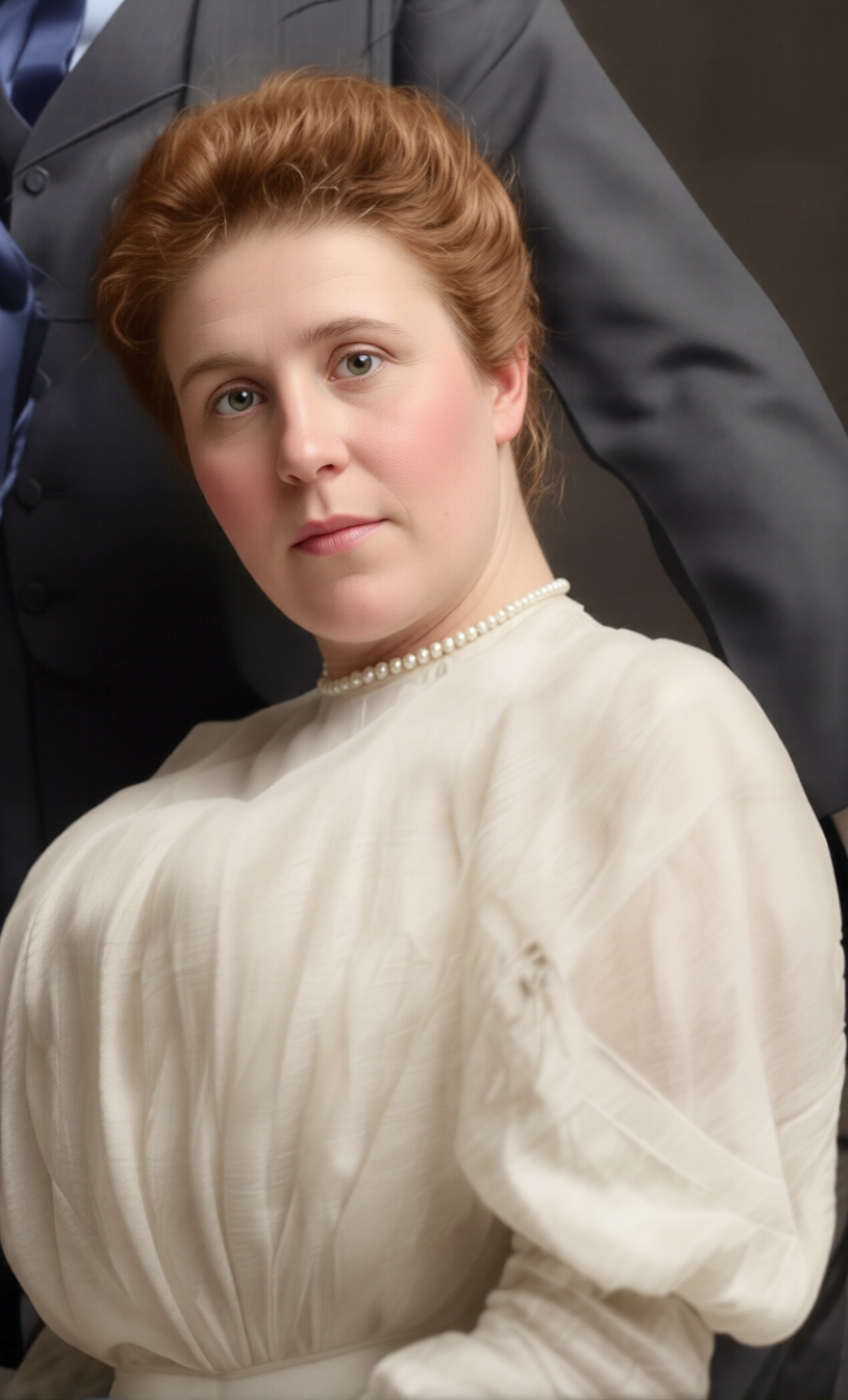
From “Fragments” Vol. I, p. 90-98, by Cavé (Genevieve Griscom), published by The Theosophical Society headquartered in New York. This Society no longer exists; to learn more about it, including Genevieve Griscom’s important esoteric role within it and the occult trust given to her by William Q. Judge towards the end of his life, please see The Forgotten Theosophical Society.
The relations of Master and pupil – and the training and struggle along the path which leads to the heights of adeptship, these have an interest profound. They induce thoughts which are to the mind like cool shady resting places in the fever and fret of life, or like a draught of water to thirsty lips. But though many are truly seeking, the most earnest share in the common heedlessness of the age, and overlook when they reach it, the very hint they have sought for so long. However, it is not for those who understand, but for those who do not, that I will write and re-write, trusting that each time a new presentation may reach them, a new “voice crying in the wilderness” strike on their inner ears.
Much has been said on this subject then, little understood, and this lack of understanding is largely due to the strangeness of the theme, and also that it is written in that inner language, that language of the soul, which few can read, and which it is almost impossible to translate into the vernacular of the day. For the true language is one of vibration and picture, and our common speech is only a matter of set form and memory. So that when the attempt is made to put higher things into words, they lose their life and meaning, and become as cold and dead as the words which frame them, without energizing power, and robbed of all possibility of awakening the soul.
And yet the cry continually is, to put these matters “plainly,” denuded of imagery, and reduced to mathematical formula. True, they could all be expressed by mathematical terms and figures, but in those planes or divisions of mathematics where the student must exercise the highest powers of the imagination – a faculty all great mathematicians have possessed in marked degree. So I repeat, the expression of inner truths in plain everyday speech is as difficult as to put a proposition of Euclid in words a child could comprehend. An approximation, therefore, is the most I can hope for, and it must not be forgotten that the “plainer” the phrase, the more the “spirit” will be lacking. Yet since the need exists the effort is made to supply it. If it fail no harm is done, and it will have succeeded if only one soul comes into closer touch with the Helpers of humanity, or obtains one fuller glimpse of the life which all must ultimately lead, and the path along which all in time must travel.
Chelaship, then, has two main divisions, which have been called the “probationary” and the “accepted.” These terms will serve as well as any others. Now “probationary chelaship” has also two main divisions, and these divisions are in fact two stages of meditation, so that the subject of meditation is the first to be dealt with.
I do not suppose that in the entire range of Theosophical thought and study, there is any subject of greater importance than this, or at the same time so little understood. It has been defined as “the cessation of active, external thought.” [Note: This preceding quote, defining meditation, is from a comment by Julia Keightley in “Letters That Have Helped Me” p. 31.] To most that condition appears one of absolute negation, for most people live in the brain, identify themselves with its consciousness and are unable to con- ceive of a condition which is exclusive of active thought of some kind. To such people the first step is plain: they must learn to do this – they must learn to meditate. And therefore so much stress has been laid upon daily meditation, for until a man meditates daily and regularly he can go no further. The beginnings of chelaship lie in this, and in what grows out of it.
The first effort then must be to take a regular time each day, and concentrate the mind upon some one thing, something of a spiritual and elevating nature, something which will give food to the soul, though in the beginning this will be more of a mental discipline than anything else; for it is not easy absolutely to concentrate the mind, and it usually takes much time, persistence and patience to accomplish it. When, however, this is accomplished, when the man has learned to concentrate his mind on any given subject, then as he daily practises this, he will attain during his periods of meditation that conscious condition, which is the true meditation, the “cessation from active, external thought.” In this condition the mind is used as an instrument, the man’s consciousness remaining behind or above it. In this way the man attains a higher state of consciousness, one which when it becomes habitual enables him to enter into communication with the Masters, and all who function on those higher planes of being.
At first he learns to do this at stated times; gradually he learns to do it always, so that in the true sense he is always meditating. No matter how the body or the mind be employed, the true centre of consciousness is [then] never lost; the mind will be the man’s instrument, and instead of identifying himself with the mind, mental activity will be carried on without his losing the consciousness of the real “I” in it.
This state of continual meditation constitutes the second degree; for when the disciple has reached it he finds his Master waiting, and thereupon becomes an “accepted chela.”
Under this heading of “probationary chelaship” I have not discussed purification, but that I think almost goes without saying as a sine qua non, and there is nothing that accomplishes this as meditation does. “As a man thinks so he becomes.” Meditation on a virtue causes it to spring up in the heart; meditation on the Master causes one to grow into His likeness, the likeness of the perfected man. And no man whose thoughts are always pure and high will be guilty of mean, low or sinful acts. These two, therefore, this effort of continual meditation, accompanied by practice, the living out in the life what one thinks in the mind, constitute the preparation for chelaship or the probationary degree.
And all of this the man must accomplish entirely alone and unaided. As the babe must learn to eat and digest for itself, though the loving care which surrounds it would help and save in every way, so with the neophyte in occultism (what St. Paul has called “babes in Christ”); there are certain steps he must take alone, certain things in which no one can aid him, however great the love and compassion which may long to do so. And this fact, that until these steps are taken, these certain things accomplished for himself, the Master can do nothing for him, must be realized and its full meaning faced and accepted.
For we cannot reach the Masters until we penetrate their plane [i.e. the plane on which their consciousness resides and functions, irrespective of whether they are living externally on this physical plane]. When we have so done, we find, each one finds his Master waiting. And this is no figure of speech, as some have taken it to be. When a man reaches his own Soul, he reaches the Master truly, for the “Master Soul is one,” and so the Soul is often spoken of as the Master. [Note: “The Voice of The Silence” says that there are many Teachers but the Master-SOUL is just ONE: Alaya, the Universal Soul. Earlier in “Fragments” Vol. 1, it was stated, “Thus he finds that, having obeyed his Highest Self, he has obeyed the Master: they are one.”] But the Masters are living men, and the chela is regularly taught and trained by his Master after he has been accepted, just as any pupil is by any teacher.
So faith is needed. For a man can hardly hope to reach and communicate with those whose actual existence he doubts, and after a certain point the help and training of a Teacher is essential for further spiritual develop- ment. Until this point is reached however, the man must work alone, for how long depending entirely upon the length of time he may require to attain the indicated conditions. At the risk of being wearisome I must repeat this again and yet again, for no one seems to comprehend it, and all complain over it at some stage or other, which they would not do if they appreciated the inevitableness of it.
Therefore this is in very truth a path of difficulty, for as he makes his first demands upon the Law, as he makes his first efforts towards another life, certain trials are sure to meet him. This demand and this effort have two sure results. They first of all arouse his whole nature, bring to the surface all that is in him, both of bad and good, and thus he finds himself assailed by an hundred faults and temptations which he has never known previously. Secondly his demand upon the Law brings the Law upon him. Before he can be an accepted chela his past Karma must descend upon him and be measurably exhausted. So that just when he is striving to lead a better and a purer life, he finds troubles, difficulties, sorrows, and burdens of all kinds descending upon him, and it is in the midst of this turmoil and struggle that he must teach himself, unaided, the control of mind and heart, and enter into that more spiritual condition known as continual meditation.
Blessed he who continues unfaltering to the end. This is the just and merciful Law, and one can easily see that it must be this way and no other. With the gradual unfoldment of time, the orderly progression of the ages, all will know and enter into these conditions, slowly, step by step, climbing the ladder of life. But he who determines to seize his heritage now, by main force, can expect only a fierce combat, for he takes with one blow what others will toil for through centuries.
Of accepted chelaship little has been told. What need? The Master instructs his disciples then, and those who have not reached that stage, are wiser to concern themselves with the needs and aspirations of their own condition.
The eastern books tell us of four divisions, and give them names [i.e. presumably a reference to the stages of Srotapatti, Sakridagamin, Anagamin, and Arhat]. After these stages are passed the man is “more than man,” and if he choose aright at that great day of choice, then “all Nature’s wordless voice in thousand tones ariseth to proclaim: Joy unto ye, O men of Myalba. A pilgrim hath returned back ‘from the other shore’; a new Arhan is born.” [Note: These closing words are quoted from the closing words of the last section (“The Seven Portals”) of “The Voice of The Silence.”]
~ * ~
SOME RELATED ARTICLES: CHELAS AND CHELASHIP, ASSIMILATION TO THE MASTERS, THE MASTER WHO STANDS AT THE HEAD OF YOUR RAY, THE MASTERS AND MADAME BLAVATSKY, WILLIAM Q. JUDGE AND THE MASTERS OF WISDOM, MASTERS OF WISDOM: OUTWARDLY MORTAL, INWARDLY IMMORTAL, TWO LITTLE-KNOWN LETTERS FROM THE MASTER HILARION, AND MEDITATION.
YOU CAN ALSO VISIT THE ARTICLES PAGE FOR THE COMPLETE LISTING OF OVER 400 ARTICLES ON ALL ASPECTS OF THEOSOPHY AND THE THEOSOPHICAL MOVEMENT.
~ BlavatskyTheosophy.com ~
 T H E O S O P H Y