
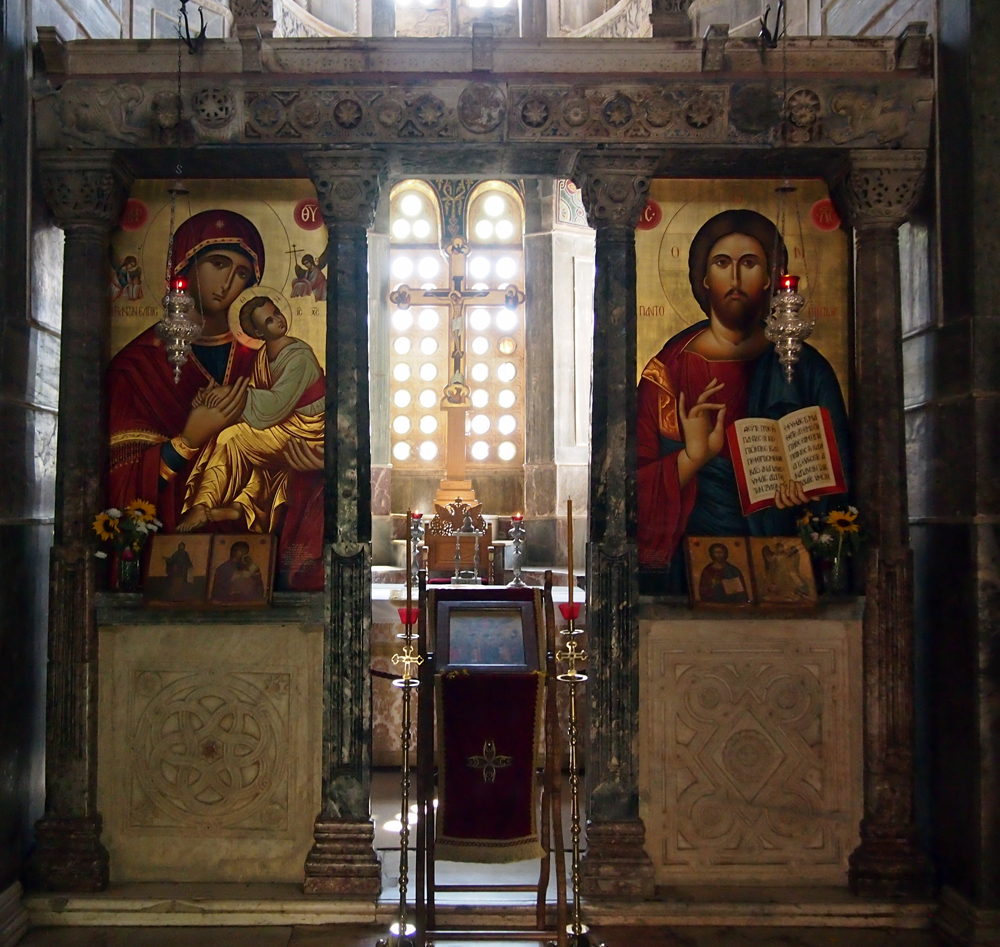
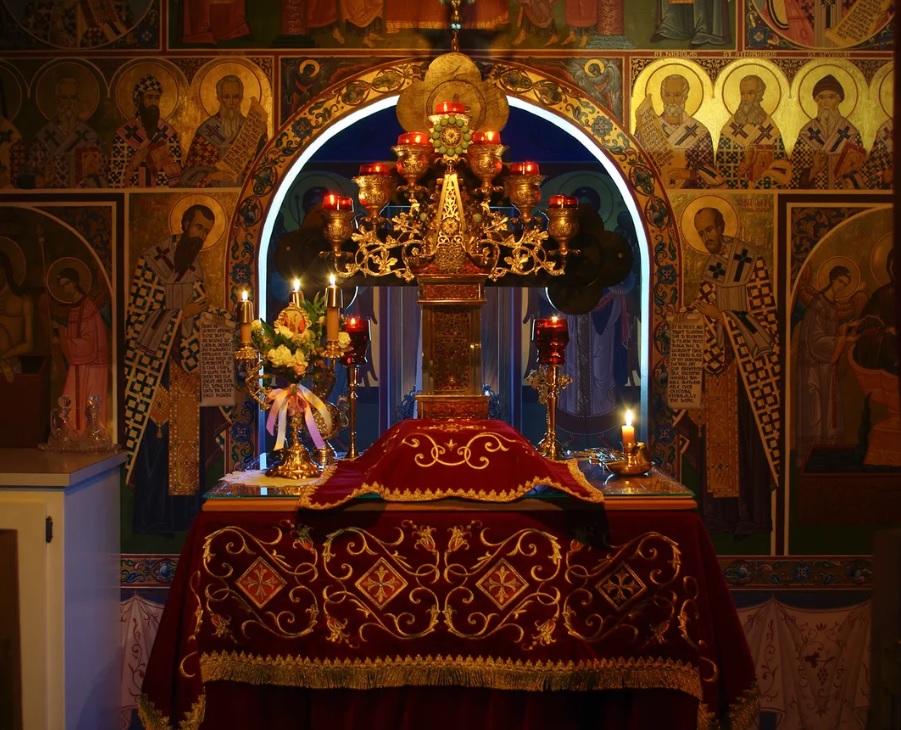
In the article Jesus, Christos or The Christ Principle, and Christianity, we wrote: “When we look at the Christian Church as it exists today, what branch or denomination of it is closest – even if perhaps still not very close – to the early established Christian Church? We mean distinctly Christian and thus not including the Ebionites, etc. HPB’s answer: The Eastern Orthodox Church, which exists as the Greek Orthodox Church, Russian Orthodox Church, and others.”
The Orthodox Church is one; the addition of “Russian” or “Greek” or whatever else to the name is a purely geographical designation, which does not denote difference in doctrine, worship, practice, etc.
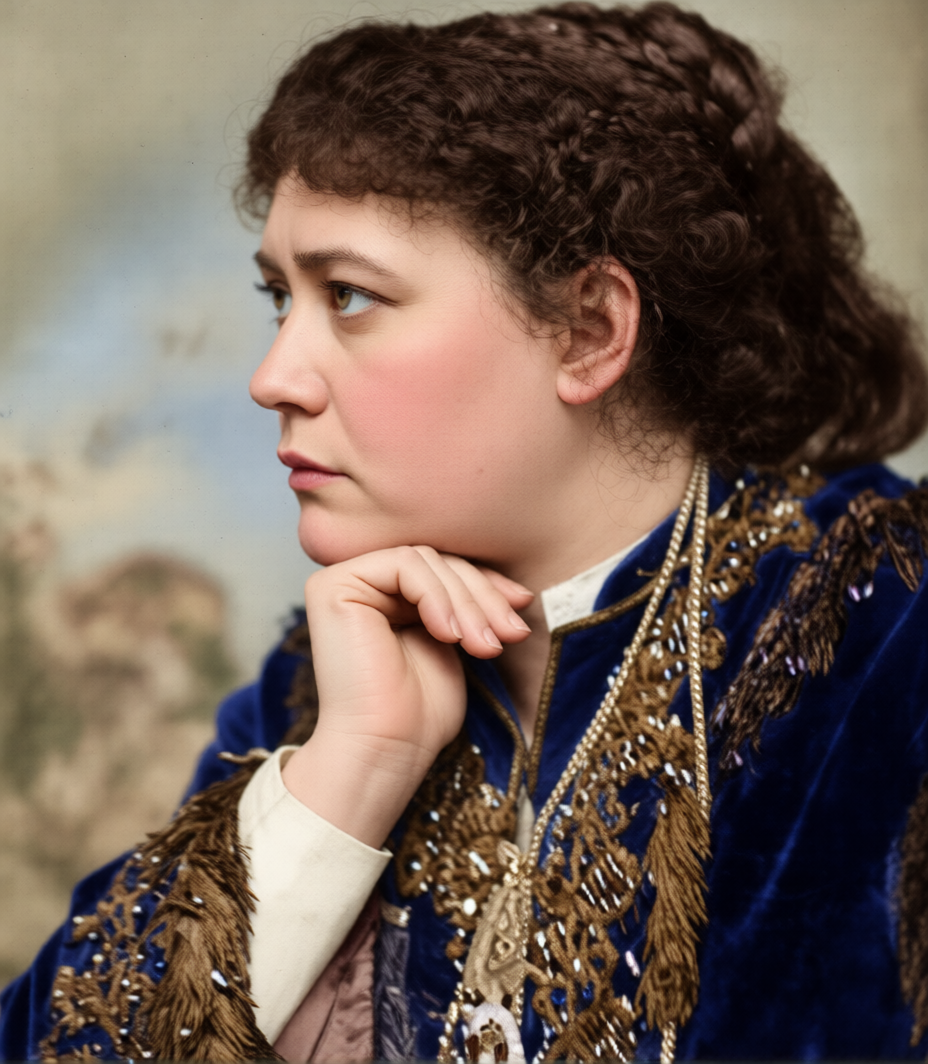
In reading the following excerpts from letters by H. P. Blavatsky to her sister Vera and aunt Nadezhda or Nadia in Russia, some might at first suppose that her great positivity and praise towards the Orthodox Church is just a way of placating or appeasing her devout relatives, who we know were at least slightly concerned about what they were hearing and reading of HPB’s (then living in the USA, in New York, where she and several others had established the Theosophical Society in 1875) seeming rejection of both Christ and Christianity.
However, as will be seen, HPB attributes much of this positive opinion of the Eastern Orthodox Church to her Indian Guru, the Master M. She would never dishonestly or deceptively attribute something to him which was not so, for she knew and fully respected the great sacredness and responsibility of the Guru-chela or Master-disciple relationship.
Further, even when not addressing her relatives or any Russians, she still praised and defended the Orthodox Church to a significant degree, throughout the remainder of her life. Numerous examples from her articles are cited in the section headed “THE CHRISTIAN CHURCH” in the Jesus, Christos or The Christ Principle, and Christianity article. We encourage anyone who is deeply interested in these subjects to carefully read the entirety of that very lengthy article, as well as what is here on this page.
These particular letters were fully translated in Vol. 1 of “The Letters of H. P. Blavatsky,” published in 2003 by Quest Books/Theosophical Publishing House. We have occasionally made some very minor edits to these extracts, to improve readability in English.
These passages deal not only with the Church but also shed some valuable light on the work of the Master Christ.
~ * ~
H. P. Blavatsky to her sister, Vera Zhelihovsky, February 1877
“I told him that his [i.e. the Jesuit Secretary who the Roman Catholic Church had sent to visit HPB in New York, to entreat her to stop criticising that Church in her writings] efforts were in vain; that whatever I personally, as a Theosophist, believe, was none of his business! That the Orthodox faith of my Russian brethren was sacred to me! That I will always defend that faith and Russia, and shall challenge the attacks of the hypocritical Catholics upon them, as long as my hand can hold a pen, without fear of either the threats of their Pope or the wrath of the Roman Church – la Grande Bête de l’Apocalypse [i.e. the “Great Beast” spoken of in the Book of Revelation].”
H. P. Blavatsky to her aunt, Nadezhda Fadeyeva, 19th July 1877
“I know what a devoutly religious person you are; how clear and pure your faith is; and my only hope is that you will understand that my books are not aimed against religion, against the Christ, but against the heinous hypocrisy of those who murder, burn, and kill in the name of the Almighty Son of God, ever since the moment of his death on the Cross for the sake of all humanity, and especially the sinful, fallen men, the heathen, the fallen women, and those who have gone astray. Where is truth? Where to find it? Three enormous, so-called Christian Religions. In England, Germany, and other Protestant countries there are 232 sects, and in America, 176. Each one of them demands respect and wants its doctrines and dogmas to be acknowledged true and those of its neighbours a bunch of lies. “Where is truth – what is it?” asked Pilate of Christ 1877 years ago. Where is it? I myself, poor sinner, am asking, and nowhere do I find it; everywhere deceit, falsehood, ferocity, and – the sad results of the Jewish Bible which burdens the Christians, and by means of which half of the Christian world has stifled the actual teachings of Christ!
“Understand me; our own Orthodox Faith stands by itself. The book [i.e. “Isis Unveiled,” HPB’s first book, which had then just been published] does not mention it. I have refused point blank to analyze it, as I wish to preserve at least one small corner of my heart where suspicion could not crawl in, a feeling I put down with all my strength. The Orthodox people are sincere; their faith may be blind, unreasoned, but it leads them to the good; and though our priests are drunkards and thieves, and often fools also, the faith of the people is pure and can lead only to the good. The Master himself [i.e. HPB’s Guru, the Master M. or Mahatma Morya] admits this and says that the only people in the world whose faith is not a speculation, are the Orthodox people. . . .
“What is the essence of all religion? “Love your neighbour as yourself and God above all.” Are these not the words of Jesus? Has he left behind even one single dogma, has he taught a single one of the thousand articles of faith that the Church Fathers have afterwards invented? Not one. On the Cross, he prayed for his enemies, and in his name, as much as in the name of Moloch, 50 to 65 million people have been thrown into the fire and burned. He spoke against the Jewish Sabbath and purposely belittled it, and yet here, in free America, fines and imprisonment are imposed for the violation of the Sabbath, called just that, Sabbath day, although they have altered it to Sunday. . . .
“If we are to believe in the New Testament, then we cannot believe in the Old. Jesus goes directly against the Old Testament and the Law. His Sermon on the Mount (see Matthew [ch. 5-7]) is a teaching diametrically opposed to the Ten Commandments of Sinai. “On Sinai, in the Books of Moses, it is said such-and-such – a tooth for a tooth, etc.; but I say unto you, etc.” What is it if not a rebellion against the old institution of the Synagogue? Let all the Churches rise against me, let people curse me, God, the Great Invisible God, sees why I rebel against the teaching of the Church. I shall never believe that the purest Divine Person of Christ was the son of the Jewish Jehovah! Of that wicked, crafty Jehovah, who purposely hardens the heart of the Pharaoh and then chastises him for it; who tempts -personally tempts – the people and then throws stones at them from behind the clouds like Spanish guerillas; who materializes himself in the cleft of a rock and shows his behind to Moses!! Lord, what a blasphemy, that Bible! See Exodus 33.18-23. If Christ had believed in Jehovah, he would not have been crucified [i.e. the followers of Judaism would not have found him as profoundly objectionable as they did]. Has he ever, even once, mentioned his name? Jehovah is a purely national deity of the Jews. . . .”
H. P. Blavatsky to her aunt, Nadezhda Fadeyeva, 28th/29th October 1877
“Have you received the two copies of it [i.e. “Isis Unveiled”] sent to you? Please let me know as soon as you receive them. Of course you will not find one word therein against the Orthodox Church. Why? Your Church is the purest and the truest, and all the ugly human things, as well as all the little “enemies” of Father Kiriak will not suffice to desecrate it. In the Russian Orthodox Church alone [i.e. “alone” as far as the Christian Church goes; not “alone” with regard to the whole worldwide sphere of religion and spiritual philosophy] is Divine Truth established, firmly established. But it is buried in the foundations; it cannot be found on the surface, unless it be in such pure, angelic hearts as Father Kiriak [i.e. the open-minded, tolerant, and compassionate priest who features in Nikolai Leskov’s novel “At The Edge of the World”], or in such deeply philosophical intellects as the Most Reverend Nil [i.e. Nil Isakovich, 1799–1874, a Russian Orthodox Archbishop based in Siberia, who studied and respected the Tibetan Buddhism followed by the indigenous Siberian peoples; the fictitious Father Kiriak was largely based on him.] Please find out whether it is possible to obtain that book, On Buddhism, by Bishop Nil, which you wrote about. Can it be had apart from his other writings, for I am interested only in his opinions on Buddhism. Thank you for the book On the Edge of the World. It may well be a novel . . . but it will not fly away from my head. It is such a deep and true story that if all the Christian Bishops, priests, and monks were such as these, there would be no outlandish sects, no warring religions, and all the world would be – I will not say Christian, but Christ-like.
“You are right, my bright soul; the Master likes the former so much that he almost called me stupid when I humbly confessed that I had never heard about Nil. And he, you see, must have known him. Now I shall start translating it into English, somewhat abridged of course, and the Master will try to get it translated into three or four dialects of Hindostan [i.e. a now antiquated name for India], to make it known among the Buddhists, and to strengthen the friendship between them and the Russians. . . .
“You are wrong in expressing the opinion, my friend, that I only “cast a glance” towards Christ, but in reality yearn for the Buddha. I look straight into the eyes of Christ, as well as of Gautama the Buddha. That one of them lived twenty-five centuries ago and the other nineteen does not make the slightest difference to me. I see in both of them the identical Divine Spirit, invisible but clearly felt by me. . . . In words and deeds, as well as in the practical life of both of them, I feel with all my spiritual being the same substratum of Divine Truth. For me neither the dogmas of Christianity nor those of Buddhism and Brahmanism exist. Neither Christ nor Gautama the Buddha nor the Hindu Krishna have ever preached any dogmas. Not a single article of faith, except these greatest truths: “Love thy ‘God’ more than thyself, and thy brother as thyself.” (Excuse my altering the text.) . . .
“No, Nadyezhenka, I am not against Christ or in favour of the Buddha, but against man-made dogmas. . . . For us, Christ, and for the Buddhists, Buddha. Both taught the blind people how to see truth, but the apostles of both distorted a great deal, some out of spiritual and bodily weakness, some out of ill will and selfish ambition like that of the Papacy. . . .
“The Holy Spirit was embodied in Christ, but it was neither the first nor the last time since the beginning of the world; for this spirit was of the same essence with the immortal spirit of every man, with this difference only, that all other men were more or less sinful, while Jesus was chosen by the Divine Spirit, which descended into him instead of overshadowing him from a greater or lesser distance; and for the purpose of redeeming the human race, or rather to redeem forthcoming generations of men who had forgotten other Saviours, who had appeared in other times and countries. I fully realize that all this will appear to you as pure heresy. . . . My Master has the same reverence for Jesus of Nazareth as for Gautama of Kapilavastu, but he does not look on either of them as gods; he regards them both as simply mortals and worships the spirit of Christ and the spirit of Buddha in the same way, realizing that both are identical, both are particles of the One Great Divinity. All the rest – dogmas and rules – are purely human. If we behaved as Christ and the Buddha behaved, when embodied as two mortal men, we and any one of us would become like Christ and Buddha, namely united and blended with the Christ-Buddha principle in us, with our immortal spirit; . . .
“I know only that my [Master] is more Christ-loving and Christ-like than the best of present-day Christians and certainly reveres the Christ more than does the Pope of Rome, or Luther, or Calvin.”
~ * ~
In The Forgotten Theosophical Society, we remarked that “Mysticism has usually been very frowned upon by all branches of Christianity other than the Catholic and Eastern Orthodox Churches.” Indeed, the greatest, most inspired, and most enduringly inspirational Christian Mystics have belonged to either the Roman Catholic or Orthodox Churches. In English-speaking countries, we are most familiar with those who were Catholics, such as Meister Eckhart, Francis of Assisi, Teresa of Avila, etc., to name just a few.
As for the Orthodox Church, consider this wording and the ideas it suggests:
“Orthodox spirituality is mainly expressed through prayer, daily Christian living, and worship, which ultimately lead to union with the divine uncreated Light. . . . The human destiny is not to achieve mystical union with the essence of God, but rather to attain moral and spiritual perfection by participation in the divine uncreated energies . . . The ultimate purpose of man, therefore, is to become perfect in God, through love. That is, to attain perfect, selfless love of God and one’s fellow human beings. . . . the spirituality of the Orthodox Christian is portrayed as a life in Christ, a life of commitment to the Lord, and a complete submission to his will. One lives only to do everything for Christ’s sake, as Christ wants it and as Christ would do it. . . . These kingdoms, the spiritual and the satanic, are hidden, not in the mind, but much deeper in the soul – “under the mind, beneath the surface of the thoughts,” as Saint Makarios asserts. This fourth-century saint already had the notion of “heart,” which is strikingly close to the modern psychological concept of the subconscious. . . .
“The mystical union in Orthodox spirituality is not the “devout life” that some sects claim but the communion of the person with God. In sectarian teachings, the “devout life” is a sentimental and emotional relation to “divinity.” The Orthodox Church rejects this concept in favor of one, which envisions the meeting of man with the divine Person in a mystical way. Orthodox spirituality is union with Christ, with God. A spiritual person is one who purifies himself of all worldly and moral defects in order to be united with the love of Christ. The mystical experience takes place in this world, yet the cause, God, is from beyond the material world. . . . In the mystical vision of the divine energies of the advanced Christian, he experiences the divine presence within himself, as vision of the uncreated Light and of the energies of God. It is especially through the sacrament of the holy Eucharist that we experience mystical union with our Lord. . . .
“The Logos became flesh and revealed to humanity the divine revelation. He is the Truth and through him we can attain knowledge of the divine will. . . . The Philokalia speaks of “the increasing knowledge of God decreases knowledge of all else. In other words, the more a man knows God; he knows less of other matters. Not only this, but he begins to realize more and more clearly that neither does he know God.” This point is of fundamental importance to Orthodoxy that declares the total mystery and unknowability of the divine essence.
“The purpose of man is to achieve moral perfection through the acquisition of the Holy Spirit. In the teachings of Saint Seraphim of Sarov, the Holy Spirit leads the individual through the steps outlined above in order to attain union with the Spirit of Truth. . . .
“The Greek Orthodox Fathers, whenever they speak of God, emphasize the unknowability of God’s essence and stress the vision of the divine energies, especially the divine uncreated Light. Orthodox spiritual tradition emphasizes the divine Logos indwelling in the world and our ability to attain a spiritual life and mystical union with the Holy Spirit in this world. . . . The divine energies are “within everything and outside everything.” All creation is the manifestation of God’s energies. . . .
“The hidden truths of Holy Scripture are not revealed to everyone, since illumination comes through the special divine gift of revelation. For this reason in the early Church, the holy Bible was read only in the Church and only by a charismatic person. In the Orthodox Church, we have never experienced “bibliolatry” or “worship of the Book,” as in some sects. . . . This concept of the Church as the mystical body of Christ is very dear to our Orthodox tradition because it expresses the reality of Christ in the world and the unity of the Church, which is real only when Christ is the central figure. The Orthodox Church rejects the misconception, of sectarian origin, that Christianity is only a system of morals. It strongly emphasizes the fact that mystical union with Christ is a reality in his Church.”
Those are not the words of some rare Mystic on the outlying fringes of the Orthodox Church but are standard mainstream Eastern Orthodox Christianity and come from an article titled “An Introduction to Orthodox Spirituality” on the official website of the Greek Orthodox Archdiocese of America. There are numerous things in that same article which no student of Theosophy would feel able to endorse or agree with, but the parts we have quoted above resonate so clearly with the ideas, approach, and aims of what H. P. Blavatsky typically calls the Esoteric Philosophy, that it is hardly surprising that she and the Masters of Wisdom view the Eastern Orthodox Church as the closest form of present-day officially established Christianity to the universal divine Truth, or that which the Western Avatar imparted to his disciples 2,000 years ago. But please note that “closest” doesn’t mean it is the same, nor is it intended to imply that the Eastern Orthodox Church is Gnostic or esoteric, for it is not.
Its more Theosophical aspects include that the Orthodox Church does not believe in “original sin,” nor that salvation is a one-time event which then guarantees and assures one of an eternity in Heaven regardless of one’s subsequent actions. It also does not take Heaven or Hell in a literalistic, materialistic sense but considers them to be internal states. The Bible itself is not viewed as being the infallible and literal Word of God, although it is of course supremely respected. Biblical references to God having a body, appearance, emotions, etc. are interpreted as symbolic, allegorical, and metaphorical, for anthropomorphism of the Trinity is clearly denied (as it also is in Roman Catholicism, although most do not realise this). Orthodox Christianity focuses far more on the resurrection of Jesus than his crucifixion, agony, and death. It also places great emphasis on the doctrine of the Logos, and Jesus as the incarnation of the Logos, as described in the opening of John’s Gospel, which in Orthodoxy is significantly elevated above the other three Gospels. Numerous details and events in the Old and New Testaments (especially the former) are explained to be symbolic allegories, rather than literal history.
Although the Orthodox Church venerates Mary – the Theotokos: “God-bearer” or “Mother of God” – to a far greater extent than does Protestantism (which tends to largely ignore her, except at Christmas), it is more restrained than the Roman Catholic Church. Unlike the latter, Orthodoxy says that Mary herself was not immaculately conceived (the conception of Jesus was the only immaculate one in the Orthodox view) and does not view her as having a redemptive power of her own, like a Saviouress. It does not use the rosary or the “Hail Mary” prayer.
Finally, the Orthodox Church maintains that simply “being a Christian” or having confidence of going to Heaven after death is far from being the highest goal, which is nothing less than direct, experiential, mystical UNION with God, i.e. Theosis, translated as deification or divinisation. One becomes by Grace what God is by His Nature. The words in Peter’s epistle about “becoming partakers of the divine nature” are applied to this, as are Jesus’ and the Psalmist’s statement of “You are gods.” The famous utterance of St. Athanasius is often quoted, depicting the possibility by human beings of attaining Theosis – the actual sharing in the spiritual, divine LIFE (represented in a material sense by his blood) of Christ – as the very purpose of the Incarnation: “God became man, so that man may become god.” The Orthodox Church also accepts as a possibility that some non-Orthodox and non-Christians in general may go to Heaven, for they acknowledge that there are many “divine mysteries” and that for humans to make definitive judgments on such matters would be presumptuous. A minority of Orthodox Christians are Universalist (in the Christian sense), believing that Jesus restored harmony between man and God in such a way that all human beings for all time are innately reconciled to the Father, so that none will ever have to suffer more than – if their sins necessitate it – a temporary hell. The 4th century Gregory of Nyssa was a proponent of Christian Universalism and is widely revered by the Orthodox Church, even those members and priests who may not be universalists themselves.
But on the other hand, the Orthodox Church is fiercely opposed to belief in reincarnation, as well as pre-existence (it believes that our souls are created at the same time as our bodies and that this is our first and last time on Earth), and thus always derides Origen as “heretic.” Despite having numerous quasi-gnostic aspects itself, such as enumerated above, it is against actual Gnostic Christianity. It is also very sectarian and views devotion to – and regular, faithful attendance at – the organisational institution of the Church as tantamount to essential for salvation. It’s often added, as mentioned above, that one cannot be absolutely categorical on such matters, but Orthodox Christians often come close to it. Like the Catholic Church, it encourages confession of one’s sins to the priest, who is then said to act as a conduit through which God forgives those sins. Although disbelieving in an anthropomorphic God, Satan or the Devil is said to be a personal, anthropomorphic entity. And in light of all this, it is hardly surprising that it views Theosophy in a very negative light, condemning it as inspired by demons and asserting that H. P. Blavatsky was a heretic in the snares of the Evil One. These are some of the untheosophical characteristics of the Eastern Orthodox Church.
Nevertheless, HPB felt that the good in the Eastern Church far outweighs the bad, and was always willing to largely overlook those flaws:
“The Popes have most undeniably the right to call themselves successors to the title of Peter, but hardly the successors to, least of all the interpreters of, the doctrines of Jesus, the Christ; for there is the Oriental Church, older and far purer than the Roman hierarchy, which, having ever faithfully held to the primitive teachings of the Apostles, is known historically to have refused to follow the Latin seceders from the original Apostolic Church, though, curiously enough, she is still referred to by her Roman sister as the “Schismatic” Church.” (H. P. Blavatsky, “Peter, A Jewish Kabalist, Not An Initiate”)
“Theosophists, even those who are no longer, as those who never were, Christians, regard, nevertheless, Jesus, or Jehoshua as an Initiate. It is not, therefore, against the “bearer” of that name – in whom they see one of the Masters of Wisdom – that they protest, but against that name as travestied by pseudo-Christian fancy and clad in the pagan robes borrowed from heathen gods, that they have set their hearts.” “Jesus . . . the Theosophists . . . see in him, or the ideal he embodies, a perfect adept (the highest of his epoch), a mortal being far above uninitiated humanity.” (H. P. Blavatsky, “Miscellaneous Notes” and “A Word with “Zero””)
~ * ~
This article may have raised more questions about various things. Please make use of the site search function (the magnifying glass symbol at the top of the page) and visit the Articles page to see the complete list of over 400 articles covering all aspects of Theosophy and the Theosophical Movement. You may particularly be interested in those listed under the heading “CHRISTIANITY, JUDAISM, ISLAM,” including Theosophy is ONE with the Christianity of Christ.
~ BlavatskyTheosophy.com ~
 T H E O S O P H Y