
THERE IS NO RELIGION HIGHER THAN TRUTH

The famous motto of the modern Theosophical Movement is the Sanskrit phrase “Satyat Nasti Paro Dharmah” (sometimes written “Satyan Nasti Paro Dharmah”) which is translated as “There is no religion higher than Truth.”
In her article “The New Cycle” H. P. Blavatsky warned that in the New Age, the Aquarian Age – which, according to Theosophy, dawned near the start of the 20th century – “Everyone fanatically clinging to an idea isolating him from the universal axiom – “There is no Religion higher than Truth” – will find himself separated like a rotten plank from the new ark called Humanity.” The phrase, written all in capitals, is also the last sentence of “The Secret Doctrine.”
But what does “There is no religion higher than Truth” actually mean? The phrase was never really elaborated on in any particular way by HPB or other Theosophists. It may have multiple meanings, such as: (1) No religion that exists can be higher or greater than Truth itself, which, while present to some degree in every religion, pre-dates and transcends all religions and can never be contained by any, (2) Truth is itself a religion and the highest of all religions, (3) Cultivating the quality of truth-seeking and truthfulness in one’s life is the highest of all religious or spiritual duties.
IS THERE “MY TRUTH,” “YOUR TRUTH,” OR JUST THE TRUTH?
Another famous and celebrated saying is from the Rig Veda of Hinduism, the most ancient scripture and book known to man: “Truth is One, though the Sages call it by many names.” (Rig Veda 1:164:46)
But “Truth is One” (a phrase which is repeated quite frequently by HPB and the Masters) is not equivalent to saying “Everything is Truth.” It clearly does not say that but simply says that “Truth is One,” i.e. that there is only One Truth, although it can indeed be presented, taught, and spoken about, in many different ways, using a variety of different systems and terminologies.
But the Master K.H. once clarified: “Well; if in the different spheres contradictory doctrines are propounded, these doctrines cannot contain the Truth, for Truth is One, and cannot admit of diametrically opposite views.” At another time he emphasised the necessity for those who are convinced that the Masters of Wisdom do exist on this Earth to “cross over from one’s land of dream and fiction to our Truth land, the region of stern reality and fact.” (“The Mahatma Letters” p. 49, 358)
Some of these points are explored further in other articles such as My Truth, Your Truth, or THE Truth? and Universal Theosophy and Universal Theosophists.
LOVING TRUTH AND SEARCHING FOR IT
“We preach and advocate an incessant and untiring search for TRUTH, and are ever ready to receive and accept it from whatever quarter.” (H. P. Blavatsky, Notes from “The Theosophist,” “Theosophical Articles and Notes” p. 77)
“Now, they [i.e. people who use their intelligence] seek to learn and understand before they believe. This is the right and purely theosophical state of mind, and is quite consistent with the precept of Lord Buddha, who taught never to believe merely on authority but to test the latter by means of our personal reason and highest intuition. It is only such seekers after the eternal truth who can profit by the lessons of old Eastern Wisdom.” (HPB, “Thoughts on Karma and Reincarnation,” “Theosophical Articles and Notes” p. 169)

“Philaletheans (Gr.). Lit., “the lovers of truth”; the name is given to the Alexandrian Neo-Platonists, also called Analogeticists and Theosophists. (See Key to Theosophy, p. I, et seq.) The school was founded by Ammonius Saccas early in the third century, and lasted until the fifth. The greatest philosophers and sages of the day belonged to it.” (HPB, “The Theosophical Glossary” p. 252)
“There is no room for absolute truth upon any subject whatsoever, in a world as finite and conditioned as man is himself. But there are relative truths, and we have to make the best we can of them. In every age there have been Sages who had mastered the absolute and yet could teach but relative truths. For none yet, born of mortal woman in our race, has, or could have given out, the whole and the final truth to another man, for every one of us has to find that (to him) final knowledge in himself. As no two minds can be absolutely alike, each has to receive the supreme illumination through itself, according to its capacity, and from no human light. The greatest adept living can reveal of the Universal Truth only so much as the mind he is impressing it upon can assimilate, and no more. . . .
“Still each of us can relatively reach the Sun of Truth even on this earth, and assimilate its warmest and most direct rays, . . . On the plane of spirituality, to reach the Sun of Truth we must work in dead earnest for the development of our higher nature. We know that by paralyzing gradually within ourselves the appetites of the lower personality, and thereby deadening the voice of the purely physiological mind – that mind which depends upon, and is inseparable from, its medium or vehicle, the organic brain – the animal man in us may make room for the spiritual; and once aroused from its latent state, the highest spiritual senses and perceptions grow in us in proportion, and develop pari passu with the “divine man.” This is what the great adepts, the Yogis in the East and the Mystics in the West, have always done and are still doing. . . .
“Now, since truth is a multifaced jewel, the facets of which it is impossible to perceive all at once; and since, again, no two men, however anxious to discern truth, can see even one of those facets alike, what can be done to help them to perceive it? As physical man, limited and trammelled from every side by illusions, cannot reach truth by the light of his terrestrial perceptions, we say – develop in you the inner knowledge. From the time when the Delphic oracle said to the enquirer “Man, know thyself,” no greater or more important truth was ever taught. Without such perception, man will remain ever blind to even many a relative, let alone absolute, truth. Man has to know himself, i.e., acquire the inner perceptions which never deceive, before he can master any absolute truth. Absolute truth is the symbol of Eternity, and no finite mind can ever grasp the eternal, hence, no truth in its fulness can ever dawn upon it. To reach the state during which man sees and senses it, we have to paralyze the senses of the external man of clay. This is a difficult task, we may be told, and most people will, at this rate, prefer to remain satisfied with relative truths, no doubt. But to approach even terrestrial truths requires, first of all, love of truth for its own sake, for otherwise no recognition of it will follow. And who loves truth in this age for its own sake? How many of us are prepared to search for, accept, and carry it out, in the midst of a society in which anything that would achieve success has to be built on appearances, not on reality, on self-assertion, not on intrinsic value? We are fully aware of the difficulties in the way of receiving truth. The fair heavenly maiden descends only on a (to her) congenial soil – the soil of an impartial, unprejudiced mind, illuminated by pure Spiritual Consciousness; and both are truly rare dwellers in civilized lands. . . .
“To sum up the idea, with regard to absolute and relative truth, we can only repeat what we said before. Outside a certain highly spiritual and elevated state of mind, during which Man is at one with the UNIVERSAL MIND – he can get nought on earth but relative truth, or truths, from whatsoever philosophy or religion. Were even the goddess who dwells at the bottom of the well [i.e. as Truth appeared to Democritus] to issue from her place of confinement, she could give man no more than he can assimilate. Meanwhile, every one can sit near that well – the name of which is KNOWLEDGE – and gaze into its depths in the hope of seeing Truth’s fair image reflected, at least, on the dark waters. This, however, as remarked by Richter, presents a certain danger. Some truth, to be sure, may be occasionally reflected as in a mirror on the spot we gaze upon, and thus reward the patient student. But, adds the German thinker, “I have heard that some philosophers in seeking for Truth, to pay homage to her, have seen their own image in the water and adored it instead.” . . .” (HPB, “What is Truth?”)
“Let us repeat for the hundredth time: The Truth is one! but the moment it is presented, not under all its aspects, but according to the thousand and one opinions which its servants form about it, it is no longer the divine TRUTH, but the confused echo of human voices. Where can one look for it as a whole, even approximately? Is it among the Christian Kabalists, or the modern European Occultists? Or among the Spiritists of to-day, or the early spiritualists? . . . Like the Bible, the Kabalistic books have their dead letter, the exoteric sense, and their true or esoteric meaning. The key to the true symbolism, which is that also of the Hindu systems, is hidden to-day beyond the gigantic peaks of the Himalayas. No other key can open the sepulchres where, interred thousands of years ago, lie the intellectual treasures which were deposited there by the primitive interpreters of the divine Wisdom. But the great cycle, the first of the Kali Yuga, is at its end; the day of resurrection for all these dead cannot be far away. The great Swedish seer, Emmanuel Swedenborg, said: “Look for the lost word among the hierophants of Great Tartary [i.e. Central Asia] and Tibet.”” (HPB, “Le Phare de L’Inconnu, meaning “The Beacon-Light of The Unknown,” Part VII, “Theosophical Articles and Notes” p. 67)
MAHATMA GANDHI ON TRUTH
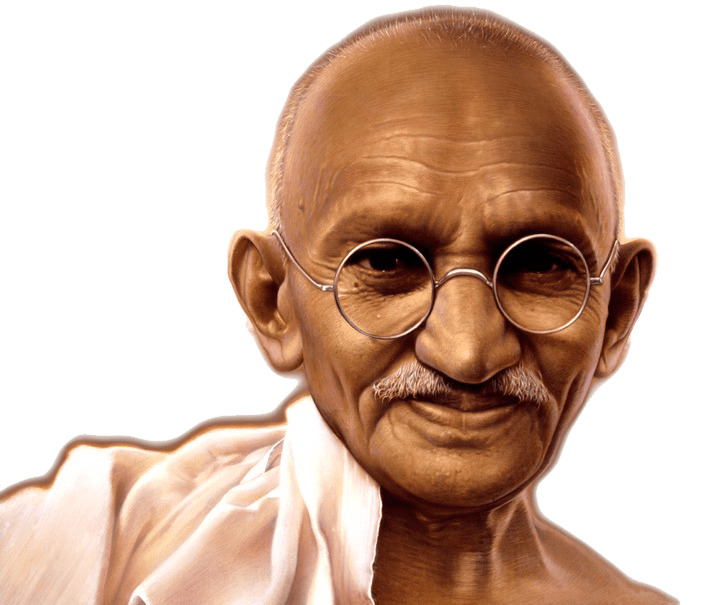
The famous Mohandas Karamchand Gandhi, who lived from 1869-1948, was sometimes described as a politician, though he never held any governmental office nor did he present himself as representing any particular political party. He has perhaps more accurately been described as a political ethicist and political thinker, yet first and foremost he was a philosopher; one who applied practical philosophical thought to every area and aspect of individual and collective life. His connection with Theosophy, and the lasting beneficial influence it had on him from his young adulthood, during which time he also met H. P. Blavatsky, is summarised in Gandhi on Blavatsky and Theosophy.
Gandhian philosophy is constituted of four main principles which have been called the four pillars of Gandhian thought. These are Satya (Truth), Ahimsa (Non-Violence), Sarvodaya (Non-Violent Social Transformation, sometimes also called Non-Violent Socialism; not in the sense of what the world knows of as political socialism, but true spiritual socialism, which belongs neither to left nor right wing, nor to the political centre, but which is the application of Universal Brotherhood and the principles of Ageless Wisdom to human society and collective life; for more on this, see The Social Vision of H. P. Blavatsky and Theosophy), and Satyagraha (literally meaning “Truth-Force,” also called “Soul-Force,” but manifesting primarily as Non-Violent Resistance). The following is just a small sample of Gandhi’s clear and inspiring words on the supremacy, necessity, pursuit, and practical application of Satya or Truth.
““The path of truth is for the brave alone, never for a coward.” I realize the significance of this poem [i.e. by Pritamdas, 18th century Gujarati poet] more and more as days pass. . . . This path has always been for the brave because a much greater effort is required to go up the steep slope of truth than to climb the Himalayas. If at all, therefore, we want to work in this direction and serve ourselves, we should give the first place to truth and march forward with unshakable faith in it. Truth is God.” (July 1920)
“Beyond these limited truths, however, there is one absolute Truth which is total and all-embracing. But it is indescribable because it is God. Or say, rather, God is Truth. All else is unreal and false. Other things, therefore, can be true only in a relative sense.
“He, therefore, who understands truth, follows nothing but truth in thought, speech and action, comes to know God and gains the seer’s vision of the past, the present and the future. He attains moksha though still encased in the physical frame. . . . One who always follows truth is never guilty of untruth in word or deed even unknowingly. In fact such a person becomes incapable of acting in this manner. According to this definition, I certainly lapsed from truth. My only consolation is that I never claim anything beyond a sincere endeavour to keep the vow of truth. It never happens that I tell a lie deliberately. . . . I am not beyond indulgence in unconscious exaggeration or self-praise or taking interest in describing my achievements. There is a shade of untruth in all these and they will not stand the test of truth. A life wholly filled with the spirit of truth should be clear and pure as crystal. Untruth cannot survive even for a moment in the presence of such a person. . . . The most difficult vow to keep is the vow of truth. . . . When somebody utters a lie before me, I get more angry with myself than with him because I then realize that untruth still exists somewhere deep in me. . . .
“This path is for the brave alone; the timid had better not tread it. He who strives for all the twenty-four hours of the day ever meditating on truth, . . . will certainly have his whole being filled with truth. And when the sun of truth blazes in all its glory in a person’s heart, he will not remain hidden. . . . Or, rather, every word uttered by him will be charged with such power, such life, that it will produce an immediate effect on the people. . . . Truth cannot exist without love. Truth includes non-violence, brahmacharya, non-stealing and other rules. It is only for convenience that the five yamas [i.e. non-violence, truth or truthfulness, non-stealing, continence/celibacy, and non-possessiveness, in the Yoga Sutras of Patanjali] have been mentioned separately.” (November 1921)
“Out of Truth emerge love and tenderness. A votary of Truth, one who would scrupulously cling to Truth, must be utterly humble. His humility should increase with his observance of Truth. . . . He who has achieved such extinction of the [personal] ego becomes the very image of Truth; he may well be called the Brahman [i.e. the Absolute, the Infinite, the One Reality, Parabrahm, the Supreme One SELF].” (March 1922)
“Bear ill will to none, do not say an evil thing to anyone behind his back, above all ‘to thine own self be true,’ so that you are false to no one else. Truthful dealing even in the least little things of life is the only secret of a pure life.” “A pure heart enables one to find and see truth. Every one of us therefore must aim after purity of heart. All else follows as a matter of course.” (December 1925, April 1926)
“I see truth every day clearer and clearer. The process through which the soul has been passing is an effort of the heart. The intellect has been hooked to its service by prayer, meditation and constant watchfulness which are essentially matters of the heart and which have been the predominant factors that have contributed to the growing revelation of truth. I have never felt that whatever knowledge has been gained was imposed from without but that it has come from within. It has been an unfolding, drawing out or perhaps better still removing the hard and ugly crusts that overlay the truth that is within us. In other words, the process has been one of self-purification.” (April 1926)
“If God who is indefinable can be at all defined, then I should say that God is TRUTH. It is impossible to reach HIM, that is, TRUTH, except through LOVE. LOVE can only be expressed fully when each man reduces himself to a cipher [i.e. zero or nought]. This process of reduction to cipher is the highest effort man or woman is capable of making. It is the only effort worth making, and it is possible only through ever-increasing self-restraint.” (June 1927)
“The word satya is derived from sat, which means that which is. Satya means a state of being. Nothing is or exists in reality except Truth. That is why sat or satya is the right name for God. In fact it is more correct to say that Truth is God than to say that God is Truth. But as we cannot do without a ruler or general, the name God is and will remain more current. On deeper thinking, however, it will be realized that sat or satya is the only correct and fully significant name for God.
“And where there is Truth, there also is knowledge which is true. Where there is no Truth, there can be no true knowledge. That is why word chit or knowledge is associated with the name of God. And where there is true knowledge, there is always ananda, bliss. There sorrow has no place. And even as Truth is eternal, so is the bliss derived from it. Hence we know God as Sat-chit-ananda, one who combines in Himself Truth, knowledge and Bliss.
“Devotion to this Truth is the sole justification for our existence. All our activities should be centred in truth. Truth should be the very breath of our life. When once this stage in the pilgrim’s progress is reached, all other rules of correct living will come without effort, and obedience to them will be instinctive. But without Truth it is impossible to observe any principles or rules in life.
“Generally speaking, observance of the law of Truth is understood merely to mean that we must speak the truth. But we in the Ashram should understand the word satya or Truth in a much wider sense. There should be Truth in thought, Truth in speech and Truth in action. To the man who has realized this truth in its fullness, nothing else remains to be known, because all knowledge is necessarily included in it. . . .
“But how is one to to realize this Truth, which may be likened to the philosopher’s stone or the cow of plenty? By abhyasa, single-minded devotion, and vairagya, indifference to all other interests in life – replies the Bhagavad Gita [i.e. in Chapter 6, v. 35; this pairing – sometimes likened in Hinduism to a pair of wings, both of which are necessary in order to fly – is also mentioned by Patanjali in I:12-16]. Even so, what may appear as truth to one person will often appear as untruth to another person. But that need not worry the seeker. Where there is honest effort, it will be realized that what appear to be different truths are like the countless and apparently different leaves of the same tree. Does not God Himself appear to different individuals in different aspects? Yet we know that He is one. But Truth is the right designation of God. Hence there is nothing wrong in every man following Truth according to his lights. Indeed it is his duty to do so. . . . the quest of Truth involves tapascharya, self-suffering, sometimes even unto death. There can be no place in it even a trace of self-interest. In such selfless search for Truth, nobody can lose his bearings for long. Directly he takes to the wrong path he stumbles, and is thus redirected to the right path. Therefore the pursuit of Truth is true bhakti,devotion. Such bhakti . . . is the path that leads to God. There is no place in it for cowardice, no place for defeat. It is the talisman by which death itself becomes the portal to life eternal.” (July 1930)
“Do you remember my definition of God? Instead of saying that God is Truth, I say that Truth is God. I did not always think thus [i.e. he had previously thought and said it the other way round, that “God is Truth.”]. I realized this only four years ago. . . . This Truth is not a material quality but is pure consciousness. That alone holds the universe together.” (March 1932)
“He alone is a lover of truth who follows it in all conditions of life. Nobody is forced to tell lies in business or in service. One should not accept a job which does so, even if one starves in consequence.” (June 1932)
“If we follow truth today in solving the problems which confront us in our daily life, we shall know instinctively how to act in difficult situations when they arise. . . . Each of us should examine only himself or herself from this point of view. Do I deceive anybody knowingly? If I believe that B is a bad person but show him that I believe him to be good, I deceive him. Do I try to show, in order to win people’s respect or esteem, that I possess certain virtues which in fact I do not possess? Do I exaggerate in my speech? Do I hide my misdeeds from persons to whom I should confess them? If a superior or co-worker puts me any question, do I evade him? Do I keep back what I ought to declare? If I do any of these things, I am guilty of untruth. Everybody should examine his conduct daily in this manner and try to overcome his shortcomings. . . . Anybody who follows this practice even for a month will clearly observe a change having taken place in himself.” (July 1932)
“Dharma, i.e. religion in the highest sense of the term, includes Hinduism, Islam, Christianity, etc., but is superior to them all. You may recognize it by the name of Truth, not the honesty of expedience but the living Truth that pervades everything and will survive all destruction and all transformation.” (quoted by B. P. Wadia in “The Gandhian Way” p. 25)
TRUTH AND BOOKS
“Truth is not a man, nor a book, nor a statement. The nature of Truth is universal; its possessors in any degree will be found to be appliers of universality in thought, speech and action. Their efforts will be for humanity regardless of sex, creed, caste or color. They will never be found among those claiming to be the chosen spokesman of the Deity – and exacting homage from their fellow-men: true Brotherhood includes the least developed as well as the very highest. We must seek to give aid to all in search of truth. Our value and aid in this great work will be just what we make them by our motive, our judgment, our conduct.” (Robert Crosbie, “The Friendly Philosopher” p. 363)
“There must be within the man something which he already knows, that leaps up and out when he scans the books of wisdom; a thing already existing, which only takes an added life or confirmation from books. True Theosophy has all that is practical, but many forget this; there is no greater system of practice than that required by it.” (William Q. Judge, “Answers to Questioners”)
“Books are not the final source of Self-Knowledge. That is in the Self. But how to get at that final source? Philosophy, even esoteric, is got from the books, as a starting point. The very essence of work at the Shravaka [i.e. “listener,” the initial stage of esoteric development] stage in this cycle depends on books, and the Textbook of the century – The Secret Doctrine.” (B. P. Wadia, “Extracts from Unpublished Letters”)
“I repeat then, that though the true doctrine disappears for a time from among men it is bound to reappear, because first, it is impacted in the imperishable center of man’s nature; and secondly, the Lodge forever preserves it, not only in actual objective records, but also in the intelligent and fully self-conscious men who, having successfully overpassed the many periods of evolution which preceded the one we are now involved in, cannot lose the precious possessions they have acquired.” (William Q. Judge, “The Ocean of Theosophy” p. 12)
FROM “GEMS FROM THE EAST” COMPILED BY H. P. BLAVATSKY
“Like oil, truth often floats on the surface of the lie. Like clear water, truth often underlies the seeming falsehood.” (15th February)
“Daily practical wisdom consists of four things: – To know the root of Truth, the branches of Truth, the limit of Truth, and the opposite of Truth.” (28th February)

“There is more courage in facing the world with undisguised truth, than in descending into a wild beast’s den.” (26th May)
“It is not necessary for truth to put on boxing-gloves.” (29th June)
“You cannot build a temple of truth by hammering dead stones. Its foundations must precipitate themselves like crystals from the solution of life.” (30th June)
“The pure soul is a river whose holy source is self-control, whose water is truth, whose bank is righteousness, whose waves are compassion.” (24th August)
~ * ~
“To the student of Theosophy his [i.e. Gandhi’s] doctrines and ideas are of great value – they reveal most unmistakably Gandhiji’s place in the Theosophical Movement. To participate intelligently in the work of applying Gandhiji’s ideas and teachings to India’s problems as to world problems, the student of Theosophy must familiarise himself with the principles of Gandhian philosophy. He is, in one way, better equipped to understand and explain that philosophy because of his own Theosophical knowledge. . . . Because the Theosophical Movement is wider than any Theosophical organisation it is not only legitimate but necessary that Gandhiji’s place in that Movement as also the influence of his teachings on that Movement is accurately evaluated.”
(B. P. Wadia, “Gandhian Philosophy and Theosophy,” “The Gandhian Way” p. 15-16, 19)
This article may have raised more questions about various things. Please make use of the site search function (the magnifying glass symbol at the top of the page) and visit the Articles page to see the complete list of over 300 articles covering all aspects of Theosophy and the Theosophical Movement. Some articles closely related to this one have already been linked to above.
~ BlavatskyTheosophy.com ~
 T H E O S O P H Y