
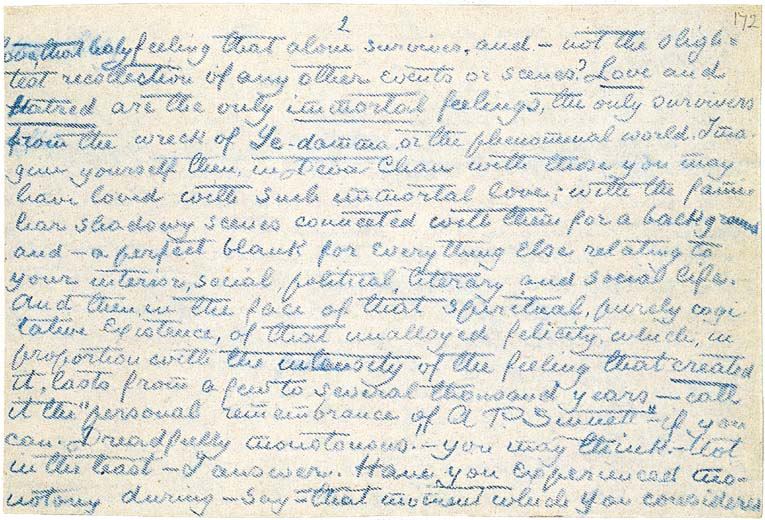
Like many students of Theosophy, we have no doubt that the letters which were published a century ago in such books as “The Mahatma Letters” and “Letters from The Masters of The Wisdom” originate with the Masters. But originating with the Masters is not necessarily the same as being directly written by the Masters Themselves, nor even necessarily being formulated in rough draft by the Masters beyond the briefest and most basic of outlines.
We have included below many statements from H. P. Blavatsky and the Master K.H. or Koot Hoomi which clearly assert this to generally be the case. We say “generally” because, as they explain, there were rare exceptions in which the Masters wrote and literally penned the letters Themselves. But this is said to be a very special occurrence.
We need to be aware of this, otherwise we may easily misrepresent to others, as to ourselves, what the Mahatma Letters actually are. Though sanctioned by and written at the behest of Masters, they are rarely the actual words of Masters. And also, as we will see, it is not even always the case that the words have been reviewed and approved by the Masters before their sending. Being the most extremely and unimaginably busy people on Earth, we could hardly expect Them to always do so. Technically, what we call “Mahatma Letters” are thus most often “Chela Letters,” i.e. letters written by chelas (disciples) at their Guru’s request.
While some Theosophists do not attach enough importance to the Mahatma Letters, others could be said to attach too much importance, elevating them into a type of perfect and infallible sacred writ, with each page pored over by the Mahatma himself at his writing desk. These letters are magnificent, precious, sacred, and valuable enough without us needing to make them even greater by falling – unwittingly, or occasionally knowingly – into exaggerations.
~ * ~
“All those who have received such communications being nearly all sincere . . . the Masters . . . could not spurn you off and refuse answering you, if not Themselves, then by ordering a Chela to satisfy the addressers to the best of his or hers [the chela’s] ability. How many a time was I – no Mahatma – shocked and startled, burning with shame when shown notes from Chelas exhibiting mistakes in science, grammar, and thoughts expressed in such language that it perverted entirely the meaning originally intended, and having sometimes expressions that in Thibetan, Sanscrit, or any other Asiatic language had quite a different sense. . . .
“It is very rarely that Mahatma K. H. dictated verbatim, and when He did there remained the few sublime passages found in Mr. Sinnett’s letters from Him. The rest – he would say – write so-and-so, and the Chela wrote often without knowing a word of English, . . .
“I have told you the truth, the whole truth, and nothing but the truth, so far as I am allowed to give it. Many are the things I have no right to explain if I had to be hung for it. Now think for one moment. Suppose _____ receives an order from his Master to precipitate a letter to the _____ family, only a general idea being given to him about what he has to write. Paper and envelope are materialized before him, and he has only to form and shape the ideas into his English and precipitate them. What shall the result be? Why his English, his ethics and philosophy – his style all round. . . .
“Now [for a disciple of the Masters, in this case HPB] to send on a letter [from someone to the Masters] two or three processes are used: (1) To put the envelope sealed on my forehead, and then, warning the Master to be ready for a communication, have the contents reflected by my brain carried off to His perception by the current formed by Him. This, if the letter is in a language I know; otherwise, if in an unknown tongue, (2) to unseal it, read it physically with my eyes, without understanding even the words, and that which my eyes see is carried off to Master’s perception and reflected in it in His own language, after which, to be sure, no mistake is made. I have to burn the letter with a stone I have (matches and common fire would never do), and the ashes caught by the current become more minute than atoms would be, and are rematerialized at any distance where Master was. . . .
“It is my heart’s desire to be rid forever of any phenomena but my own mental and personal communication with Masters. I shall no more have anything to do whatever with letters or phenomenal occurrences. This I swear on Masters’ Holy Names, and may write a circular letter to that effect.
“Please read the present to all, even to _____. FINIS all, and now Theosophists who will come and ask me to tell them so and so from Masters, may the Karma fall on their heads. I AM FREE. Master has just promised me this blessing!!” (“H. P. Blavatsky on Precipitation and Other Matters”)
Regarding the stone mentioned in the above, more light is shed on it in a letter from HPB published in the Appendix to “The Mahatma Letters” p. 471:
“The letter must be opened and then burnt with what we call virgin fire (lit neither with matches, brimstone nor any preparation but rubbed with a resinous, transparent little stone, a ball that no naked hand must touch.”
Compare this with William Judge’s instructions to Ernest Hargrove, after Hargrove had removed – at Judge’s direction – various sacred and secret items from a private room used only by Judge, at the very top of the then-headquarters of the Theosophical Society in New York: “The yellow stone in the little filagree box is not to be handled. Tell the Gs [Griscoms] if they have it.” (Letter dated 29th January, 1896, published by Hargrove in “Theosophical Quarterly” in the 1930s, and more recently in “The Judge Case” Book II, p. 290)
This is intriguing and suggestive evidence in support of William Q. Judge acting as a genuine and knowledgeable transmitter of letters to – and from – the Mahatmas, particularly in the years following the passing of HPB, a claim which he made publicly only after extended persecution for it by Annie Besant and Col. Olcott, who were aware of Judge’s private actions in this regard and considered it fraudulent. But, having a proper sense of the sacred, there were many things – such as the abovementioned yellow stone – which Judge would not and could not make public or even share anything about with more than just a handful of his very closest colleagues. We mentioned that, knowing his life was quite probably drawing to an end, and being away at that time from New York, he asked Ernest Hargrove to remove items, including that stone, from a private room. More specifically, he wrote:
“There is a small room on the top story of 144 [Madison Avenue] which has a Yale lock. In it are the following: . . . Now then: I want to give up the room to the Trustees. Take large sheets of wrapping paper and twine (Look out for ____’s curiosity). Do up the old robe and ask Griscoms (Mrs.) to take charge of it for me. Nobody knows what’s in the room, no matter what they may suspect; so don’t tell them.” (republished in “The Judge Case” Book II, p. 288)
Also of interest in those two excerpts is the importance of and the great occult trust accorded by WQJ to the Griscoms, namely Clement Acton Griscom and his wife Genevieve Ludlow Griscom, and especially the latter, as she was the one who he specified should “take charge of . . . the old robe,” whatever that may be. Just two years later, Genevieve – usually writing under the pseudonym of Cavé – would assume, in a very anonymous way, the most important role in the Esoteric School in the reformed “Theosophical Society in America” (not to be confused with the Adyar-affiliated “Theosophical Society in America” of the present day) which later renamed itself as simply The Theosophical Society. For an extensive exploration of the latter, please see The Forgotten Theosophical Society.
“And, no doubt when K. H. writes naturally [i.e. using solely his own knowledge and ability in English, without utilising any occult means of letter production], then Mr. Hume can write better than he does. So can you. But let him try to run a race not with K. H. but with a simple chela when a writing or letter is really phenomenally produced and then he will be nowhere.” (HPB, “The Letters of H. P. Blavatsky to A. P. Sinnett” p. 32)
“Another of our customs, when corresponding with the outside world, is to entrust a chela with the task of delivering the letter or any other message; and if not absolutely necessary — to never give it a thought. Very often our very letters — unless something very important and secret — are written in our handwritings by our chelas. Thus, last year, some of my letters to you were precipitated, and when sweet and easy precipitation was stopped — well I had but to compose my mind, assume an easy position, and — think, and my faithful “Disinherited” [i.e. a name applied to Djwhal Khul or Juala Khool, etc., a chela or disciple of K.H.] had but to copy my thoughts, making only occasionally a blunder. Ah, my friend, I had an easy life of it . . . Anyhow, this year, for reasons we need not mention, I have to do my own work — the whole of it, and I have a hard time of it sometimes, and get impatient over it.” (Master K.H., “The Mahatma Letters” p. 296)
“Hübbe Schleiden . . . says, that unless I explain how it is that such a similarity is found and proven by Hodgson between my faulty English and Mah. K.H.’s certain expressions, the construction of sentences and peculiar Gallicisms — I stand accused for ever of deceit forgery (!!) and what not. . . .
““Difference in handwritings” [i.e. a reference to German Theosophist Hubbe Schleiden’s suspicion over the fact that some Mahatma Letters signed by one and the same Master are written in quite different and sometimes completely different handwriting] — oh the great wonder! Has Master K.H. written himself all His letters? How many chelas have been precipitating and writing them — heaven only knows. Now if there is such a marked difference between letters written by the same identical person mechanically, (as the case with me for instance who never had a steady handwriting) how much more in precipitation, which is the photographic reproduction from one’s head, and I bet anything that no chela (if Masters can) is capable of precipitating his own handwriting twice over in precisely the same way — a difference and a marked one there shall always be, as no painter can paint twice over the same likeness. . . . Now all this shall be easily understood by theosophists (not all) and those who have thought over deeply and know something of the philosophy. Who shall believe all I say in this letter outside of the few? No one. And yet, I am demanded an explanation . . . Yet you have to show at least one thing: occult transactions, letters handwriting etc. cannot be judged by the daily standard, experts, this that and the other.” (HPB, Appendix to “The Mahatma Letters” p. 479-480)
“But now, I have to ask you to read the passages as they were originally dictated by me, and make the comparison with the Occult World [i.e. A. P. Sinnett’s first book, in which were transcribed excerpts from Mahatma Letters he had received; more were transcribed in his later book “Esoteric Buddhism”] before you.
“I transcribe them with my own hand this once, whereas the letter in your possession was written by the chela. I ask you also to compare this handwriting with that of some of the earlier letters you received from me.” (Master K.H., “The Mahatma Letters” p. 424)
“In noticing M⸫’s opinion of yourself expressed in some of his letters — (you must not feel altogether so sure that because they are in his handwriting, they are written by him, though of course every word is sanctioned by him to serve certain ends) — you say he has “a peculiar mode of expressing himself to say the least.” Now, that “way” is simply the bare truth, . . .” (Master K.H., “The Mahatma Letters” p. 232)
An example of how the process can go wrong, referring specifically in this case to the Mahatma Letter which led to the so-called “Kiddle incident”:
“The letter in question was framed by me while on a journey and on horseback. It was dictated mentally, in the direction of, and “precipitated” by, a young chela not yet expert at this branch of Psychic chemistry, and who had to transcribe it from the hardly visible imprint. Half of it, therefore, was omitted and the other half more or less distorted by the “artist.” When asked by him at the time, whether I would look it over and correct I answered, imprudently, I confess — “anyhow will do, my boy — it is of no great importance if you skip a few words.” I was physically very tired by a ride of 48 hours consecutively, and (physically again) — half asleep. Besides this I had very important business to attend to psychically and therefore little remained of me to devote to that letter. It was doomed, I suppose. When I awoke I found it had already been sent on, and, as I was not then anticipating its publication, I never gave it from that time a thought.” (Master K.H., “The Mahatma Letters” p. 422)
“The [Mahatma] letters certainly need a commentary, . . . Think of any letters of that period — say the letters of Gladstone— being read without knowledge of what provoked them, or of the political, scientific and theological problems of his contemporaries! For one thing, the Mahatma letters must remain incomprehensible unless recognized as combative, and unless we know what it was they were combatting.” (“On The Screen of Time,” “Theosophical Quarterly” October 1924)
“These letters should not have been published. They were not written for publication, and in one of them the writer states explicitly that neither he nor his “Brother” would allow their publication at any time. Both morally and legally, letters are the property of their authors, not of the recipients, and it is dishonourable in the extreme to override this basic principle of conduct.
“The compiler pleads in his Introduction that their publication today may be excused because of “the present impasse in the affairs” of the Adyar Society. In plain language this means that he wants to open the eyes of those who believe in the infallibility of Mrs. Besant and of Mr. Leadbeater; which is no excuse. People who are capable of such a belief are better off with their eyes closed in any case. The compiler’s error, probably well meant, is part of the Karma of Mrs. Besant’s publication, years ago, of documents she had pledged herself to keep secret.
“The letters themselves, written between 1880 and 1884, are a weird but fascinating jumble. . . . [In producing the letters] the fortunate chela would . . . have to discover as best he could what his Master really wanted him to write, the result occasionally being a letter which now fills ten or more pages of solid type. Further, some of these letters were dictated interiorly to chelas who did not know a word of English. Words and whole sentences were omitted, and the punctuation is positively wild. . . .
“One gratifying result of the jumble will be that even the most superstitious, even the laziest – those who will not think for themselves – could not turn these letters into a new infallibility. Of all things, the Masters would deplore that most, and that, in any case, they will be spared.
“On the other hand these letters are simply invaluable. Genuine? Of course they are genuine! The great heart of the Lodge beats through all of them. They contain instruction for which every student should be grateful. . . . Nothing new, nothing startling, but – the bread of life. . . .
“Finally, while we have always revered Madame Blavatsky, the reading of these letters has renewed in us and, if possible, has increased, the realization of her heroism, of her selfless devotion, of her unconquerable zeal. What she endured at the hands of Olcott, Sinnett, Hume and others, we can only imagine; and yet this must have been as nothing in comparison with the attacks of those who were consciously arrayed against her Master and her Cause. Whatever her defects – and it is impossible to sympathize with all the works of a tornado – she was superb. That so many despised and condemned her was due in large measure to the fact that she was too honest, too humble, and too big, for the world in which she lived.” (Review by T. – a pen name of Ernest Temple Hargrove – of “The Mahatma Letters to A. P. Sinnett,” “Theosophical Quarterly” July 1924)
Hargrove is referring to the following passage, written in the summer of 1884 by the Master K.H. – or, as we’ve now seen amply above, more likely by a chela (disciple) under the Master’s general or specific direction – in response to an idea by Sinnett to publish as a book an unedited compilation of all the Mahatma Letters he had received. Ironically, we have to turn to the book “The Mahatma Letters” in order to learn that the Masters never wished such a book as “The Mahatma Letters” to be published and were in fact strongly against the idea of such a project.
“When our first correspondence began, there was no idea then of any publications being issued on the basis of the replies you might receive. You went on putting questions at random, and the answers being given at different times to disjointed queries, and so to say, under a semi-protest, were necessarily imperfect, often from different standpoints. When the publication of some of these were permitted for the Occult World, it was hoped that among your readers some may be able, like yourself, to put all the different pieces together and evolve out of them the skeleton, or a shadow of our system, which, although not exactly the original – this would be an impossibility – would be as near an approach to it as could be made by a non-initiate. But the results have proved quasi-disastrous! We had tried an experiment and sadly failed! Now we see that none but those who have passed at least their third initiation are able to write upon those subjects comprehensively. . . . The Secret Doctrine will explain many things, set to right more than one perplexed student.
“Therefore, to put before the world all the crude and complicated materials in your possession in the shape of old letters, in which, I confess, much was purposely made obscure, would only be making confusion worst confounded. Instead of doing any good thereby to yourself and others it would only place you in a still more difficult position, bring criticism upon the heads of the “Masters” and thus have a retarding influence on human progress and the T.S. Hence I protest most strongly against your new idea. Leave to the Secret Doctrine the task of avenging you. My letters must not be published, in the manner you suggest, . . . The letters, in short, were not written for publication or public comment upon them, but for private use, and neither M. nor I will ever give our consent to see them thus handled.” (“The Mahatma Letters” p. 357)
What each Theosophical student does, if anything, with “The Mahatma Letters,” is up to them. As the book has already been published and contains no teachings which could be considered “secret” or “confidential,” there seems no reason why students who have the book should not continue to read and study it by themselves privately if they feel so inclined, nor why those who feel a wish to acquire the book should not do so. We say “privately” because in light of the Masters’ stated wishes, we feel it would not be a good thing to hold “Mahatma Letters” study classes, lectures, or seminars for example. But for some Theosophists – especially those serious and devoted students who feel an aspiration towards chelaship or discipleship – it may and often does prove truly informative and beneficial. It would be wrong to tell anyone that they “should not” read “The Mahatma Letters” or to dampen their enthusiasm for the book.
True, unless the Masters have dramatically altered Their perspective about it since 1884 (and that is of course a possibility, especially when one considers the major developments and desperate needs that have arisen in both the Theosophical Movement and the world at large since that time, although the wording was very definite) the book ought not to have been published. But one cannot justifiably complain about its publication whilst also availing oneself of its publication by buying it, studying it, deriving inspiration and benefit from it, etc. It is too late in the day to undo what has been done. But, without any hypocrisy or self-righteousness, one can – while remembering the Mahatma’s words to Sinnett in Summer 1884 – practise for oneself and try to encourage in others a truly respectful, reverential, and restrained attitude and approach to the reading, discussing, and publicising of the book. Respectful and well-informed usage of the book, particularly when accompanied with an attitude of reverence and humility towards its Authors, can hardly be discouraged.
~ * ~
This article may have raised more questions about various things. Please make use of the site search function (the magnifying glass symbol at the top of the page) and visit the Articles page to see the complete list of over 400 articles covering all aspects of Theosophy and the Theosophical Movement. You may particularly be interested in those listed under the heading “THE MASTERS.”
~ BlavatskyTheosophy.com ~
 T H E O S O P H Y